
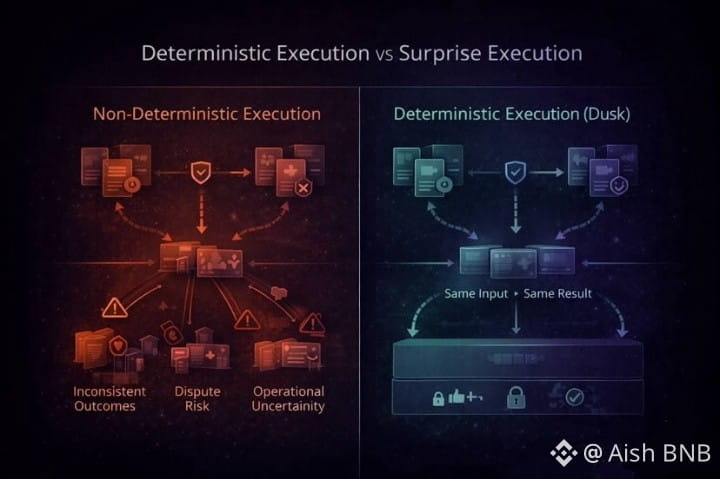
Crypto projects love storytelling—what they're gonna build, the killer apps coming soon, the moonshot vision. It's easy to hype. What's hard (and what actually matters for anything touching real money) is boring, repeatable execution: does the system do exactly the same thing every single time, no surprises, no "it worked on my machine but not yours" bullshit. Banks, exchanges, regulators—they don't care about your roadmap slide deck. They care if the engine behaves identically across every node, under stress, under load, under attack. Inconsistency isn't a bug in consumer apps; it's a catastrophe in financial infra. Two nodes giving different outputs on the same input? You don't have a market anymore. You have chaos.
Dusk gets this at a bone-deep level. They're not positioning as an "app platform" first. They're building a deterministic execution engine first, everything else layered on top. That mindset shows in everything.
Rusk: The Core Runtime That Actually Runs the Show
Forget the usual "node software = networking + gossip" stuff. Rusk is the execution heart of Dusk—the VM/runtime where confidential smart contracts live and breathe. Public repo, anyone can run it locally, test behavior, contribute. The team treats non-determinism as a critical defect, not a "nice to have fixed someday." Dev updates literally mention hunting down non-deterministic behavior in test blocks, fixing prover quirks. This isn't marketing fluff; it's engineering priority #1.
Why does this matter so much? Privacy + compliance + complex assets (tokenized securities, regulated RWAs) only work if the runtime is rock-solid deterministic. If the chain sometimes disagrees with itself, your ZK proofs become meaningless, your confidential txs become disputable, your "auditable privacy" becomes "who knows what really happened." Dusk refuses to let that gap exist. Rusk enforces discipline so the proof system and runtime stay in perfect sync.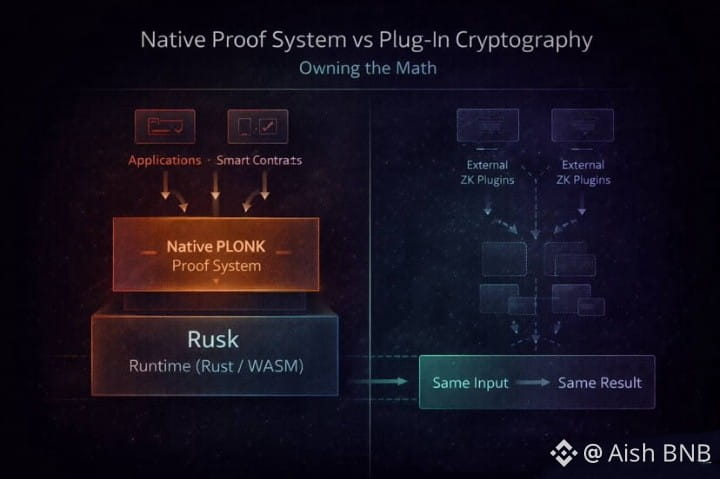
Rust-Native + WASM Path + DuskEVM (Not All Eggs in One Basket)
Most chains scream "EVM compatible!" like it's the only path. Dusk has DuskEVM (modular, shares security/settlement with base layer), but they also push hard on native Rust/WASM execution. Official ABI crate for Rusk VM, host modules, tooling geared toward systems-level languages. This is deliberate: Rust for performance-critical, low-level stuff where determinism is life-or-death; EVM tooling for easier app porting. No single-language lock-in, no "we'll rewrite everything later." The settlement layer stays stable while execution environments can evolve safely.
Owning the Proving Stack (Pure Rust PLONK, Not Leasing Someone Else's)
Most projects grab an external ZK system, tweak it, pray. Dusk built their own pure-Rust PLONK implementation (BLS12-381 curve, KZG10 commitments, custom gates for efficiency). Audited, actively maintained, repo still getting updates. Why own it? You control trade-offs—performance, constraint tuning, exact fit to your runtime. For institutions, cryptography isn't a plugin; it's core risk. Owning the stack means you own the risk model. No "the prover library broke compatibility, oops."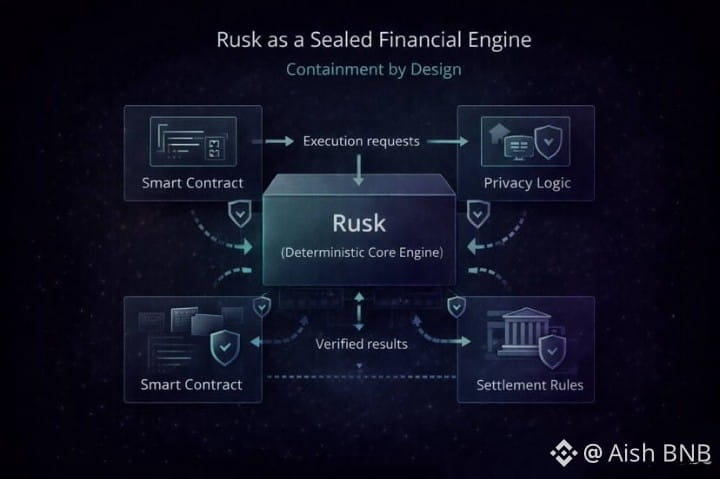
Modularity as Safety, Not Just Speed
Crypto sells modularity as "scale harder." Dusk treats it as a safety mechanism. DuskDS (settlement layer) is the unchanging truth engine. Execution environments (Rusk native, DuskEVM) plug in as modules. Change one without rewriting the core rules. Upgrades become surgical, not nuclear. Reduces blast radius of mistakes. In regulated finance, that's not nice-to-have; that's mandatory.
The Unsexy Checklist That Makes Dusk Serious
Strip away the branding, and Dusk's edge is a boring list:
- Reference node (Rusk) that's runnable and contributor-friendly.
- Non-determinism treated as high-priority bug class.
- Official ABI/tooling for Rusk VM.
- In-house, audited Rust PLONK proving system.
- Modular stack where settlement stays rock-solid.
No flashy apps yet, no meme hype. Just disciplined engineering that screams "we're building for markets that can't afford surprises." 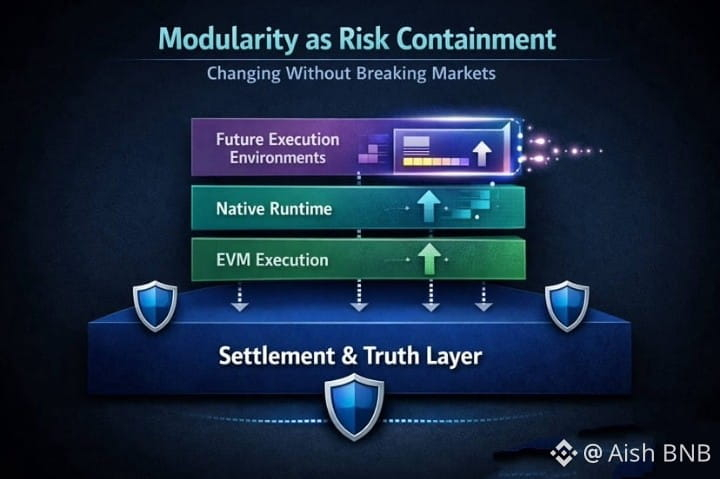
In Karachi 2026, where real finance is still banks and slow wires, but tokenized assets and regulated DeFi are creeping in, this kind of execution discipline is what separates "maybe someday" from "actually usable." Institutions don't bet on vision slides. They bet on systems that behave the same way every time, even when shit hits the fan.
Dusk isn't chasing developer hype. They're chasing boring reliability. And in finance, boring wins long-term.
