
Most people think decentralized storage is just a giant, immortal hard drive floating in the cloud—no one owns it, nothing ever disappears. That's the dream everyone sells. Walrus is not that. It's more like a service contract: you hand over your data for a set time, the network spreads it to a rotating group of storage nodes, and the system gives you clear status updates you can actually check. That's why you hear words like blobs, epochs, committees, certification, challenges instead of vague "forever available" promises.
The big shift here is Walrus isn't passive storage. It lets you see exactly who has your data right now, what happens if they flake, and how to catch anyone trying to cheat. That's what separates a real infrastructure layer from just another file bucket.
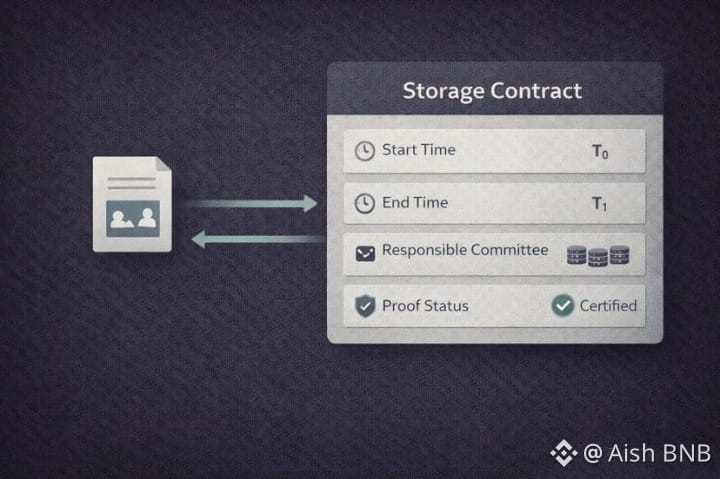
Control Plane: Blockchain Handles the Rules, Not the Data
Walrus keeps the heavy files off the blockchain. The actual blobs live on storage nodes, but the blockchain (Sui) records the proofs: who’s responsible, what rules apply, when epochs change. Every time a file gets stored, its whole lifecycle gets logged on-chain—registered, uploaded, certified, committee changes, etc. Other apps can trust that record instead of relying on some company's dashboard that could lie or go down.
This means you get a credible, public truth about your data without clogging the chain with gigabytes.
Epochs: Time Isn't Vague—It's a Tool
Everything in Walrus runs in epochs—fixed time blocks where a specific set of nodes is responsible for holding the data. At epoch end, the committee rotates: new nodes take over, old ones get rotated out. No one owns your file forever; it's a temporary duty.
Why does this matter? Networks are messy—nodes drop offline, get hacked, go offline for maintenance, partitions happen. Most systems hope for perfect availability and end up burning cash on constant repairs when things inevitably break. Epochs make time visible and predictable. You know exactly when responsibility shifts, when you need to renew or re-upload if needed. No silent degradation where your file quietly rots for months before you notice.
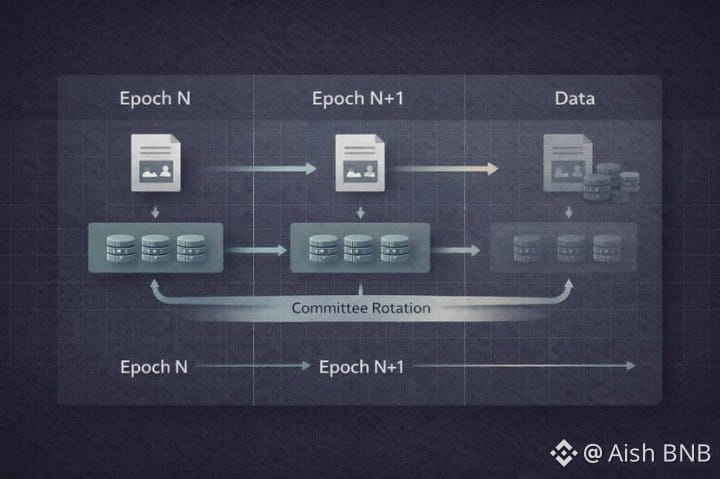
Committees: Clear "Who's Holding My Stuff Right Now?
In most storage networks, you upload and hope. Walrus assigns a committee of nodes for each blob in each epoch. The blockchain logs who they are, tied to staking contracts with $WAL. If a node misbehaves, it's clear who to slash.
This clarity lets you build real things: dashboards showing current committee, alerts if a node drops, auto-renew when epoch ends, or re-upload signals if availability looks shaky. No guessing games.
Certification: The Network Says "Yes, We Got It
Certification is the key moment. Upload finishes, but the file isn't "stored" until the network certifies it—enough slivers are on enough nodes, verifiable via on-chain event or CLI check. That's when you know it's safe for the epoch.
This is huge for apps. Most systems say "uploaded" when your computer finishes. Walrus says "certified" when the decentralized network confirms it. You can build logic around that: wait for certification before minting an NFT, start AI training only on certified datasets, sell access to a blob only after it's certified. Clear states mean cleaner code.
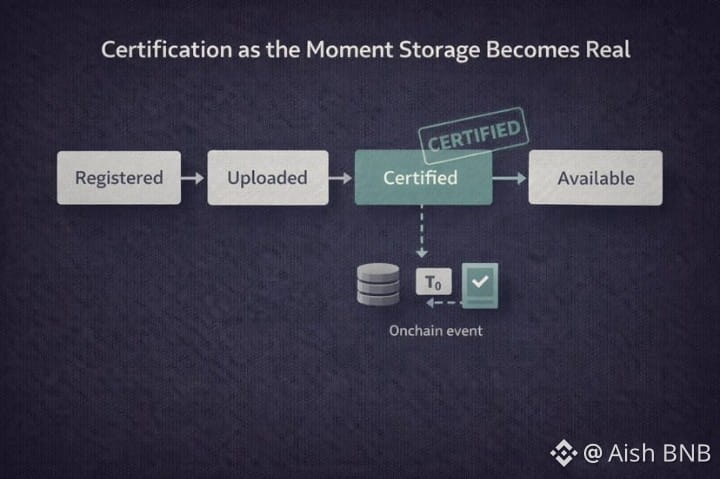
Blob Model: Storage as a Real Contract, Not "Upload and Forget
From the SDK: register blob → upload slivers → pay SUI for tx + $WAL for storage duration + write costs. It's explicit: pay for a time period, get certification, renew or lose it. No "forever" illusion—clear rules, clear costs.
This makes Walrus programmable infrastructure. Devs can price storage, set durations, build around verifiable events.
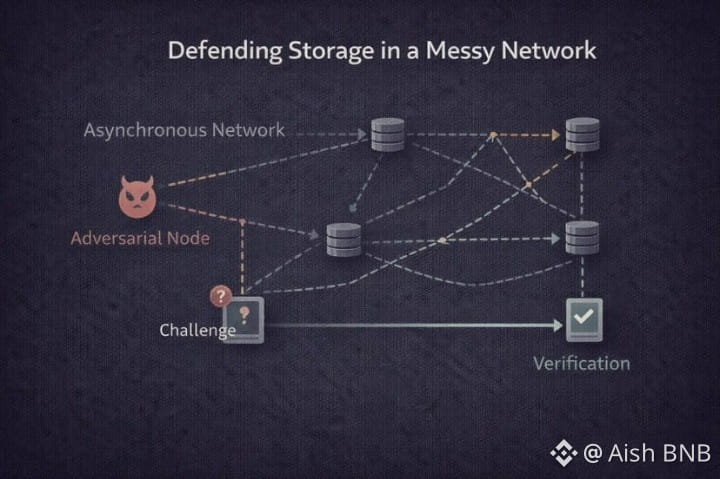
Real-World Security: Handling Messy Networks and Bad Actors
Walrus assumes networks are sloppy and attackers exist. RedStuff + asynchronous challenges protect against delays, partitions, nodes faking availability. Bad clients (uploading junk or trying to spam) get handled with authenticated data structures—ensures what you upload is what comes back, no silent corruption.
This isn't paranoia; it's realism. If you're feeding data to AI, analytics, finance, media—hidden corruption is worse than total loss because it poisons everything built on top.
What This Means for Builders
Clear states (registered, uploaded, certified, current committee, epoch ends) let you write solid logic:
- UI waits for certification before letting users mint or trade.
- AI agents only pull from certified blobs.
- Data markets sell access to provably available, intact files.
- Monitoring tracks committee rotations, flags if availability dips.
You don't have to guess or over-build trust layers. The infra gives you the truth.
**The Quiet Point: Walrus Turns Storage into a Real Service Contract**
The big thesis: Walrus takes decentralized storage and makes it a measurable, verifiable service—not hopeful redundancy. Epochs make time clear, committees make responsibility clear, certification makes "it's safe" clear, challenges and auth structures admit real networks are messy and attackers exist.
That's why serious builders pay attention. It's not "store forever and pray." It's "store with rules you can see, verify, and build on."
In the long run, crypto infra wins by being boring and dependable. Walrus is pushing decentralized storage into that zone: clear ownership, clear timelines, clear proofs, clear accountability. That's the foundation ecosystems actually grow on without constantly reinventing trust.

