
Vanar isn’t trying to be the fastest blockchain or the loudest one in the room.
It’s trying to become something far more foundational: the memory and payment layer of the next digital economy.
While most blockchains obsess over throughput and speculation, Vanar asks a deeper question:
How do we give digital worlds memory, intelligence, and sustainability without breaking scalability or trust?
The answer it proposes is radical, but surprisingly practical.
From Immutable Records to Living Memory
Blockchains today treat data like stone tablets: immutable, heavy, and expensive to store. Vanar flips that idea on its head.
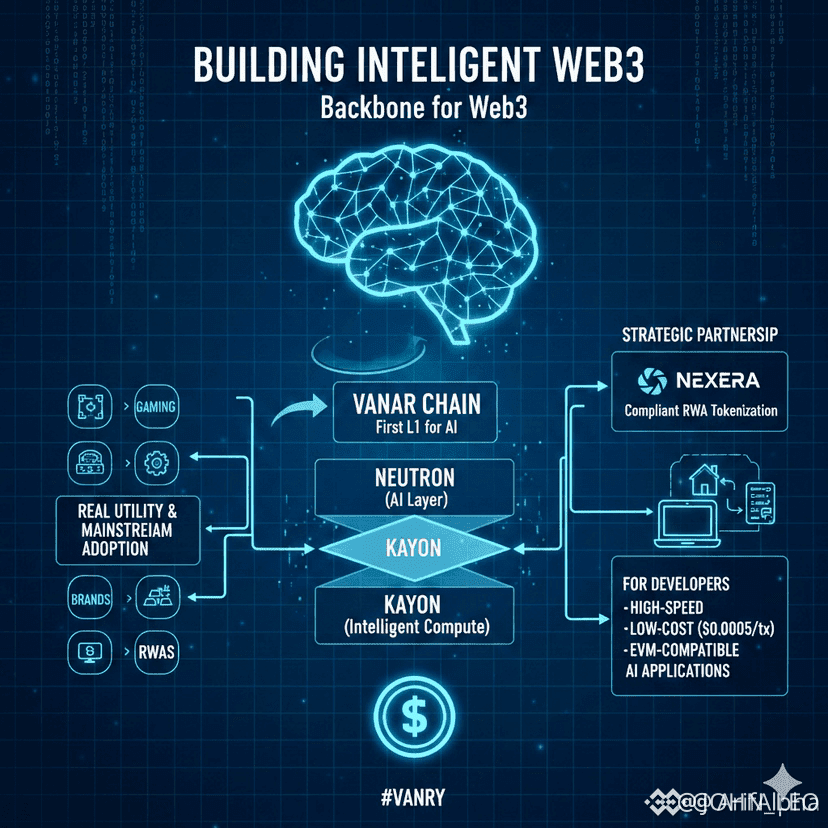
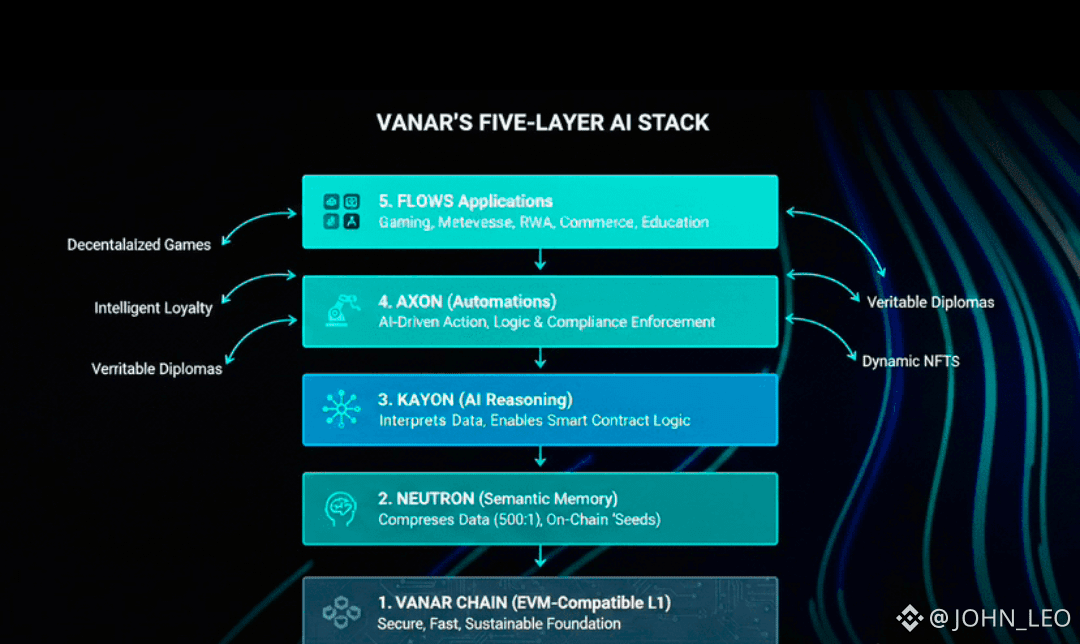
At the core of the network is Neutron, an AI-powered application memory layer. Instead of stuffing rich content media files, game states, behavioral data directly on-chain, Vanar uses AI to compress that information into tiny, verifiable seeds.
Those seeds live on-chain as proof of origin and integrity.
The full content lives off-chain and can be reconstructed on demand.
Think of it this way:
Vanar doesn’t store the book it stores the DNA of the book.
This transforms the blockchain from a storage bottleneck into a memory reference system, capable of supporting games, media platforms, and financial applications without slowing down.
myNeutron: AI Agents With Continuity
This idea comes alive in myNeutron, Vanar’s flagship AI product.
myNeutron isn’t just another chatbot. It’s an AI agent with memory and agency. It remembers what you own, how you interact with apps, and what you’ve done before because it can reference on-chain proofs and past interactions.
Over time, these agents can:
Manage digital assets
Participate in games
Guide users through complex applications
Act autonomously within predefined rules
You can think of myNeutron as a digital servant persistent, aware, and verifiable.
Zoom out, and the implications are massive:
agent-to-agent markets, AI-managed DeFi positions, automated entertainment experiences, and negotiated payments without constant human input.
An Ecosystem Where Data, Value, and Intelligence Flow
Vanar’s ecosystem is deliberately broad. It connects:
Users interacting through AI agents
Validators securing the network
Developers building on an EVM-compatible runtime
Tokenized real-world assets like real estate or carbon credits
Existing Ethereum contracts can be ported easily, while Neutron adds intelligence on top. Off-chain markets connect to on-chain logic, allowing value, data, and decision-making to circulate instead of sitting in silos.
A Pragmatic Path to Decentralization
Vanar doesn’t pretend decentralization magically exists on day one.
Instead, it combines Proof-of-Authority with Proof-of-Reputation.
Early on, trusted validators provide speed and stability. Over time, community members earn validation rights through reputation, behavior, and contribution.
It’s decentralization as a process, not a slogan security first, openness earned.
Fixed Fees, Real-Time Use Cases
Vanar also tackles one of Web3’s most painful problems: unpredictable fees.
Transactions are processed sequentially with a small, fixed fee. No bidding wars. No gas spikes. No timing games.
Blocks are produced every three seconds, making Vanar viable for:
Gaming
Micro-payments
Live digital interactions
This predictability isn’t flashy but it’s essential if Web3 is going to power real economies.
Sustainability by Design, Not Marketing
The network runs on carbon-free infrastructure and offsets remaining emissions. This isn’t branding it’s strategy.
Environmental sustainability reduces friction with institutions, brands, and regulators who increasingly care about ESG compliance. It makes adoption easier, not harder.
Tokenomics Built for Longevity
Vanar’s native token, VANRY, has a capped supply of 2.4 billion.
Around half is minted at launch to support a 1:1 migration from the previous ecosystem token. The rest is released gradually over twenty years.
Distribution follows clear priorities:
Validators securing the network
Developers building the ecosystem
Community incentives
There are no oversized team allocations, and block rewards decrease over time. The design favors slow, healthy growth over short-term speculation.
Bridging Digital Worlds and Physical Economies
Vanar’s roots in the Virtua ecosystem explain its strength in gaming and digital collectibles. Low fees and fast blocks make high-interaction experiences practical.
But the vision goes further.
Vanar positions itself as infrastructure for real-world assets supporting stablecoins, tokenized property, commodities, and AI-driven payment workflows.
Imagine:
AI agents paying energy bills continuously
Fractional real estate ownership managed on-chain
Compliant, automated payments with minimal overhead
With predictable fees, sustainability, and AI integration, these ideas move from theory to execution.
A Modular, Middleware-First Stack
Vanar isn’t trying to be everything it’s trying to connect everything.
Its modular stack includes:
An execution layer for smart contracts
The Neutron AI compression and memory layer
Storage and retrieval systems
Cross-chain bridges to Ethereum, Polygon, and beyond
This makes Vanar less of “another chain” and more of middleware for digital experiences.
Momentum Built on Delivery
Vanar’s growth isn’t loud it’s rhythmic.
Token migration, AI product launches, ecosystem tools, and partnerships arrive in stages. Investor interest follows execution, not hype.
That consistency keeps speculation low and foundations strong.
Why Vanar Matters
Vanar isn’t chasing speed for its own sake.
It’s building inhabited infrastructure systems that remember, reason, and act.
By combining AI-based memory, pragmatic consensus, predictable fees, and sustainability, it tackles both the technical and human limitations of Web3.
There are risks, as with any young network. Adoption, governance, and competition remain open challenges. But Vanar’s focus on practicality over promises sets it apart.
If Web3 is meant to serve real economies, it needs infrastructure that is boring, intelligent, and stable in the best possible way.
Vanar is trying to build exactly that.
