

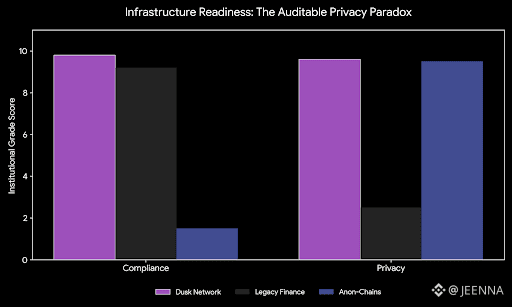
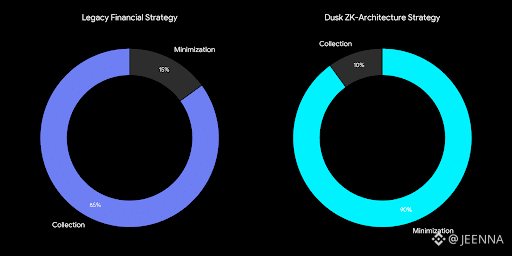
Dusk Network has reached a phase where its long-standing thesis—privacy that works inside regulation rather than against it—is no longer theoretical but operational. With the mainnet live and the protocol stack stabilising, Dusk is shifting from years of foundational engineering into real financial relevance, positioning itself as infrastructure for regulated markets that need confidentiality without sacrificing accountability.
Unlike legacy privacy chains built around absolute anonymity, Dusk’s design acknowledges a structural reality of modern finance: institutions, issuers, and exchanges require privacy at the transaction and settlement layer, but they also require auditability, disclosure pathways, and legal compliance. This is where Dusk’s zero-knowledge architecture becomes meaningful—not as a tool to obscure activity, but as a mechanism to selectively reveal information under predefined regulatory conditions.
Recent progress around confidential smart contracts and EVM compatibility reinforces this direction, lowering the barrier for developers while preserving privacy by default. More importantly, Dusk’s expanding focus on real-world assets signals a clear intent to serve capital markets rather than speculative DeFi loops. The collaboration with regulated financial entities in Europe has reframed Dusk from a “privacy coin” into a settlement layer for tokenized securities, where equities, bonds, and other financial instruments can exist on-chain without exposing sensitive order flow or counterparty data. This approach aligns closely with evolving regulatory frameworks such as MiCA, where compliance is not optional but foundational, and blockchains that cannot accommodate supervision will remain peripheral.
Market volatility around DUSK has drawn attention, but price action is secondary to what is structurally changing: Dusk is building for issuance, trading, and settlement workflows that mirror traditional finance, while removing friction through programmability and cryptographic guarantees. As institutions explore blockchain not for ideology but for efficiency, Dusk’s model of auditable privacy addresses one of the hardest constraints in adoption—the conflict between transparency and confidentiality. The coming period will test execution rather than narrative: real asset issuance, live institutional flows, and sustained usage will matter more than announcements. Yet the trajectory is clear.
Dusk is not competing to be the loudest Layer-1; it is competing to be the one regulators can tolerate and institutions can actually use. In an environment where privacy is increasingly scrutinised, Dusk’s insistence on compliance-first design may prove to be its strongest differentiator, positioning it as quiet but critical infrastructure for the next phase of on-chain finance.