

I find myself revisiting @Walrus 🦭/acc most often during turbulent sessions, not because it dominates the tape, but because it doesn’t respond the way it should. There’s no obvious rotation, no momentum-driven influx, no panic exits when volatility spikes elsewhere. That absence starts to feel meaningful. Storage protocols are usually treated like background utilities predictable, yield-like, easy to ignore. Walrus resists that classification. Each interaction on-chain feels closer to a long-duration commitment than a transactional choice, something selected with the expectation of sitting through long stretches of nothing.
What unsettles me first is how Walrus-style cold storage doesn’t line up with traditional risk-off behavior. When organizations commit data for a decade or more, they’re not de-risking exposure they’re betting on permanence. That’s a very different demand profile. Conviction capital doesn’t behave like speculative capital. It doesn’t circulate quickly; it removes float. That distinction helps explain why WAL’s effective supply often feels tighter than surface-level metrics imply.
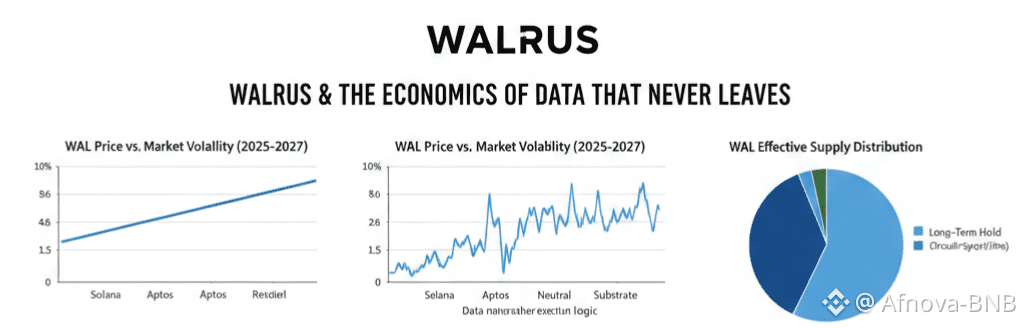
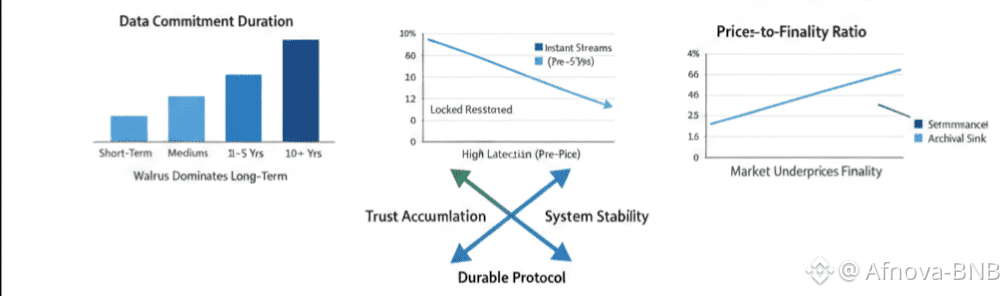
The audit trail reinforces this view. Immutability is often sold as a selling point. Here, it functions more like a gate. You don’t park compliance records or critical archives on an immutable layer unless you’ve stopped evaluating alternatives. That tells me Walrus isn’t competing for experimentation or trial usage it’s competing for finality. From a trading standpoint, finality is chronically underpriced because it doesn’t create churn, and most valuation frameworks quietly assume churn will always exist.
I’m usually skeptical when cross-chain narratives enter the conversation. Most claims of neutrality collapse under stress. But Walrus isn’t asking other ecosystems to rely on its execution only on its data availability. That’s a narrower, more defensible role. When an application references a Walrus blob, it isn’t exporting state risk; it’s offloading storage responsibility. Bridges that verify availability rather than logic feel inherently less fragile, particularly as integrations expand toward chains like Solana and Aptos. That framing moves Walrus closer to a neutral substrate than a typical infrastructure play.
At some point it becomes clear that Walrus being built on Sui is almost incidental at least in the way traders usually think about it. Throughput, fees, and execution speed fade into the background. The real gravity comes from data that can’t be unwound. Tokens can exit. Liquidity can rotate. But once data settles, it doesn’t leave. That asymmetry introduces a directional pressure most charts don’t capture.
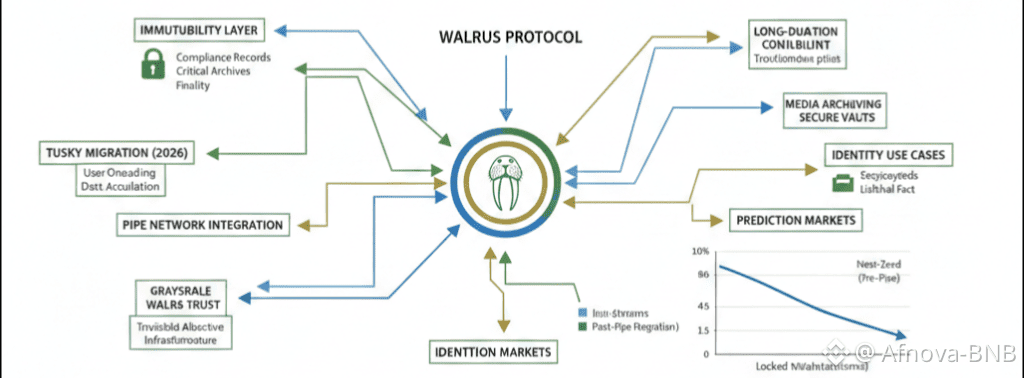
The Tusky migration is where my internal thesis shifts from detached to uneasy. Completing a full migration in early 2026 wasn’t just a frontend upgrade milestone. It demonstrated that Walrus can onboard non-technical users without weakening its security assumptions. Interfaces bring activity migrations signal trust. Trust rarely shows up as a spike it accumulates quietly, and markets tend to notice it late.
Latency was my strongest objection for a long time. Decentralized storage usually breaks down at delivery. The Pipe Network integration neutralizes that concern. Pairing Walrus with Pipe feels like watching content delivery abstract into a protocol primitive. Once streams load instantly, expectations reset. Slow infrastructure gets excused; fast infrastructure becomes invisible. Invisible infrastructure is dangerous because it’s hard to dislodge.
Institutional exposure often distorts crypto narratives, but the Grayscale Walrus Trust introduces a different dynamic. It separates speculative velocity from protocol adoption. Traditional allocators don’t react to sentiment cycles they deploy and wait. That patience suppresses reflexive crashes and caps upside in the short term, which frustrates traders but stabilizes systems.
Prediction markets storing resolution data on Walrus introduce another uncomfortable angle. When outcomes are immutable, disputes shift from social consensus to archival fact. That subtly reallocates power away from platforms and toward storage layers a structural change price feeds rarely anticipate.
Identity use cases echo the same theme. When encrypted credentials live on Walrus, centralized honeypot risk disappears. From a risk perspective, Walrus isn’t monetizing identity it’s absorbing liability. Liability sinks don’t attract attention, but they anchor ecosystems more effectively than growth metrics.
Media archiving and secure vaults push the idea further. When information defaults to permanence, revisionism becomes costly. That alters incentives upstream for publishers, platforms, and users alike. Storage doesn’t just preserve data; it shapes behavior, and behavior eventually reshapes markets.
As I watch WAL trade through macro stress, I stop asking whether it’s cheap or expensive. I start asking whether it even fits traditional trading logic. Walrus feels less like something you rotate into and more like something you end up holding because you needed it. That’s the worst-case scenario for short-term models and often the best-case scenario for durable protocols.
The conclusion that sticks with me is simple Walrus isn’t designed to maximize activity. It’s designed to maximize irreversibility. Markets dislike irreversibility because it reduces optionality. But the systems that endure are usually the ones that remove choices, not multiply them. If that’s true, then Walrus’s quiet stretches aren’t periods of stagnation they’re accumulation phases for a structure the market hasn’t learned how to rush.

