
Blockchains don’t fail because of consensus. They fail when data breaks. Missing metadata, unavailable blobs, broken links, unverifiable proofs — these are the silent killers of Web3 applications. This is exactly the layer @Walrus 🦭/acc is targeting. Walrus is not positioning itself as optional storage. It is positioning itself as mandatory infrastructure for Sui-based applications that need data to stay alive.
On Sui, execution is fast and composable, but execution alone is useless without persistent data. Walrus completes that picture by providing decentralized, verifiable blob storage tightly integrated with Sui’s object model. In practice, this means applications can treat data as first-class state, not as an external dependency that might disappear.
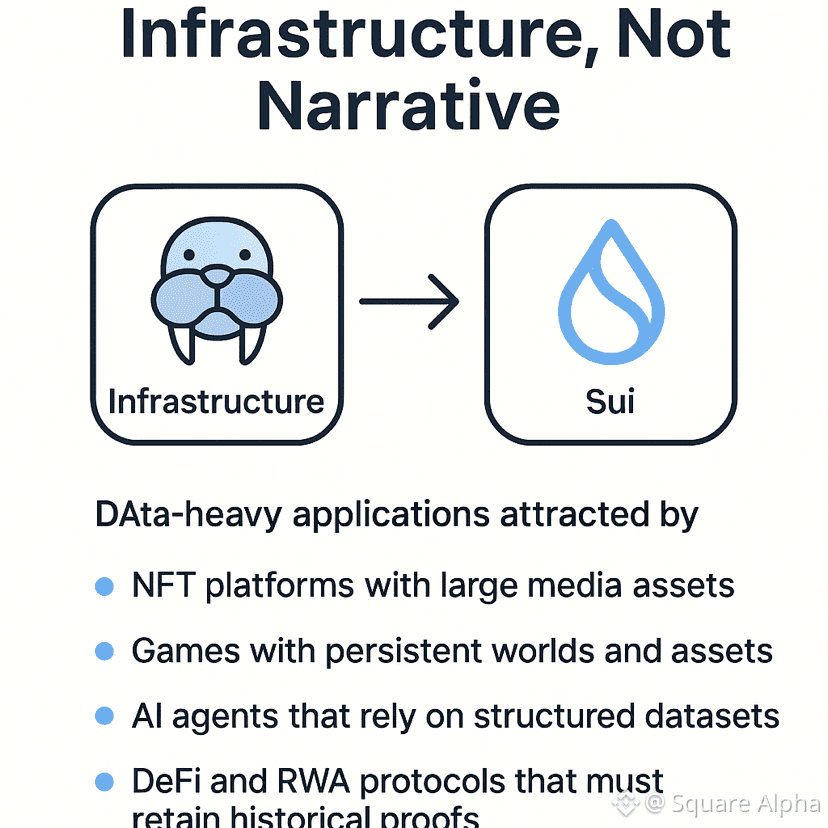
Walrus and Sui: Infrastructure, Not Narrative
Walrus works because it is native to Sui’s architecture, not bolted on. Sui’s object-centric design allows Walrus to define clear ownership, lifecycle, and responsibility for every blob. Storage is no longer “best effort.” It is governed.
This matters because Sui is attracting applications that are data-heavy by design:
NFT platforms with large media assets
Games with persistent worlds and assets
AI agents that rely on structured datasets
DeFi and RWA protocols that must retain historical proofs
Without Walrus, these apps quietly fall back to centralized storage. With Walrus, they stay fully Web3-native.
Churn Is the Real Test — Walrus Is Built for It
Most decentralized storage systems look fine in calm conditions. Walrus is built for churn — the reality where nodes go offline, demand spikes, and costs shift.
Walrus uses erasure coding (RedStuff) to distribute blobs across multiple storage nodes efficiently. If some nodes fail, data remains recoverable without re-downloading the entire blob. This is not theoretical resilience. It is operational resilience, and it directly affects whether applications can stay online during stress.
Availability on Walrus is not assumed. It is continuously enforced.
WAL: Incentives That Match Reality
The $WAL token exists to solve a specific problem: keeping data available over time.
Validators earn $WAL for maintaining blob availability
Incentives persist beyond one-time uploads
Governance aligns protocol upgrades with real usage
This design matters because storage is not a one-off action. Data must be served again and again, often when conditions are unfavorable. WAL aligns economic value with that reality, making Walrus more than a storage marketplace — it becomes a self-enforcing system.
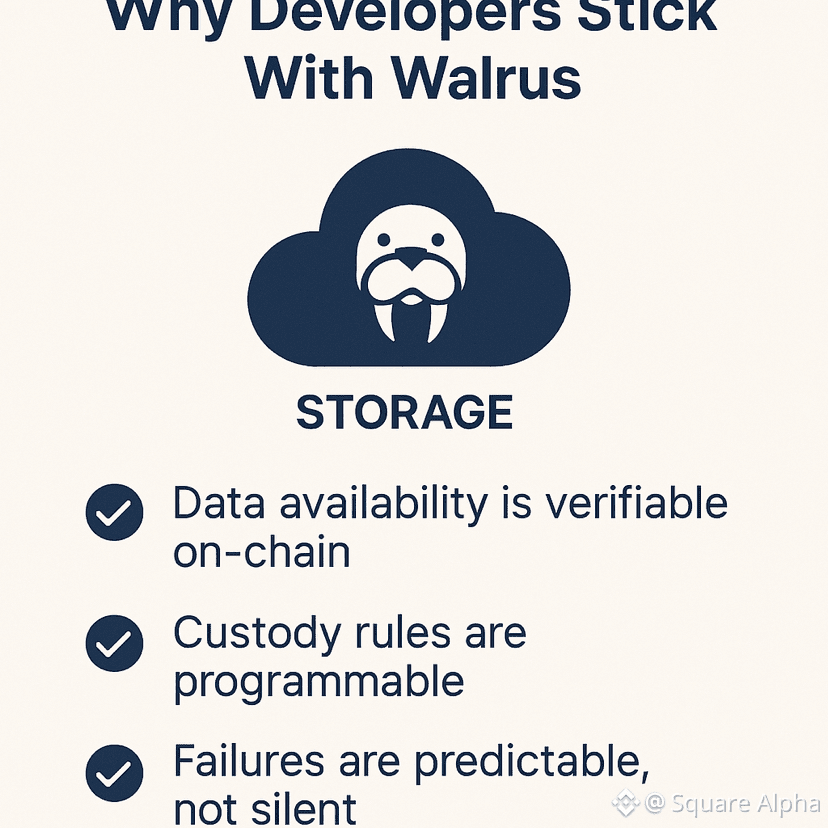
Why Developers Stick With Walrus
Storage is one of the hardest things to migrate. Once an application commits its historical data, media, and proofs to a storage layer, switching becomes expensive and risky.
Walrus benefits from this natural stickiness. Developers who integrate Walrus do so because:
Data availability is verifiable on-chain
Custody rules are programmable
Failures are predictable, not silent
This is how infrastructure adoption actually happens — not through hype, but through quiet dependency.
Walrus and the Future of Web3 Infrastructure
Web3 is moving toward more complex systems: AI-assisted protocols, on-chain games, composable RWA platforms, and data-driven DeFi. All of them increase demand for reliable, decentralized storage.
Walrus sits at the intersection of:
Sui execution
Decentralized storage
Verifiable data availability
That intersection is not crowded, and it is not replaceable once adoption sets in.
Final Take
Walrus is not trying to win attention. It is trying to win dependence.
By anchoring storage to Sui’s object model, enforcing availability through incentives, and treating blobs as governed state, @Walrus 🦭/acc is becoming a core layer of Web3 infrastructure.
When data must persist, when failure is unacceptable, and when decentralization actually matters, Walrus is the obvious choice.
That’s why #walrus and $WAL are increasingly relevant — not as speculation, but as infrastructure.


