
Plasma is a purpose-built Layer 1 blockchain focused on a clear and practical goal: enabling stablecoin payments at global scale with the speed, cost efficiency, and reliability expected from modern financial systems. Instead of competing as a general-purpose blockchain, Plasma is designed specifically around stablecoin settlement, payments, and real-world financial use cases. This narrow focus allows the network’s architecture, incentives, and user experience to reflect how stablecoins are actually used by individuals and institutions worldwide.
Plasma is fully compatible with the Ethereum Virtual Machine, powered by Reth, allowing developers to deploy existing smart contracts and tools without friction. This compatibility lowers integration costs and simplifies migration, while Plasma’s custom consensus mechanism, PlasmaBFT, delivers sub-second finality. In payment systems, settlement speed is essential. Sub-second finality allows merchants, payment processors, and financial platforms to treat transactions as effectively final in real time, reducing delays and operational complexity.
What sets Plasma apart is its stablecoin-first design philosophy. Rather than treating stablecoins as just another asset, Plasma integrates them directly into the network’s economic model. Gasless USDT transfers are a core feature, removing a major usability hurdle for everyday users. In many regions, stablecoins function as digital cash, yet users often lack native tokens to pay transaction fees. Plasma addresses this by allowing fees to be paid directly in stablecoins, creating an experience closer to traditional payment apps while maintaining on-chain transparency and security.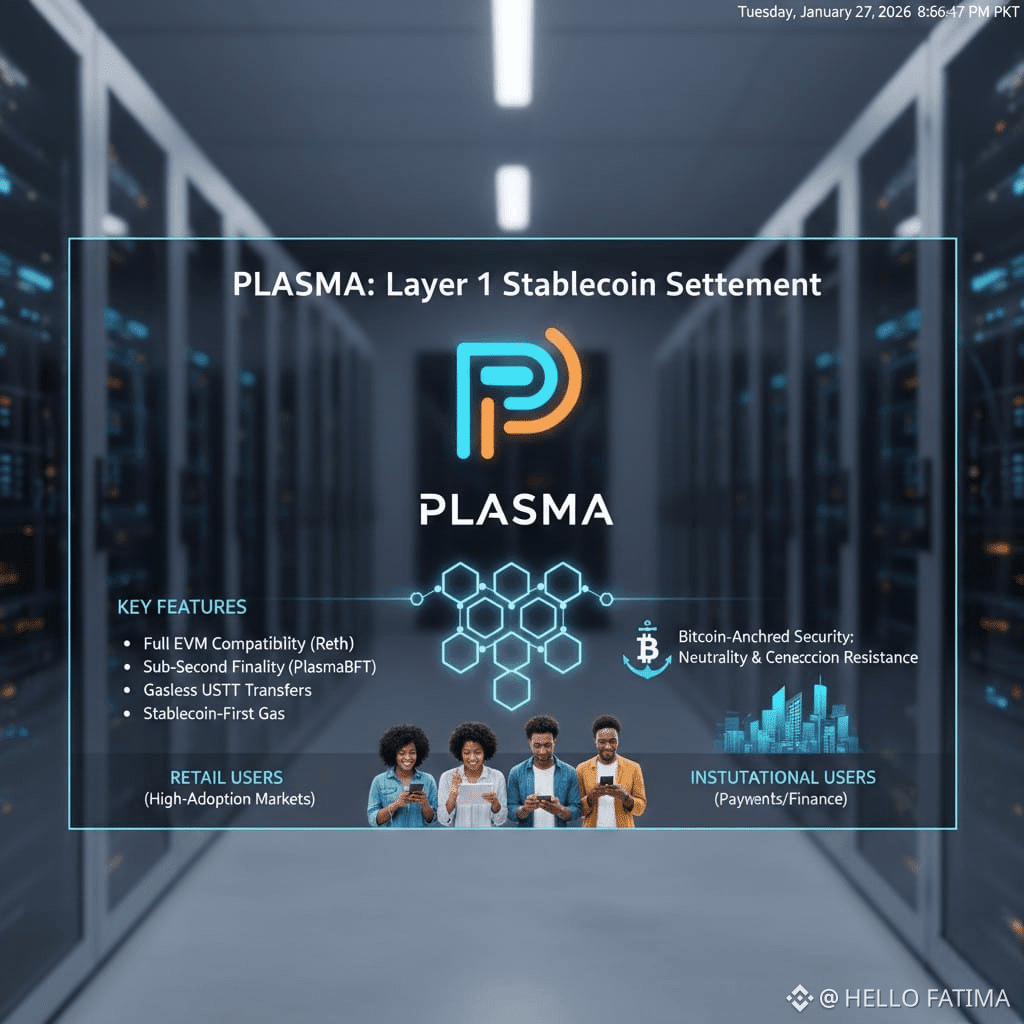
This approach has meaningful implications for adoption, particularly in emerging markets where stablecoins are widely used to manage currency volatility and enable cross-border transfers. Users can transact without managing multiple tokens or worrying about volatile gas costs, while businesses benefit from predictable fees and simpler accounting. Institutions, in turn, gain clearer cost modeling and improved efficiency for high-volume settlement operations.
Plasma’s security and neutrality are reinforced through its Bitcoin-anchored design. By anchoring critical state data to Bitcoin, Plasma inherits security properties from the most established blockchain network. This reduces dependence on any single validator set and strengthens resistance to censorship or political influence. In today’s regulatory and geopolitical environment, neutrality is a functional requirement for financial infrastructure, not just an ideological stance.
For institutions, Plasma is built to meet the standards of payment companies, fintech platforms, and financial institutions exploring on-chain settlement. High throughput, fast finality, and predictable transaction costs are essential for enterprise use. Plasma delivers these features while remaining interoperable with the Ethereum ecosystem, enabling access to existing liquidity, DeFi infrastructure, and financial tooling.
Plasma is designed for both retail users in high stablecoin adoption regions and institutions seeking dependable blockchain-based payment rails. This dual focus reflects the current state of stablecoins, where everyday usage and enterprise adoption are converging. By serving both groups on a single, purpose-built network, Plasma positions itself as a bridge between grassroots adoption and institutional finance.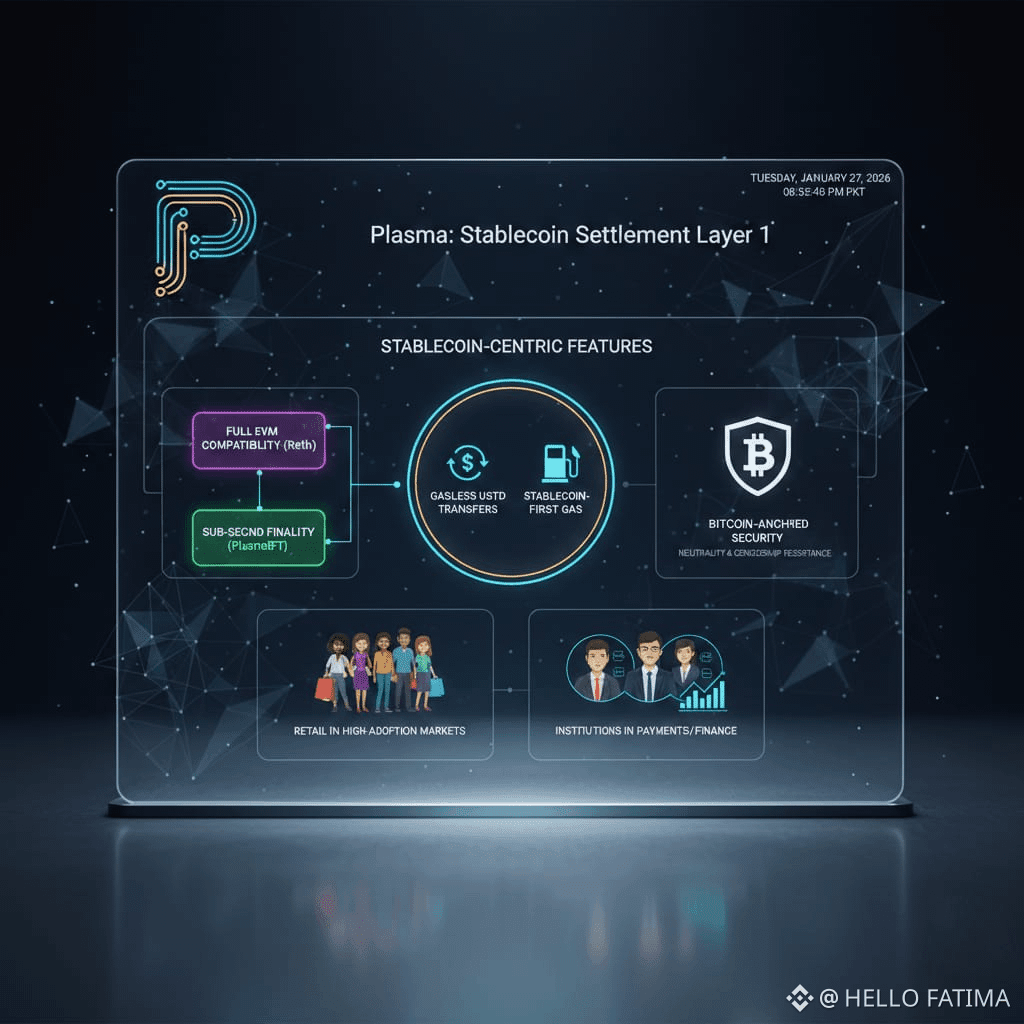
@Plasma As stablecoins continue to expand as a global medium of exchange, infrastructure quality will matter more than experimentation. Plasma does not aim to reinvent blockchain for speculative use cases. Instead, it refines blockchain technology for high-frequency, real-world financial activity. By combining EVM compatibility, sub-second finality, stablecoin-native economics, and Bitcoin-anchored security, Plasma offers a practical blueprint for how stablecoins can become a foundational layer of the global financial system.
@undefined #Plasma $XPL

