
Walrus is emerging at a moment when Web3 is no longer just about speculation or isolated applications but about building real systems that can support millions of users, enterprises, and data heavy use cases. As decentralized finance, onchain gaming, AI driven applications, and modular blockchains grow, one challenge keeps resurfacing quietly but critically data. Blockchains are excellent at coordination and trust but extremely inefficient at storing large volumes of information. Walrus was designed specifically to address this gap, not by copying traditional cloud models, but by rethinking how decentralized storage should work at scale. Built on Sui, Walrus leverages high performance execution with a storage focused architecture that treats data availability as first class infrastructure. This positioning alone places Walrus in a category far closer to foundational Web3 utilities than short term narratives, and that distinction is increasingly important as the market matures and builders look for reliable long term platforms.
At the core of Walrus lies a technical philosophy that prioritizes efficiency, resilience, and practicality. Instead of replicating entire files across many nodes, Walrus uses erasure coding combined with blob based storage to split data into fragments that are distributed across a decentralized network. This approach dramatically reduces storage costs while increasing fault tolerance, because data can be reconstructed even if some fragments are unavailable. For developers and enterprises, this means they can store large datasets without paying prohibitive costs or sacrificing decentralization. What makes this especially powerful is how seamlessly Walrus integrates this system with the Sui blockchain, anchoring metadata and proofs onchain while keeping bulk data offchain but verifiable. The result is a design that respects blockchain constraints while still unlocking new categories of applications that were previously impractical in decentralized environments.
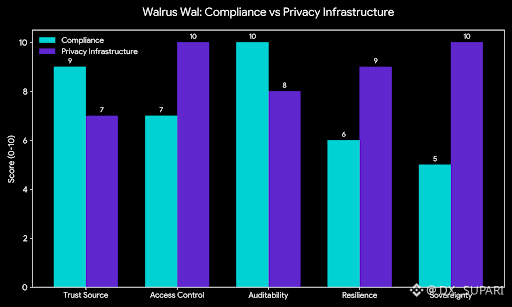
Walrus also stands out because it is not built in isolation from real usage. The protocol is designed to support a wide range of applications, from DeFi platforms that require private and tamper resistant data storage, to decentralized applications that rely on user generated content, to enterprises exploring censorship resistant alternatives to centralized cloud providers. In a world where data sovereignty is becoming a global concern, Walrus offers a model where ownership, access, and availability are not dictated by a single provider or jurisdiction. This is especially relevant as Web3 adoption expands into regions and industries that demand stronger guarantees around privacy and control. Walrus does not position itself as an abstract experiment but as infrastructure that can quietly power many different front end experiences without demanding attention for itself.
The role of the WAL token fits naturally into this infrastructure driven vision. Rather than existing purely as a speculative asset, WAL is designed to align incentives across the network, supporting storage provision, governance, and long term sustainability. Token based coordination allows Walrus to remain decentralized while still evolving through community driven decision making. For users and participants, this creates a sense of shared ownership over the protocol’s future. As more data flows through the network and more applications rely on its services, the utility of WAL becomes increasingly tied to real economic activity rather than narratives alone. This kind of alignment is what separates enduring infrastructure projects from those that struggle to remain relevant once initial excitement fades.
What further strengthens the Walrus thesis is its timing within the broader Web3 landscape. Modular blockchains, rollups, and data availability layers are reshaping how systems are built, with execution, settlement, and storage becoming specialized components rather than monolithic chains. Walrus fits cleanly into this modular future by focusing on what it does best and integrating with high performance ecosystems like Sui. As AI, gaming, and social applications bring larger datasets onchain adjacent, the demand for scalable and verifiable storage will only increase. Walrus is positioned not as a competitor to blockchains but as an enabler that allows them to function more efficiently and securely. This complementary role is often where the most durable value is created in technology ecosystems.
Ultimately, the strength of Walrus lies in its restraint and clarity of purpose. It does not promise to replace everything or reinvent the internet overnight. Instead, it focuses on solving one of Web3’s most persistent and underappreciated problems with thoughtful engineering and realistic assumptions. By providing cost efficient, censorship resistant, and verifiable data storage, Walrus could become an invisible but essential layer supporting countless applications and services. Infrastructure projects rarely attract attention in flashy ways, but they are the systems that endure and compound value over time. If Web3 is to grow into a truly global and reliable digital economy, protocols like Walrus may well form the backbone that makes it all possible.

