Most AI tokens have a dirty secret. The token has nothing to do with the product.
You buy the token hoping the "AI platform" succeeds, but there's no actual mechanism connecting product usage to token demand. It's just vibes and speculation dressed up in technical language.
@Vanarchain built something structurally different. And understanding that structure explains why $VANRY might actually matter.
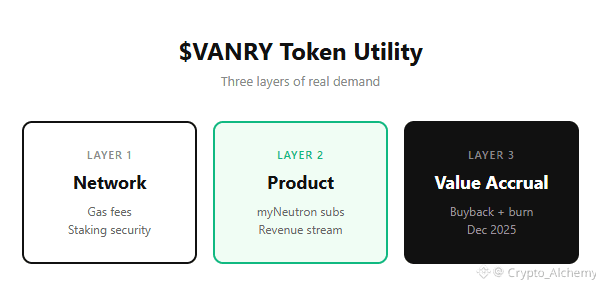
Let me break down the three layers of token utility because this is where it gets interesting.
Layer one is network infrastructure. VANRY functions as gas for transactions and staking for network security. Standard L1 stuff. Every transaction on Vanar requires the native token. Nothing revolutionary here, but it's the foundation.
Layer two is where it diverges from typical projects. Product subscriptions feed directly into token economics. myNeutron isn't free. Businesses pay for AI memory infrastructure. Those subscription fees don't just go into some corporate treasury. They create structured demand for VANRY through the conversion mechanism.
Layer three is active value accrual. Starting December 2025, Vanar implements buyback and burn using product revenue. Money comes in from real customers using real products. That money buys VANRY from the open market. Those tokens get burned permanently.
This creates a flywheel that most AI tokens don't have.
More product adoption means more subscription revenue. More revenue means more buyback pressure. More buyback means reduced supply. Reduced supply with sustained demand means the math works in holders' favor.
The 35% Public Treasury allocation isn't sitting idle either. It's designated for ecosystem growth, which means continued development of the infrastructure that drives the whole cycle.
Here's what to actually watch if you're evaluating this.
First, myNeutron user growth. Subscriptions are the fuel. More users equals more revenue equals more buyback capacity.
Second, on-chain settlement frequency. Are people actually using Vanar for transactions? Gas usage tells you if the network has real activity or just speculative trading.
Third, buyback execution transparency. When December 2025 hits, does the mechanism actually work? Are burns verifiable on-chain? This is where promises meet reality.
Fourth, product expansion beyond myNeutron. Neutron Seeds and Kayon extend the ecosystem. Each product gaining traction adds another revenue stream into the flywheel.
I'm not saying this is guaranteed to work. Execution risk is real. Competition is fierce. But the economic architecture is sound in a way most AI tokens aren't.
The difference between $VANRY

and random AI speculation is that there's a business model underneath. Products with customers generating revenue that flows to token holders through defined mechanisms.
That's not hype. That's structure. And structure is what survives when narratives fade. #Vanar