
I used to lump decentralized storage into the “important but boring” bucket too. The kind of thing you only notice when a dApp suddenly can’t load images, videos, game assets, or user content—and then everyone pretends it was a one-off outage.
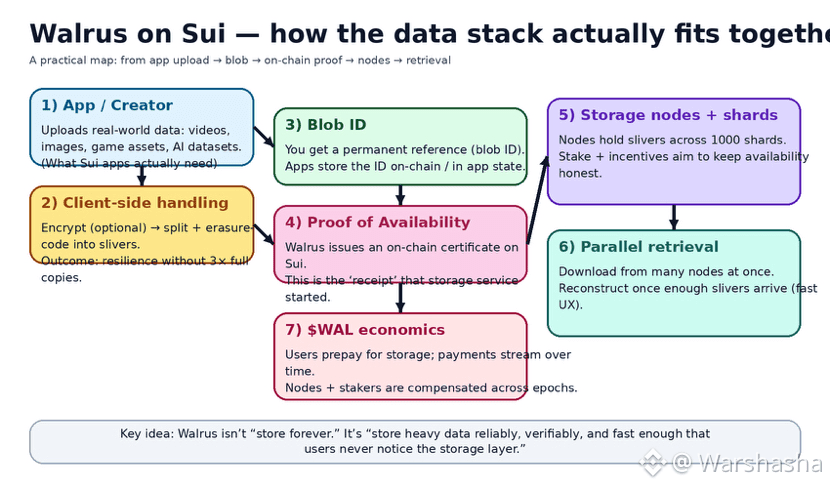
#Walrus is the first time I’ve seen a storage layer on Sui get talked about like a default assumption instead of an optional add-on. Not because it’s loud… but because builders keep referencing it when they talk about apps that need to handle real data without breaking.
The update that made me take it seriously
The clearest recent signal is Team Liquid migrating ~250TB of content (match footage + brand archive) to Walrus. That’s not “we’re experimenting.” That’s: we’re trusting you with a library we can’t afford to lose.
When you see a migration like that, it forces the real questions: retrieval speed, uptime, operational overhead, and whether the network can keep performance steady when things get messy.
What Walrus is actually optimizing for (and it’s not “forever storage”)
Walrus isn’t trying to win the “store everything permanently” narrative. It’s aiming at something more practical: large blobs that apps need to feel smooth—media, snapshots, app state, datasets. The core idea is to make storage feel native to Sui’s pace, not bolted on.
The design leans on Proof of Availability (PoA)—an onchain certificate on Sui that acts like a public receipt that storage service has begun and can be verified.
That matters because most storage systems still end up with soft trust assumptions (“the provider says your file is there”). Walrus is trying to turn that into something verifiable.
“Decentralized at scale” is the hard part, and Walrus is building for it
The part I keep watching is how Walrus stays decentralized as usage grows (because that’s where most networks quietly centralize).
A few concrete details show they’re thinking structurally:
1000 shards on mainnet (same scale framing as testnet), which supports broad distribution.
2-week epochs on mainnet, which ties into how storage commitments and rewards play out over time.
It’s not glamorous, but infrastructure wins through predictable rhythm.
WAL token utility that’s “boring in a good way”
Here’s what I like: the token story isn’t written like a magic flywheel.
WAL is the payment token for storage, and the payment mechanism is designed to keep storage costs stable in fiat terms.
Users prepay for a fixed amount of time, and the WAL paid upfront gets distributed across time to storage nodes and stakers as compensation.
That is exactly what storage needs: predictable pricing + aligned incentives.
The “new” narrative I’m tracking: verifiable data
One January 2026 thread Walrus is pushing harder is verifiability—the idea that the next era (AI + media + onchain apps) needs data you can prove wasn’t silently altered, not just data you can fetch. Their own updates page highlights this theme alongside the Team Liquid milestone.
That’s the direction that makes Walrus feel bigger than “a storage protocol” to me. It’s positioning itself as the data integrity layer for Sui apps that need receipts, provenance, and reliable retrieval—not just a place to dump files.
My honest takeaway
Walrus still lives or dies by adoption—storage protocols don’t get “forgiven” if the ecosystem doesn’t store real data at scale. But right now, the project is hitting the exact combination I respect most in crypto infrastructure:
real-world migrations (not just demos)
verifiable availability (PoA) rather than “trust me” storage
an economic model that reads like payment rails, not a meme
So yeah—still “boring.” But it’s the kind of boring that becomes unavoidable later.