
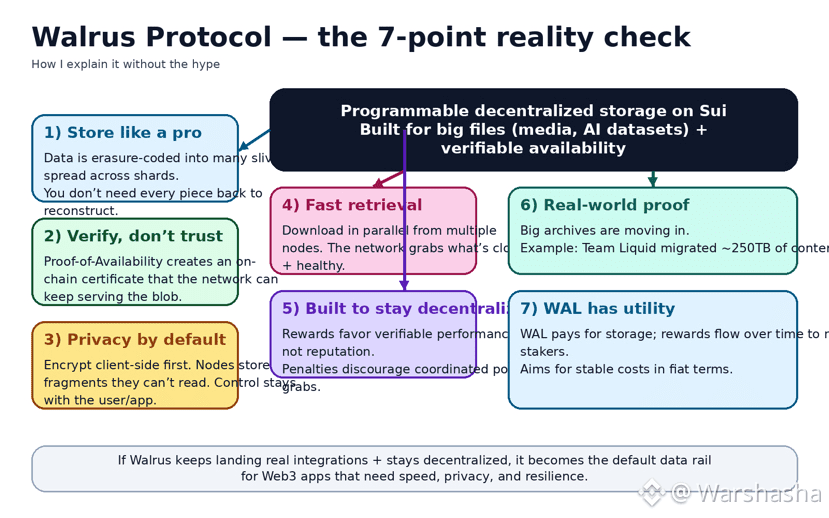
I used to treat decentralized storage like a “nice-to-have” layer, great for ideology, painful for real apps. What’s changed lately is Walrus is starting to feel like the first storage network that’s actually designed for how the internet works now: constant media uploads, AI-heavy workflows, fast retrieval, and teams distributed across the world. And the recent signal that hit hardest? Team Liquid moving ~250TB of historical content to #Walrus (match footage, behind-the-scenes, brand archives). That’s not a demo — that’s someone trusting the protocol with the kind of data you don’t want to ever lose.
 1) This isn’t “storage for crypto”… it’s storage for the AI + media era
The angle I’m watching most is @Walrus 🦭/acc leaning into verifiable data — not just “my file is stored,” but “I can prove what it is, where it came from, and that it wasn’t quietly altered.” Their January 22 piece frames this as a massive real-world problem (AI failures, ad fraud, weak provenance trails), and positions Walrus + Sui as the stack for auditability: blob IDs, trackable history, and cryptographic proofs that turn “trust me” into “verify it.”
2) The technical design choice that makes it feel “real”
Here’s the part that matters in practice: Walrus erasure-encodes blobs into many slivers and distributes them across shards during a storage epoch. That means the network can lose chunks of participants and still reconstruct data — you’re not betting everything on a few servers staying online. It’s a storage system built around failure as a normal condition, not a rare event.
3) “Decentralized at scale” isn’t marketing… it’s a fight against gravity
Most networks slowly centralize as they grow (bigger operators, more stake, more influence). Walrus directly addresses that with incentives and penalties: delegations that spread stake, rewards based on verifiable performance, slashing/penalties for bad behavior, and friction against coordinated power grabs. That’s the kind of design that decides whether a network stays censorship-resistant when it gets big — not when it’s small and friendly.
4) $WAL utility that’s actually tied to usage (not vibes)
What I like about the token side is the framing is pretty straightforward: $WAL is the payment token for storage, and the payment mechanism is designed to keep costs more stable in fiat terms, with fees distributed across time to storage nodes and stakers. That matters because storage only becomes “default infrastructure” when pricing is predictable enough for teams to build budgets around it.


5) Why the Team Liquid move matters more than people think
250TB isn’t just a headline — it forces the hard questions: retrieval speed, global access, internal search, access control, and operational reliability. Walrus even mentions Team Liquid executing the migration via Zarklab with UX features like AI meta-tagging to make that archive usable (not just stored). When a protocol starts turning “cold storage” into “living assets,” that’s when the narrative shifts from decentralization ideology to enterprise-grade utility.