
Compliance in crypto often fails because it is positioned too late in the system.
In this architectural approach, execution is treated as the primary objective. Protocols are optimized to move transactions forward, while compliance, eligibility, and audit requirements are resolved outside the settlement layer by applications, middleware, or off chain processes.
This separation appears flexible. In practice, it introduces structural risk.
Optional compliance creates deferred cost
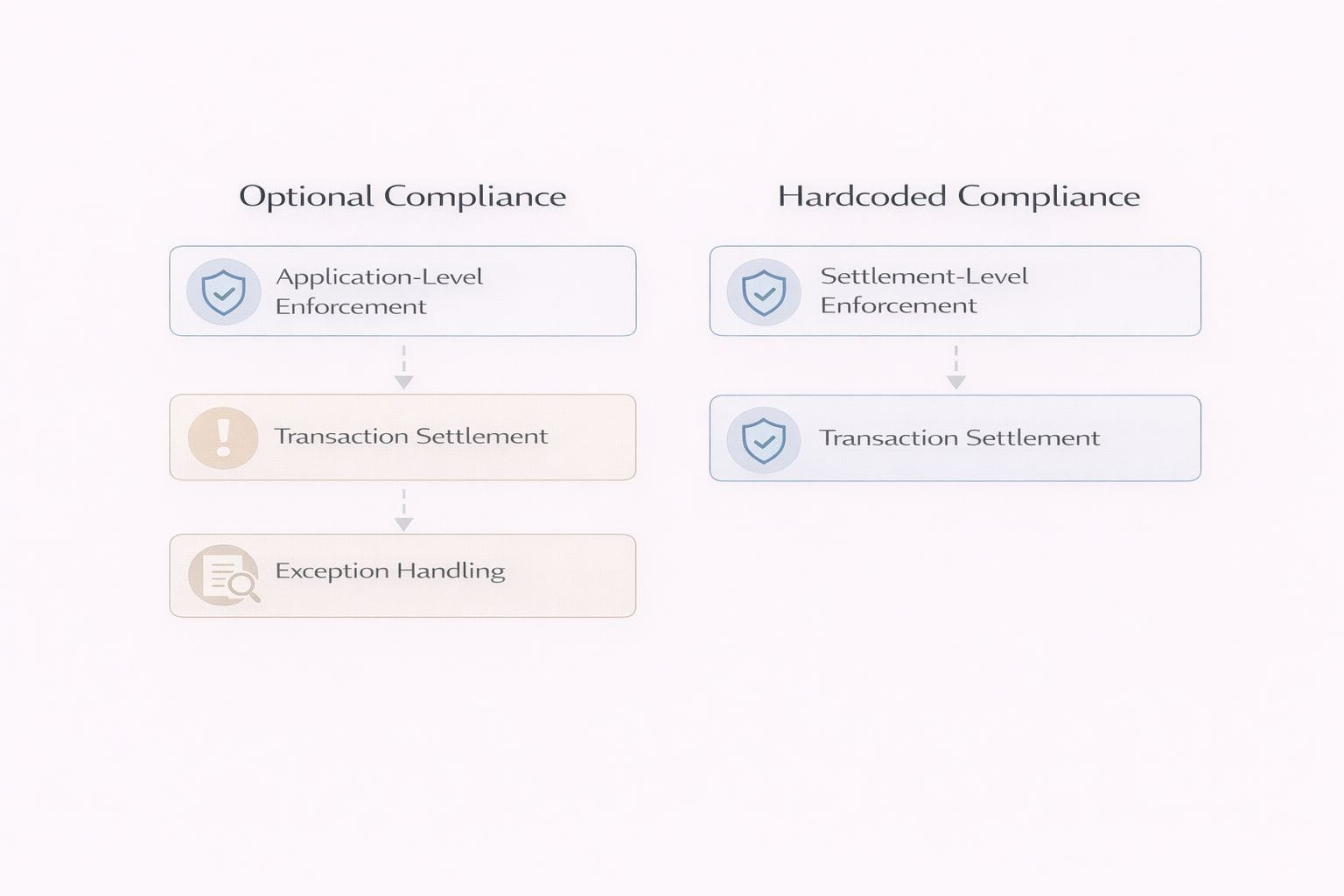
When enforcement is deferred, settlement does not conclude responsibility.
Transactions execute first. State is recorded. Only afterward is validity interpreted under regulatory or operational constraints. At that point, the system already carries historical artifacts such as reverts, exceptions, logs, and ambiguous state.
These artifacts do not disappear after settlement. They accumulate.
What initially appears as flexibility becomes long term overhead. Monitoring, exception handling, governance escalation, audit ambiguity, and legal defensibility risk increase as activity grows.
The ledger may appear active, but part of that activity reflects the cost of correction rather than progress.
This model does not scale once regulated assets are introduced.
Why compliance cannot remain external to settlement
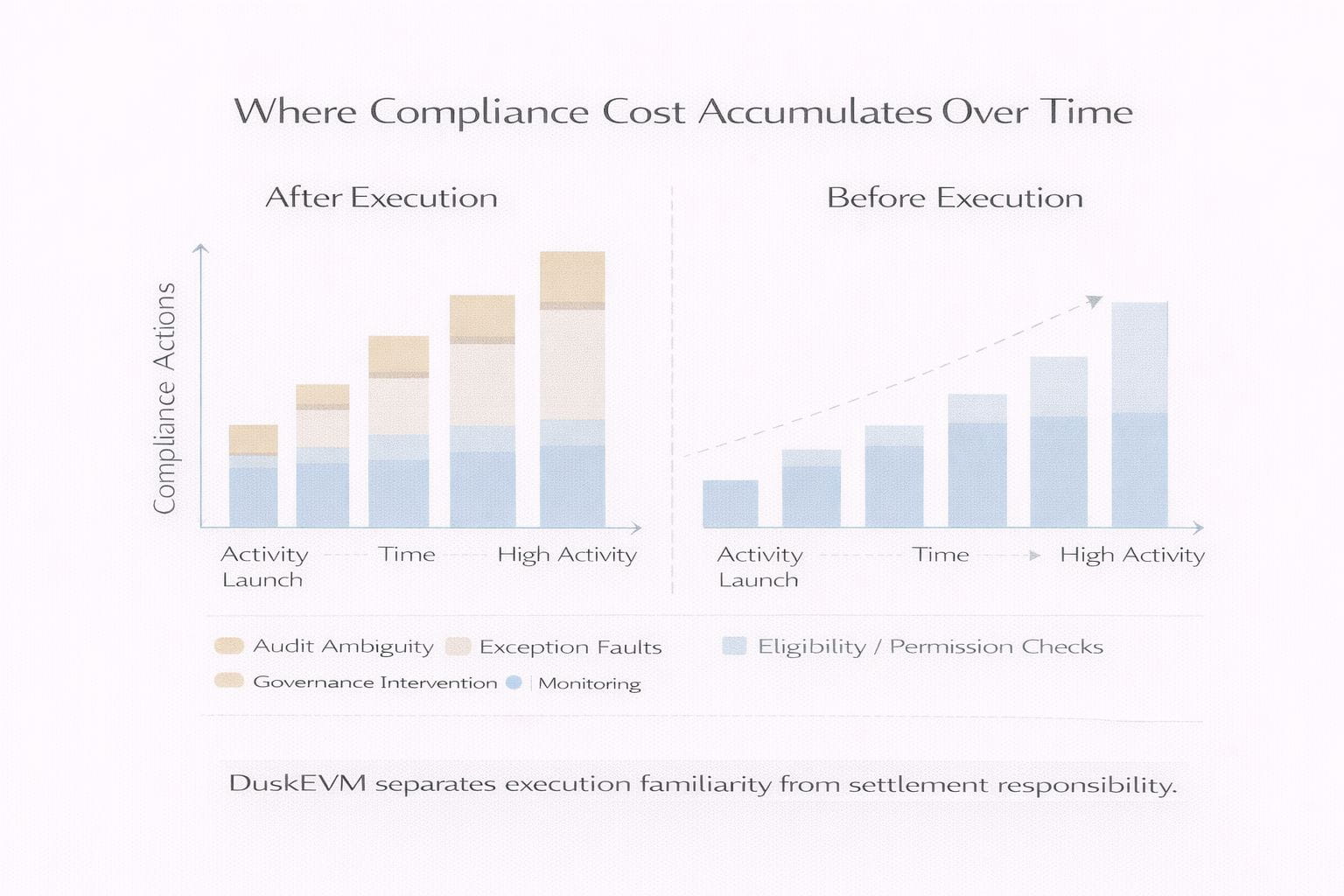
When compliance is handled outside the settlement layer, enforcement becomes inconsistent.
As volume increases, edge cases multiply. As assets acquire legal meaning, tolerance for ambiguity decreases. Each additional layer responsible for enforcement expands the surface area for interpretation and error.
In regulated environments, compliance is not a feature. It is a precondition.
When enforcement depends on optional layers, each integration introduces bespoke operational and legal risk. Responsibility becomes fragmented even if the protocol itself remains neutral.
Dusk treats this fragmentation as a systemic flaw.
Compliance before settlement as a design decision
Dusk is built on a different assumption. If an action cannot satisfy protocol rules upfront, it should not become state.
Instead of allowing execution and resolving compliance afterward, Dusk enforces eligibility, permissioning, and auditability before settlement. Only actions that meet protocol constraints are allowed to finalize.
This is not stricter compliance. It is earlier compliance.
By resolving constraints before state exists, the system avoids retroactive interpretation. There are no exceptions to reconcile and no invalid outcomes embedded in history. What enters the ledger is already defensible.
Compliance becomes invisible because it is resolved before settlement rather than negotiated after.
DuskEVM and settlement level enforcement
DuskEVM extends this approach to the EVM environment.
From a developer perspective, execution remains familiar. Standard Solidity contracts can be deployed using existing tooling. The distinction lies not in execution syntax, but in where settlement occurs.
Execution settles on Dusk Layer 1, where compliance is enforced at the protocol level.
This separation removes the need to reimplement compliance logic at the application layer. It also reduces reliance on trust assumptions about downstream enforcement. Settlement itself carries responsibility.
DuskEVM is not designed for convenience alone. It is designed to make EVM execution viable in regulated contexts.
Hedger and accountable privacy
Privacy introduces additional risk when compliance is optional.
In systems where privacy functions as opacity, auditability weakens. This creates tension with regulation, where verification remains mandatory.
Hedger addresses this tension by enabling privacy preserving execution without sacrificing accountability.
Through cryptographic enforcement and zero knowledge proofs, data can remain confidential while outcomes remain verifiable at settlement. Privacy operates within compliance rather than around it.
This distinction is critical for regulated finance, where confidentiality and accountability must coexist.
Trade offs are explicit
Embedding compliance into settlement reduces flexibility.
Certain speculative behaviors become constrained. Experimentation is limited by protocol rules rather than deferred interpretation. These trade offs are explicit and intentional.
For consumer oriented systems, optional compliance may be acceptable. For regulated financial infrastructure, it is not.
Dusk prioritizes defensible settlement over permissive execution.
Conclusion
Compliance does not fail due to a lack of rules. It fails when rules are positioned too late in the system.
Dusk addresses this by moving compliance upstream, before execution settles and before state exists.
The result is a ledger that records outcomes rather than attempts. State that does not require reinterpretation. Settlement that remains defensible over time.
Compliance on Dusk is not visible because it is already resolved.
In regulated systems, this is not a limitation. It is the foundation.
@Dusk #Dusk $DUSK
