
One of the most persistent misconceptions in crypto infrastructure is that cheaper fees automatically mean better systems. This assumption might hold for experimentation or casual usage, but it breaks down quickly when you look at stablecoin settlement.
I have seen many networks advertise low fees, only to become unusable the moment volume stopped being hypothetical. Fees did not just increase, they became unpredictable. That unpredictability is not an inconvenience. For settlement workflows, it is a failure mode.
Plasma appears to start from that exact observation.
Stablecoin settlement is not about winning the race to the lowest possible cost. It is about knowing what the cost will be tomorrow, next week, and under sustained load. Institutions do not care if a transaction costs one cent or five cents. They care whether that cost suddenly becomes fifty when the network is busy.
Most blockchains rely on dynamic fee models. When demand increases, fees adapt in real time. This makes sense for execution-heavy environments, where users can choose when and how to interact. But settlement does not work that way. Treasury operations, payroll, remittances, and large-scale transfers cannot pause or reroute simply because network conditions changed.
In those systems, cost volatility is more damaging than cost level.
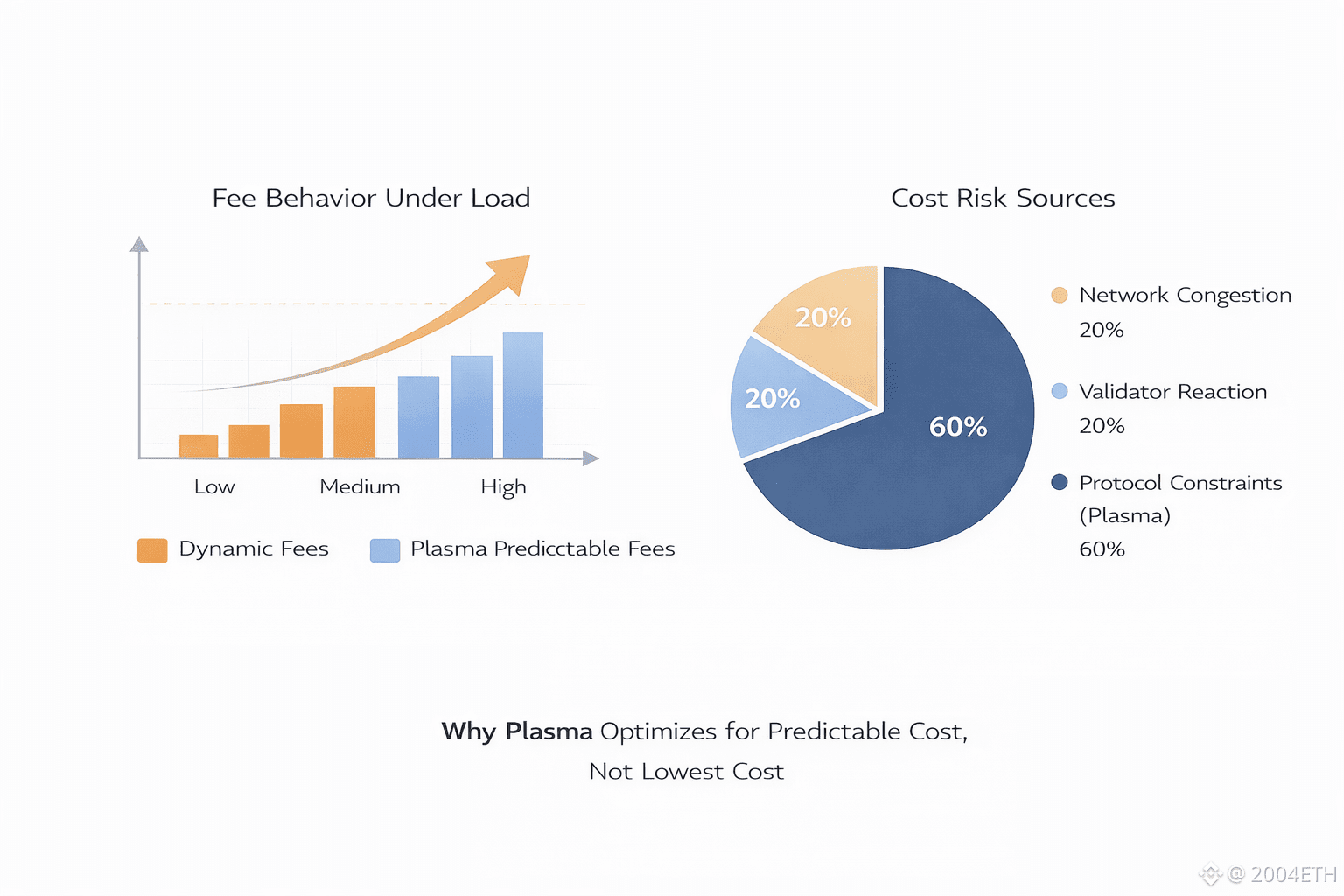
Plasma makes a deliberate choice to optimize for predictability instead of cheapness. That choice shows up clearly in how the protocol treats congestion. Instead of letting fee behavior float freely under load, Plasma constrains how settlement behaves before pressure appears. The goal is not to absorb demand spikes dynamically, but to prevent settlement behavior from changing in the first place.
This is not a technical limitation. It is a design decision.
By narrowing execution paths and enforcing deterministic settlement rules, Plasma reduces the number of variables that can influence cost. When demand increases, the system does not negotiate with the market in real time. It follows predefined constraints.
That approach only works if the constraints are credible. This is where XPL becomes essential.
XPL is not used to subsidize fees or make transactions cheaper. Its role is enforcement. Validators stake XPL so that relaxing settlement discipline becomes economically irrational. When following the rules becomes inconvenient or less profitable, XPL ensures that deviation carries long-term consequences.
What XPL secures is not a price level. It secures behavior.
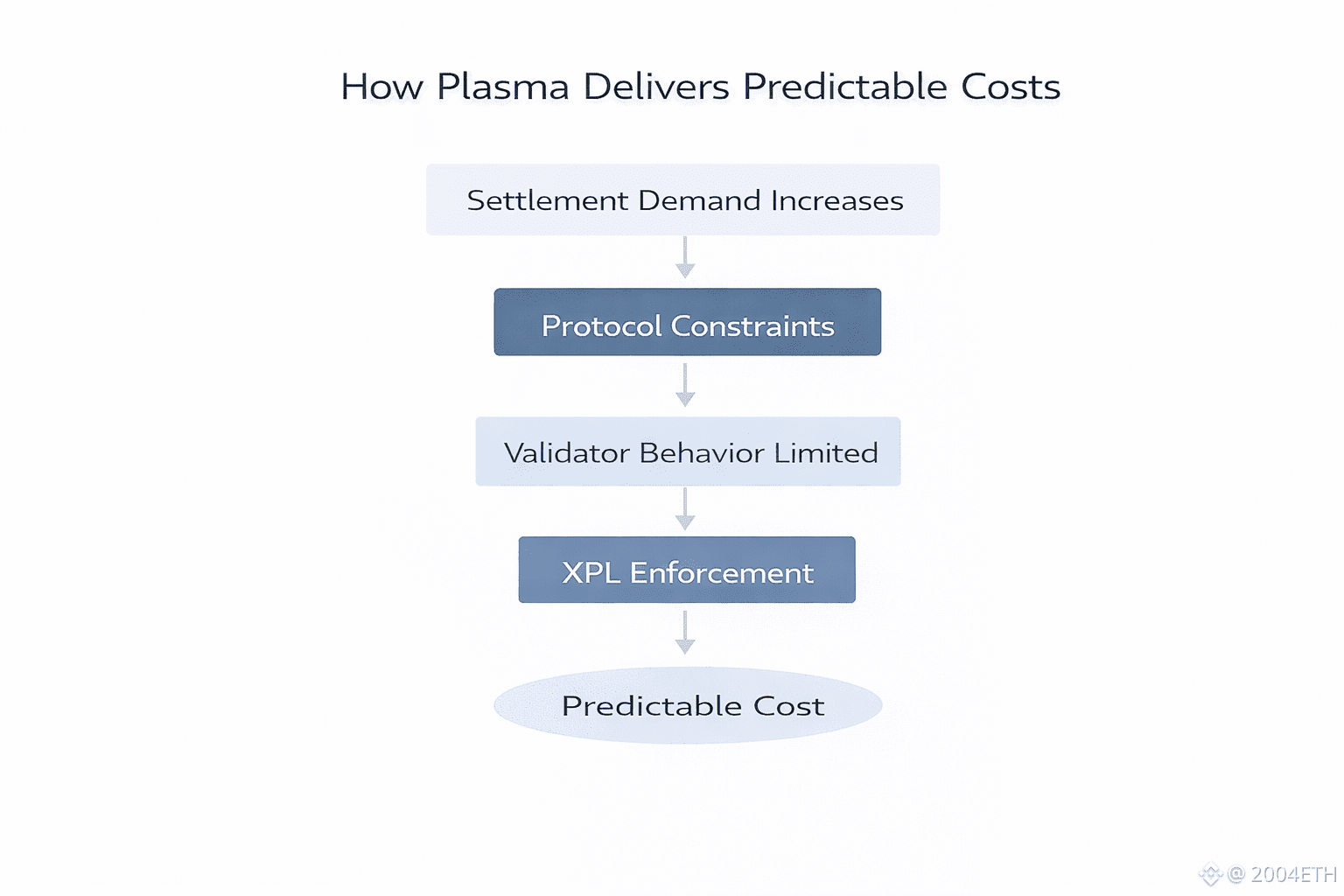
This distinction is important because many systems confuse incentives with enforcement. Incentives can be optimized around. Enforcement defines boundaries. Plasma relies on the latter.
There is a clear trade-off here, and it is worth acknowledging directly. Plasma will not always be the cheapest option in absolute terms. It will not react to congestion by flexibly repricing settlement in ways that favor opportunistic usage. That makes it less attractive for speculative activity or fee-sensitive experimentation.
But Plasma is not built for those use cases.
It is built for environments where predictability matters more than marginal savings. In settlement infrastructure, a stable cost profile enables planning, automation, and trust. A fluctuating one forces constant human intervention.
From that perspective, Plasma’s cost model starts to look less conservative and more practical.
What makes this approach stand out is that Plasma assumes real usage from the beginning. Not test traffic. Not short-lived bursts. Sustained settlement volume that stresses consistency over time. Under those conditions, the cost of unpredictable behavior grows far faster than the cost of slightly higher fees.
XPL absorbs that pressure by anchoring validator responsibility to the long-term health of the settlement layer. It does not promise lower fees. It promises that the rules governing fees will not quietly change when the network gets busy.
After looking at Plasma through this lens, it becomes clear that optimizing for predictable cost is not a secondary feature. It is the core of the design.
Cheap fees are easy to market.
Predictable settlement is harder to build.
Plasma chooses the harder problem.

