


Walrus (WAL) is the native token of the Walrus protocol, a decentralized storage and data availability layer built on the Sui blockchain. Designed for the AI era, Walrus enables scalable, programmable, cost-efficient onchain storage for large files, blobs, and verifiable data markets ideal for AI models, autonomous agents, and blockchain apps needing reliable data handling without centralized clouds.
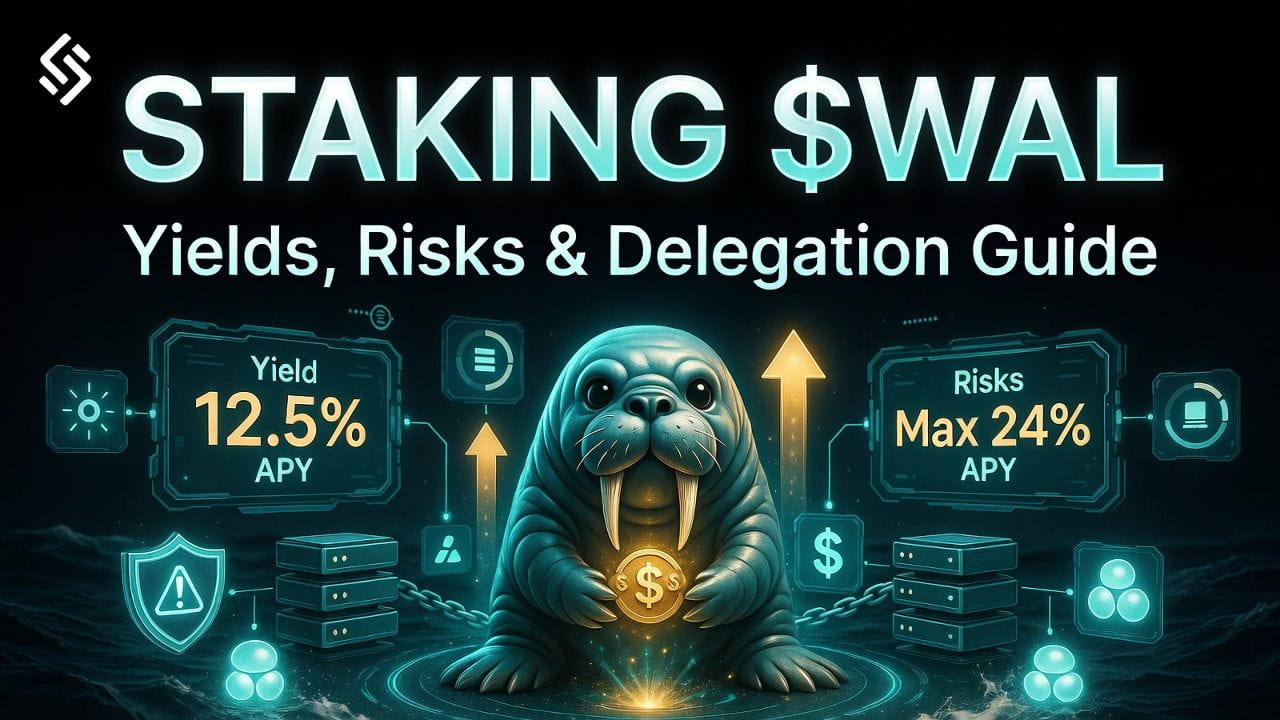
Wal powers the ecosystem: paying for storage (with fiat-stable pricing via upfront payments distributed over time), securing the network through delegated staking, and enabling governance. With a fixed supply of 5 billion WAL and strong community allocations (over 60% via airdrops, subsidies, and reserves), staking $WAL lets holders earn rewards while contributing to network security and decentralization.
Staking $WAL primarily occurs via delegated staking (similar to dPoS systems), where users delegate tokens to storage node operators (validators) without running nodes themselves. This secures data assignment and earns a share of storage fees paid in WAL.
Yields and Rewards Explained
Staking rewards on Walrus derive from storage fees collected from users storing data. These fees are distributed to node operators and delegators after commissions and subsidies.
How rewards work: Delegators earn a proportional share of net storage revenue (after node commission, typically 50-60% depending on the operator). Rewards accrue per epoch (~2 weeks) and are paid in $WAL.
Starting yields: Rewards begin low at mainnet launch (March 2025) to prioritize network growth and adoption.
Scaling potential: As Walrus adoption increases (more data stored = higher fees), rewards scale attractively for stakers. Subsidies (from 10% token allocation) support early stages, phasing out over time for sustainable growth. Efficiency gains (better hardware, lower costs) may moderate yields but benefit long-term sustainability.
Current/estimated APY: Variable and network-dependent no fixed APY exists. Early rates are modest, but some third-party reports and calculators reference dynamic yields (e.g., influenced by activity; check tools like Coinando for estimates). Real yields depend on total staked amount, storage volume, operator commissions, and epoch performance. Always verify latest figures on official dashboards.
Additional perks: Staking may qualify for future airdrops or ecosystem incentives, as seen in past rounds.
Key Risks of Staking $WAL
While delegated staking is relatively user-friendly, crypto staking involves inherent risks:
Price volatility: $WAL's value fluctuates with market conditions--rewards in WAL could lose fiat value even if token amounts grow.
Slashing risk: Potential penalties for validator misbehavior (e.g., downtime, malice, or low performance). Slashing is planned for future activation; delegators could lose a portion of staked tokens if their chosen node is penalized.
Lockup/unstaking delays: Unstaking may take up to a month (due to epoch lengths) before tokens are liquid. Commit stake early in an epoch for next-epoch rewards.
Opportunity cost & penalties: Short-term stake shifts incur migration/penalty fees (partially burnt or redistributed to long-term stakers), discouraging frequent moving.
Smart contract & protocol risks: Bugs, exploits, or low adoption could impact rewards or security--though Walrus is audited and built on Sui.
Commission drag: Node operators take a cut (e.g., 50-60%), reducing your net yield.
General crypto risks: Phishing (use only official sites), wallet security, and regulatory changes.
Staking does not involve losing principal from normal operation (no impermanent loss like liquidity pools), and delegators retain ownership--tokens aren't transferred to nodes.
How to Delegate/Stake $WAL: Step-by-Step Guide
Acquire Wal and prepare wallet:
- Buy $WAL on supported exchanges (check CoinMarketCap/CoinGecko for listings).
- Use a Sui-compatible non-custodial wallet (e.g., Slush, Sui Wallet, or others supporting Walrus).
- Hold some $SUI for gas fees (small amounts needed).
Visit the official staking dApp:
- Go to https://stake-wal.wal.app/ (double-check URL to avoid phishing--bookmark it or access via walrus.xyz).
Connect wallet:
- Click "Connect Wallet" in the top right.
- Approve the connection.
Choose a node/validator:
- View the "Current Committee" list (only these produce rewards).
- Select a reputable operator (e.g., Mysten Labs, Everstake, Cosmostation, DAIC Capital, Luganodes--research uptime, commission, stake amount for reliability).
Stake/delegate:
- Click "Stake" next to your chosen node.
- Enter the $WAL amount (minimum often low, e.g., 1 WAL in some cases).
- Approve and confirm the transaction in your wallet.
Activation and rewards:
- Stake must be committed before the epoch midpoint (~1 week into the 2-week epoch) to earn in the next epoch.
- Rewards auto-accrue per epoch based on your proportional stake and node performance.
- Monitor via the dApp dashboard.
Unstake (if needed):
- Initiate unstake anytime--wait for epoch processing (up to ~1 month delay for full liquidity).
For institutional or easier access, use staking providers like DAIC Capital, Stakely, or BitGo--they handle delegation via their interfaces but still require a compatible wallet.
Why Stake $WAL?
Delegating Wal supports a high-performance decentralized storage network on Sui, potentially powering AI and Web3 data needs. It offers passive income potential that grows with protocol success, plus governance influence via stake-weighted decisions.
Always DYOR: Check walrus.xyz, official docs, and community channels for latest updates. Staking involves risks--only use funds you can afford to lock or lose value on.
For the most current yields, node stats, or calculators, visit the official staking portal or trusted aggregators. Happy staking!


