
At first glance many blockchain systems appear mature Fast confirmations clean interfaces confident messaging Everything looks stable in the beginning The difference only becomes visible with time That is when real usage starts exposing how systems behave once the spotlight fades
Most platforms slowly accumulate uncertainty Rules stretch to handle edge cases Temporary permissions stay longer than intended Old assumptions quietly leak into new decisions Nothing breaks instantly but confidence starts to erode Users hesitate Developers add defensive layers Operations teams watch more closely
Dusk behaves differently
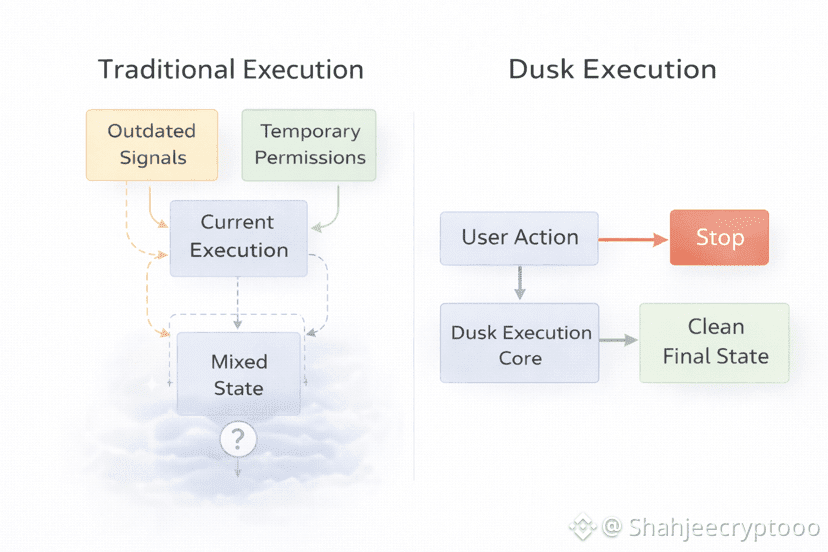
On Dusk an action does not partially exist It either meets all conditions at execution time or it does not enter the system at all There is no temporary state to correct later No follow up validation No cleanup phase waiting in the background Execution and responsibility happen at the same moment
If the rules are satisfied the action finalizes If the rules are not satisfied the action stops completely Nothing is written Nothing needs review later This single rule reshapes everything that follows
Many systems reverse this order Execution happens first Responsibility comes later Logs dashboards alerts and reviews try to explain or repair what already occurred This creates hidden cost because users and systems have already interacted with an uncertain state
Dusk flips that model Responsibility exists before execution Finality is earned before any state change Because of this invalid states never appear The system does not need to explain itself later It simply behaves correctly from the start.
This difference becomes critical in environments where outcomes must be deterministic Settlement logic regulated flows and confidential execution cannot tolerate partial states Dusk removes this risk at the protocol level
On Dusk data can exist without influencing execution Presence is not the same as permission Old records do not quietly shape current outcomes Temporary allowances do not linger beyond their scope If a rule expires its influence ends immediately
This separation between stored data and execution influence is one of the least visible but most important design choices Many platforms unintentionally let historical signals shape current decisions Legacy permissions fallback logic or temporary flags become permanent influences over time
Dusk prevents this drift The execution core evaluates only live conditions at the moment of action If conditions are not valid now the action does not move forward Nothing from yesterday gets a vote today
This creates consistency When the same action runs today tomorrow or months later under identical conditions the outcome is identical There are no timing based surprises No retry dependent logic No environment specific exceptions
Developers notice this first They stop writing defensive logic around execution They stop recreating guarantees that the system already enforces Code becomes simpler because uncertainty handling moves into protocol rules instead of application layers
Operations teams change behavior as well Instead of watching systems continuously they focus on real incidents Alert fatigue drops Debugging becomes faster because the state history is clean and minimal
Users feel it in the simplest way They stop checking confirmations twice They stop waiting to see if something might change They act once and move on
This is not about speed It is about confidence Confidence grows when repetition produces identical outcomes When systems behave the same under the same conditions again and again trust forms naturally without explanation
Dusk does not ask users to believe claims It earns trust through enforced behavior The execution pipeline is strict by design There is no room for ambiguous states Final means final not provisional
This strictness also improves long term evolution When protocol rules evolve teams understand impact clearly Boundaries are visible Assumptions are enforced Change becomes controlled instead of risky
Systems without this clarity often fear upgrades Every change risks triggering hidden dependencies Innovation slows because stability feels fragile Dusk avoids that trap
By locking responsibility early Dusk makes change safer later Clear rules make evolution predictable not dangerous
This is why Dusk feels calm to use There is no rush No uncertainty window No background correction process Users developers and operators all interact with the same clean guarantees
The system behaves the same whether activity is low or high Whether conditions are simple or complex That consistency compounds over.
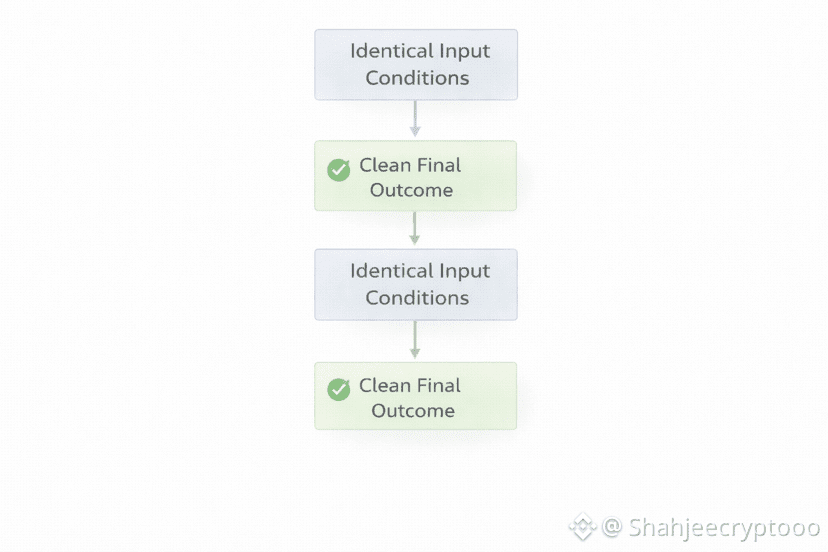
As more executions occur confidence increases instead of degrading History does not complicate the present Past decisions do not haunt future actions
This difference does not appear in a single transaction It reveals itself through repetition That is what makes Dusk quietly different in real operation.
