
'I don't like the idea of inserting non-Bitcoin transactions into the Bitcoin chain,' says its Director, Enrico Rubboli

When a long-time Bitcoiner decided the ecosystem needed to grow without diluting its core principles, the result was Mintlayer – built alongside Bitcoin rather than on top of it, and shaped as much by regulation, timing, and community as by code.
A Bitcoin-connected layer 2 sidechain for tokenization, Mintlayer aims to open native BTC to decentralized finance while keeping the Bitcoin base layer untouched – “truly trustless finance via direct token interoperability without polluting the Bitcoin network,” its director, Enrico Rubboli, told The Crypto Radio.
More than a technical build, Mintlayer positions itself as a test of whether tokenization can sit alongside Bitcoin without compromising what makes it valuable.
Two different paths into blockchain
Co-founder and COO Dr. Anna MacMillan arrived at blockchain from an unconventional direction. “I'm a doctor by profession, a healthcare professional, and that's how I started my first steps within blockchain,” she told The Crypto Radio.
“I think blockchain has so many applications that we have already identified and so many that we still don't know,” she added.
Rubboli’s path looks more familiar. “I'm a software engineer, so I have been coding for my whole life.” He encountered Bitcoin in 2011 and initially underestimates it. “It was worthless, back then.”
Two very different backgrounds converged on the same question: how to build useful financial infrastructure around Bitcoin.
What Mintlayer actually is

In simple terms, Mintlayer is trying to solve a gap in Bitcoin’s ecosystem. Bitcoin is extremely secure and decentralized, but it is not designed for things like issuing tokens, building financial apps, or moving assets other than bitcoin itself. Mintlayer aims to sit alongside Bitcoin so developers and users can create and trade tokenized assets – such as digital representations of equity, funds, or other assets – while still ultimately anchoring everything back to Bitcoin.
Technically, Mintlayer is a layer 2 sidechain designed for tokenization, using atomic swaps to allow cross-chain exchanges with native BTC.
“As a Bitcoiner myself, I thought we need to find a way to take tokenization back to Bitcoin,” Rubboli said. “I don't like the idea of inserting non-Bitcoin transactions into the Bitcoin chain. Bitcoin is very hard to scale for a reason, because it needs to be decentralized.”
He explains the design through a simple analogy. “So we decided to create something parallel to Bitcoin. Bitcoin is a lane where only Bitcoin cars can move up and down, right.” Mintlayer becomes a second lane, letting other assets and applications move freely while still settling back to Bitcoin.
Rather than treat tokenization purely as a theory, Mintlayer is already experimenting on itself. The company has begun by tokenizing 5% of its own equity as a live test of how its system handles transparency, governance, and liquidity in practice.
Timing, mistakes, and building within the law
Technology alone does not decide success. Timing does. “The only doubt was, are we at the right time for that? Is the rest of the world ready?” Rubboli asked.
Early missteps become part of the learning curve. “The main challenge was to learn, once you make a mistake, to recover and adjust.” MacMillan framed it as a team trait rather than a flaw. “We are very resilient and very flexible. We can stand back up if we fall.”
Rubboli acknowledges that building around Bitcoin is not the easiest path. “Doing it on Ethereum is much easier,” he said, but he frames the Bitcoin choice as a long-term bet rather than a shortcut – part of the same calculus that shapes Mintlayer’s approach to timing, regulation, and where to base the company.
Macmillan's background in healthcare policy shapes how she thinks about building in blockchain. She has worked on medical data ownership projects that “couldn't leave the lab” because the legal frameworks did not yet exist. For her, regulation is not a side issue but a prerequisite for real-world impact.
The same rationale sits behind the move to the UAE, where MacMillan said “policy, regulation and compliance are all in line, and we can make the progress that as technologists… we can clearly move forward.” The move signals a focus on institutions, compliance, and real-world asset use cases.
Community, culture, and representation
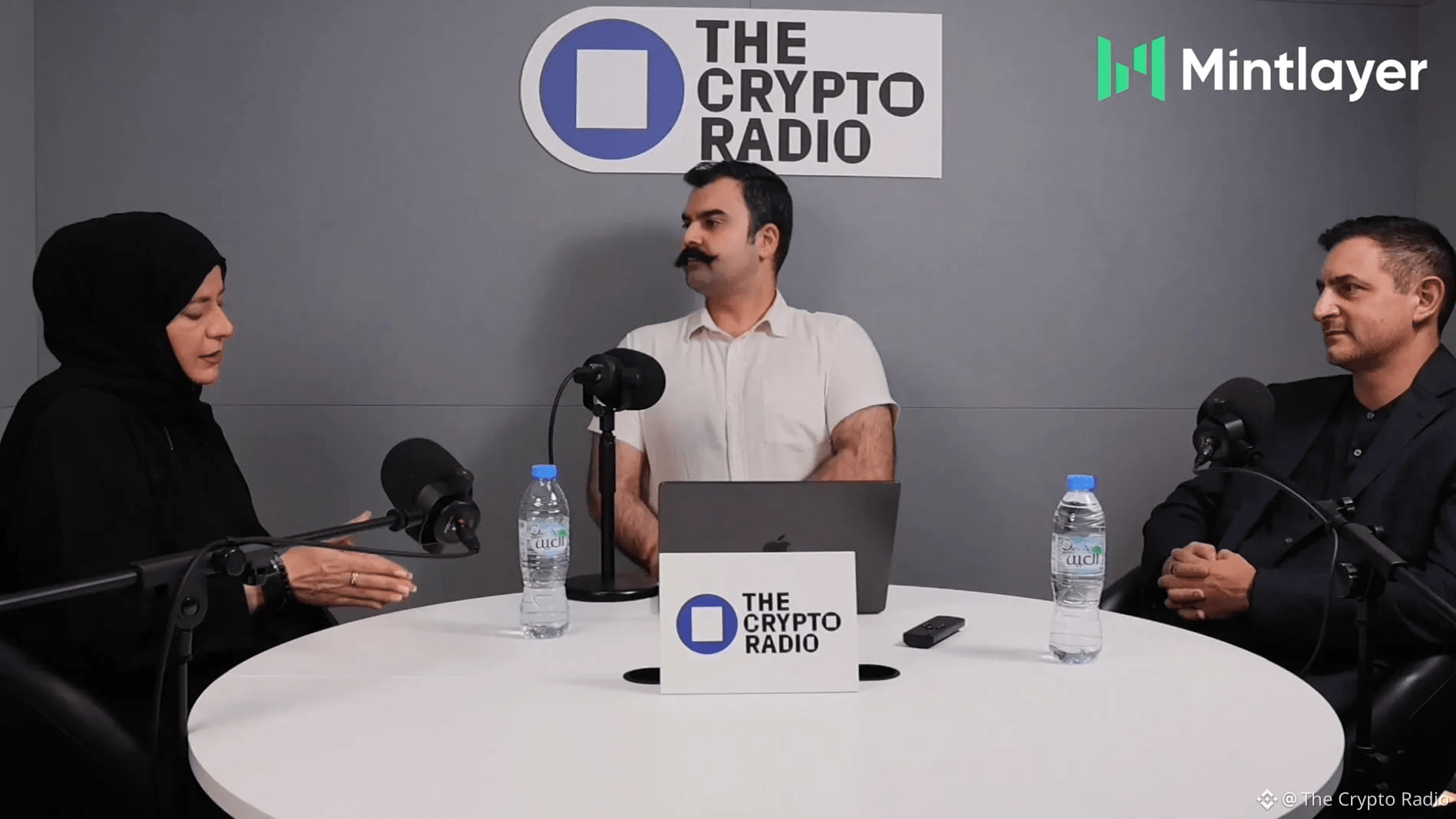
For Mintlayer, growth is as much social as technical. MacMillan argues that building an initial audience is not the hardest part – the real, daily work is nurturing that community, so it stays engaged rather than simply expanding in size.
Retention matters more than hype. A notable share of Mintlayer’s earliest supporters and investors are still involved with the project, something the leadership sees as a sign of both the technology and the culture around it.
Rubboli said this requires constantly confronting misconceptions about the industry. Many people still approach crypto as a get-rich-quick scheme, and part of Mintlayer’s role is to educate its community that while opportunities exist, the reality is more complex than that.
For MacMillan, the pull toward Mintlayer was as much about the people as the product. She joined as co-founder and COO because of the team, not just the technology. “I do believe a lot in people more than technology,” she said – a perspective that also shapes how the project engages its community.
She was equally frank about access and representation in the sector. As one of very few female – and Muslim – founders in the region, she said this identity can limit her access to certain spaces. “We need to make it personal. We need to say, ‘We want to do better,’” she added.
Mintlayer 2.0 and what comes next
With Mintlayer 2.0, the foundations stay the same while the stack expands upward. The team is adding more products built on its own infrastructure, including open-source tools to launch simple tokens. “We built the fundamentals, and now we're building more layers on top of that, and we are 100% open source from day one,” Rubboli said.
In the near term, MacMillan set an ambitious target. “For the next 6-12 months, we want to officially be recognized as the first blockchain unicorn of the UAE.”
Rubboli closed with an open invitation. “We have a community. Me, Anna, and the team are always there and responding to people directly," said Rubboli. "You are welcome to join the community.”
If Mintlayer works, Bitcoin will not bend to DeFi – DeFi will learn how to bend around Bitcoin.

