Many crypto projects talk about bringing real-world assets on-chain. Few explain what that actually means in practice.
Real financial markets are not just about trades. They are built on issuance documents, investor registries, transfer restrictions, corporate actions, settlement rules, reporting obligations, and liability protections. If these elements are missing, the “tokenized asset” is not a security at all—it is simply a token pretending to be one.
This is where Dusk fundamentally differs from most crypto initiatives.
Privacy Is Not the Point — Market Infrastructure Is
Privacy is often presented as Dusk’s defining feature, but that framing understates what the project is really doing. Dusk is building a blockchain where regulatory logic is embedded at the asset level, while sensitive financial data remains confidential.
This approach places Dusk closer to core market infrastructure than to conventional DeFi.
Dusk is a privacy-enabled blockchain designed specifically for regulated finance. Its goal is to move institutional workflows on-chain without sacrificing compliance, reliability, or performance. Privacy is not an add-on—it is a requirement derived from how real markets function.
XSC: A Security Standard, Not a Token Gimmick
One of the most overlooked aspects of Dusk is its asset standard: the Confidential Security Contract (XSC).
XSC is intended to do for securities what ERC-20 did for fungible tokens—but with privacy and regulation built into the core. Securities are not simple tokens. They have legal constraints on ownership, transferability, voting rights, dividend distribution, disclosure, and redemption. XSC encodes these constraints directly into the asset contract.
This is crucial because compliance is not merely an external process. By embedding transfer rules and disclosure logic into the contract itself, Dusk minimizes off-chain enforcement. Compliance exists within the protocol layer, not as an afterthought bolted onto an open ledger.
Why Privacy Is Essential for Regulated Markets
Public-by-default transparency is not how regulated markets operate.
Equity markets do not expose shareholder balances and wallet addresses to the world. Universal disclosure would create surveillance risks and distort strategic behavior. In traditional finance, privacy is the norm, and disclosure happens selectively and provably when required by regulators or auditors.
Dusk’s model recognizes this reality. It emphasizes asset-level confidentiality, not just private transfers. This distinction matters. Serious issuers and institutional investors will not move on-chain if ownership structures, investor lists, and transaction histories are publicly exposed.
Dusk is not pursuing secrecy for its own sake. It is recreating the privacy that already exists in traditional financial systems—while still enabling cryptographic proofs when policy requires them.
A Modular Architecture Built for Institutions
Another meaningful shift in Dusk’s evolution is its explicitly modular architecture.
At the base is DuskDS, which acts as the settlement, consensus, and data availability layer. On top of it sit multiple execution environments, including DuskVM and DuskEVM. Supporting components such as Rusk (node implementation), Kadcast (networking), and core staking and transfer contracts complete the stack.
This is not merely a technical choice—it is an institutional one.
Organizations do not want all business logic locked into a single virtual machine. They want permanent settlement and compliance guarantees at the base layer, with execution environments that can evolve as tools and regulations change. DuskDS provides exactly that.
This design signals that Dusk is not building a single-purpose chain. It is building a financial platform.
Security as a Requirement, Not a Suggestion
In DeFi culture, reliability often becomes important only after something breaks. Institutional systems do not have that luxury.
A validator failure or faulty deployment is not an inconvenience—it is a legal and operational crisis.
Dusk’s staking and validator model reflects this reality. Slashing is a real punitive mechanism, with both hard and soft penalties for downtime or invalid behavior. This moves Dusk away from casual participation and toward professional responsibility.
That is deliberate. The target users are financial processes that cannot tolerate unreliable infrastructure.
Long-Term Security Funding, Not Short-Term Hype
Dusk’s supply model reinforces its infrastructure-first mindset.
The network started with 500 million DUSK, with another 500 million issued over 36 years through staking rewards, bringing the maximum supply to 1 billion. Whether one likes inflation or not, the intent is clear: network security is funded over decades, not hype cycles.
Stock exchanges and settlement systems are built on 25-year horizons. A long, transparent emission schedule aligns with the role Dusk wants to play in regulated markets.
Adoption Through Regulation, Not Liquidity Theater
Dusk’s most credible progress is not flashy dApps—it is regulated partnerships.
In March 2024, Dusk partnered with Dutch exchange NPEX to explore a blockchain-based regulated securities market. In April 2025, it announced collaboration with 21X, a venue licensed under Europe’s DLT-TSS framework, enabling a fully tokenized and regulated securities exchange.
These partnerships are slow, procedural, and unglamorous. They involve licenses, regulatory negotiations, and real market participants. But this is what genuine adoption looks like in finance.
If Dusk succeeds, it will likely do so via controlled venues, compliant issuers, and settlement processes that quietly move real value.
What This Enables in Practice
Imagine a small or medium-sized company issuing a bond on-chain.
Investor lists remain confidential. Coupon payments are automated. Transfers are restricted to qualified buyers. Regulators can request records. Auditors can verify accounts. All of this happens natively on the blockchain.
This is the promise of confidential securities.
With standards like XSC, a settlement-focused base layer, modular execution, and privacy-preserving compliance, Dusk aims to host the full lifecycle of regulated financial assets—without turning sensitive financial data into public entertainment.
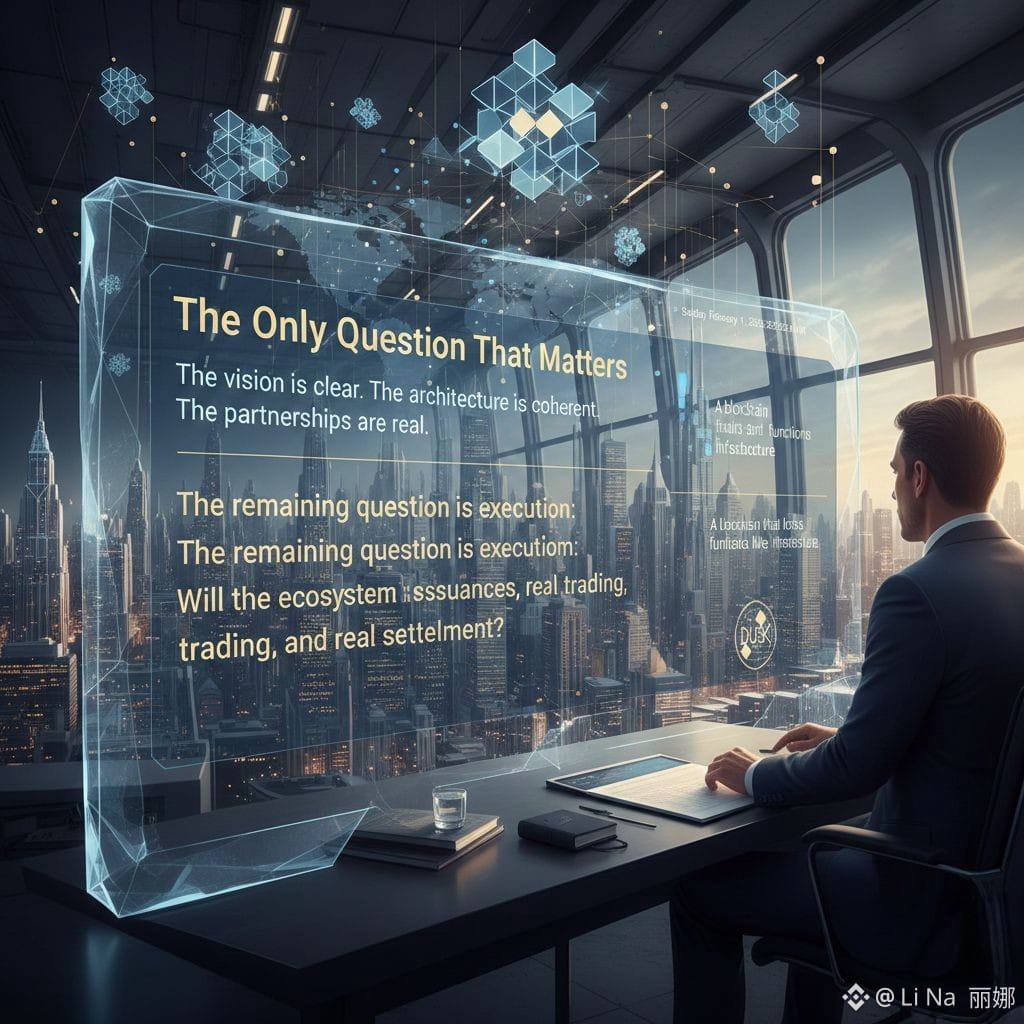
The Only Question That Matters
The vision is clear. The architecture is coherent. The partnerships are real.
The remaining question is execution:
Will the ecosystem produce real issuances, real trading, and real settlement?
If Dusk enables institutions to issue assets that behave like actual securities—private where required, provable when necessary—it stops being a crypto privacy project and becomes something rarer:
A blockchain that looks and functions like financial infrastructure.
That path is harder than chasing trends. But if it succeeds, it is far more likely to endure.