
Crypto keeps repeating the same fork in the road.
On one side you have general-purpose chains: powerful, flexible “world computers” where everything from NFTs to derivatives can live. The tradeoff is that payments and stablecoin settlement are just another workload competing for blockspace, fees, and attention.
On the other side you have issuer-led or corporate rails: highly optimized payment networks where the operator (often the issuer or a consortium) can tune UX, fees, compliance, and distribution. The tradeoff is obvious too: if the rail is controlled by the issuer, it’s hard for the market to treat it as neutral infrastructure.
Plasma is positioning itself as a strategic middle path: neutral + settlement focused. Not trying to be the everything chain, and not trying to be a captive corporate rail either. That framing shows up clearly in research coverage describing Plasma as neither general purpose nor issuer led, but closer to a neutral settlement layer focused on stablecoin flows.
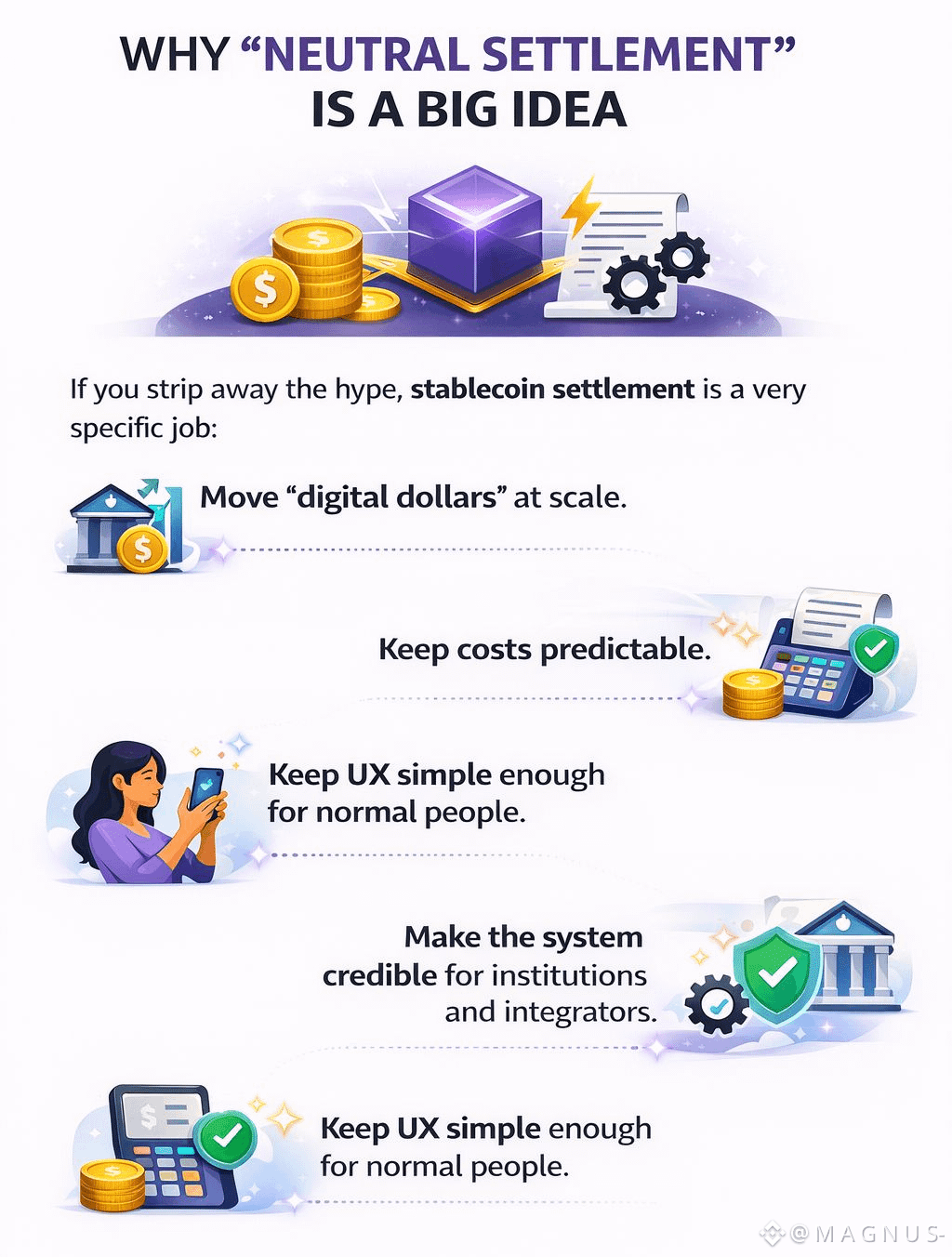
Why “neutral settlement” is a big idea
If you strip away the hype, stablecoin settlement is a very specific job:
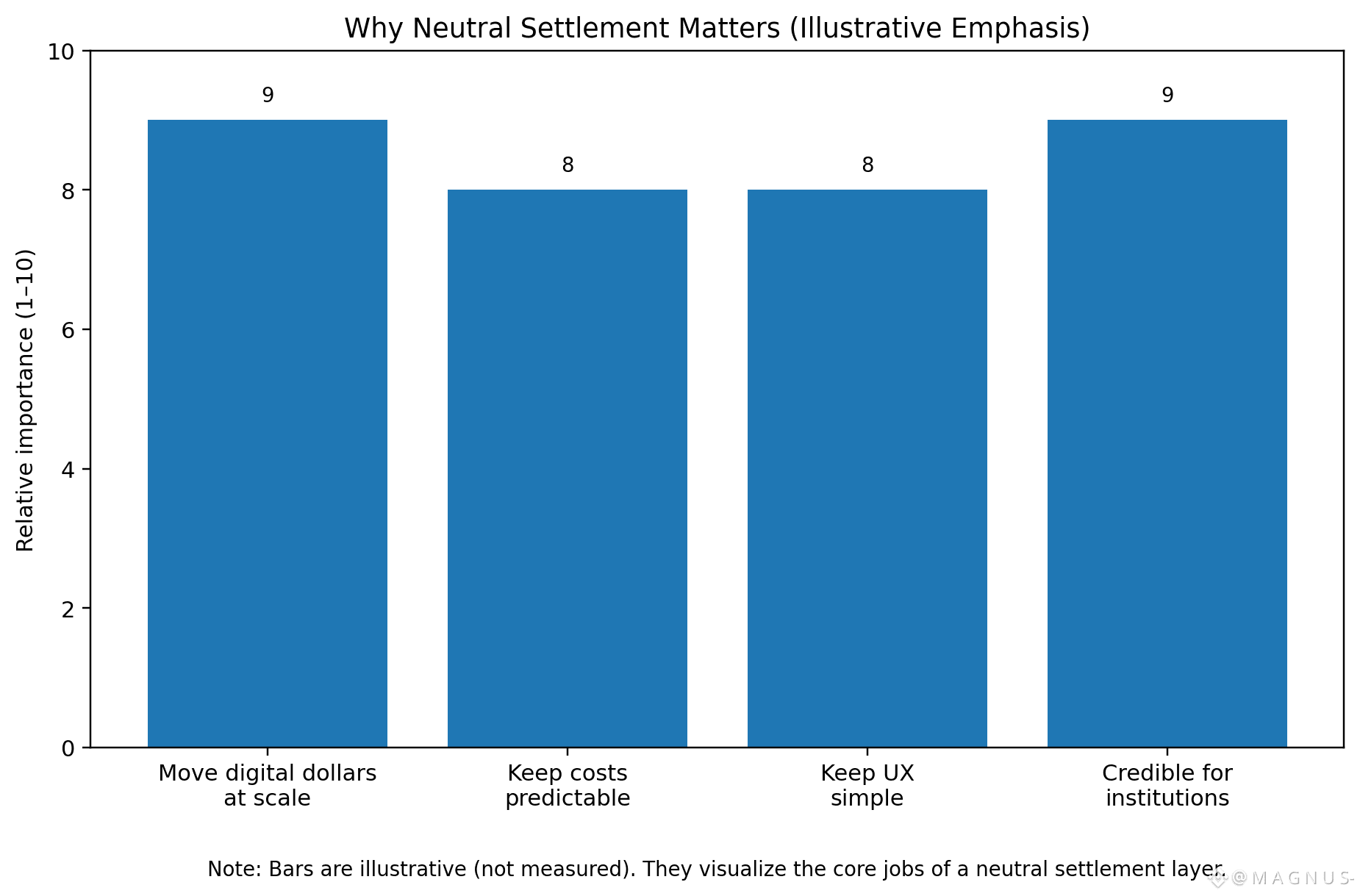
Move “digital dollars” at scale.
Keep costs predictable.
Keep UX simple enough for normal people.
Make the system credible for institutions and integrators.
Neutral settlement
A settlement layer wins when everyone can plug in without asking permission and without worrying that the operator can tilt the playing field. That’s the neutrality part. At the same time, the layer has to be engineered like payments infrastructure, not like a general purpose sandbox. That’s the settlement focus.
Plasma leans into that by describing itself as a high performance Layer 1 built specifically for stablecoins and USDT payments.
What the middle path looks like in practice
1) Stablecoin-first UX, without becoming an issuer’s walled garden
One of Plasma’s loudest product claims is zero-fee / gasless USD₮ transfers via a protocol-level paymaster/relayer approach. The key point is scope: it is aimed at sponsoring basic stablecoin transfers so users don’t need to hold a native token just to move money.
That design choice is not just “marketing free transfers.” It’s a neutrality play:
The network is optimizing for settlement utility (move stablecoins easily).
Without requiring users to adopt an issuer-controlled interface or custodial rail.
2) Settlement focused does not mean “tiny feature set”
General purpose chains tend to say: “You can build anything.”
Settlement focused chains say: “We will make the core money-motion primitive unbelievably smooth.”
If your goal is to become infrastructure for payments, remittances, and high volume stablecoin movement, then features like gas abstraction and stablecoin native contracts are not extras. They are table stakes. Plasma’s own docs and FAQ position these as core network capabilities aimed at reducing friction for stablecoin payments.
3) Neutrality is also a credibility strategy
Issuer led rails can be efficient, but they introduce a question every integrator eventually asks: What happens when incentives change?
If the issuer controls the rails, you’re not integrating “infrastructure,” you’re integrating a counterparty.
Neutral settlement tries to remove that. Some commentary around Plasma explicitly frames its ambition around neutrality and even discusses anchoring credibility to widely trusted security assumptions such as Bitcoin.
(Interpretation: the more the settlement layer feels politically and economically neutral, the easier it is for wallets, exchanges, merchants, and fintechs to standardize on it.)
The comparison that matters: general-purpose vs issuer-led vs neutral settlement
General-purpose chains
Strength: maximum flexibility for developers.
Weakness: stablecoin settlement is rarely the top priority. It competes with everything else. During congestion, “payments” becomes just another use case paying market rate fees.
Issuer-led chains / corporate rails
Strength: tight UX, high control, easier compliance, predictable product decisions.
Weakness: less credible neutrality. Integrators may worry about preferential treatment, policy shifts, censorship pressure, or commercial lock-in.
Neutral settlement layer
Strength: aims to be the shared backbone. You can build on it, route through it, and integrate it without feeling subordinate to a single issuer’s roadmap.
Weakness: harder problem. You need issuer grade UX and public network credibility, without turning into a chaotic general purpose chain.
Plasma’s thesis is that the middle is where the real scale is: become the most useful “money pipe” and let apps, wallets, and institutions build the experiences on top. That’s why it highlights stablecoin native design and payment-focused infrastructure.
Why this “middle path” can win
If Plasma executes, the upside is structural:
Liquidity and routing concentrate where settlement is cheapest and simplest.
Wallets prefer rails that reduce user failure points (no gas confusion, fewer stuck transactions).
Enterprises prefer predictable, auditable flows over meme-driven blockspace markets.
And importantly: neutrality is a distribution engine. The more a chain is perceived as a credible, settlement-focused commons, the easier it becomes for the ecosystem to standardize around it.
The punchline
Plasma’s positioning is not “we are the next everything-chain.” It’s more precise: be the neutral settlement layer that stablecoins deserve. That means borrowing the product discipline of issuer rails (UX, predictability, scale), without inheriting their trust bottleneck. And it means resisting the temptation to become a general purpose playground where stablecoin flows are always fighting for oxygen.
That strategic middle path is not the loudest narrative in crypto, but it might be the one that actually touches billions of transactions.
@Plasma #Plasma $XPL

