

I began researching @Vanarchain Chain at a time when crypto felt overwhelming. The space was packed with aggressive promotion, endless speculation, and big promises that rarely translated into tools regular people could actually use. Amid all that noise, usefulness seemed to be fading. While searching for projects that felt more grounded, I stumbled across Vanar Chain almost by accident. At first, it didn’t stand out at all. But the more I read, the more it held my attention.
What separates Vanar from most blockchain projects is its refusal to chase hype. Instead of flashy messaging, its ambition is surprisingly subtle—and far more challenging. The team wants blockchain technology to become so intuitive that users don’t even notice it’s there. That idea alone made me curious, because even now, most blockchain platforms still feel inaccessible unless you’re deeply embedded in the crypto world.
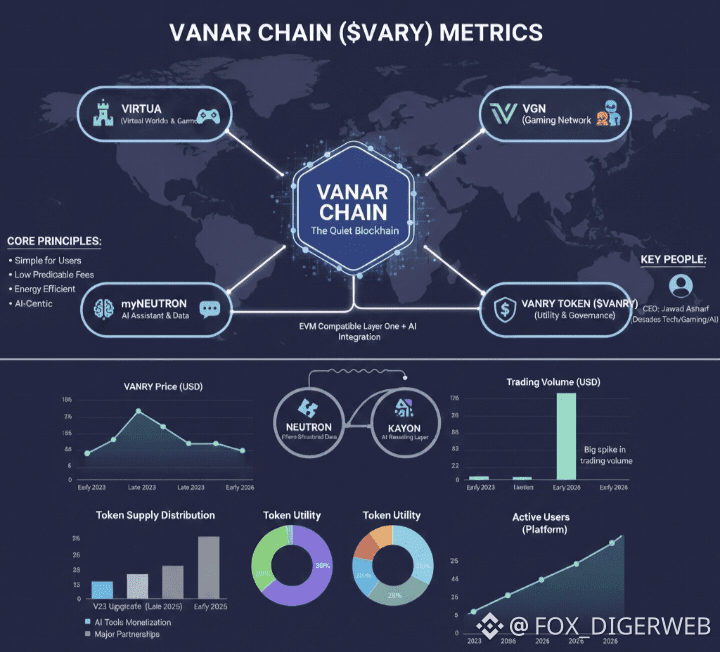
Digging into its history made things clearer. Vanar didn’t appear overnight. It evolved out of Virtua, a company that had been creating digital environments and virtual experiences long before the term “metaverse” became popular. Through years of building games and immersive platforms, the team kept running into the same obstacle: existing blockchains were slow, costly, and confusing for mainstream users. Rather than forcing their products to adapt, they chose to build their own infrastructure. That choice eventually resulted in a rebrand from TVK to VANRY and a more defined identity under Vanar Chain, with a clear focus on gaming, entertainment, and intelligent digital systems.
One aspect that stood out strongly during my research was Vanar’s commitment to hiding complexity. The project doesn’t expect users to understand wallets, gas fees, or private keys. Instead, blockchain is meant to operate quietly behind the scenes, much like cloud technology does today. Transaction fees are kept extremely low and predictable, which is critical for games, apps, and subscription-based services where unexpected costs drive users away. Their emphasis on efficiency and performance also suggests a long-term mindset rather than a short-lived trend.
The leadership team adds credibility to that impression. CEO Jawad Ashraf brings decades of experience across technology, gaming, and artificial intelligence. This isn’t a founder who arrived during a bull market looking for quick gains. The broader team has strong backgrounds in security, operations, and engineering. With the project based in Dubai and structured around a foundation, Vanar feels far more deliberate and transparent than many crypto ventures built around anonymity.
Technically, Vanar is less complicated than it might initially sound. It’s an EVM-compatible layer one blockchain, meaning developers can use familiar tools. Where it differs is in how deeply artificial intelligence is integrated. Instead of layering AI on top of the chain later, Vanar was designed from the beginning with AI-readable data structures. That’s notable, because many blockchains still treat AI as an external add-on rather than a core component.
A key innovation here is Neutron. At a basic level, it converts standard files into structured, on-chain data. Rather than simply storing references, it preserves meaning within the blockchain itself. Built on top of that is Kayon, a reasoning layer that allows smart contracts to interpret and act on that data. While the terminology sounds complex, the concept is simple: the chain can handle basic logic independently instead of constantly depending on off-chain systems. That enables a level of automation that feels genuinely intelligent.
This isn’t just conceptual work either. Vanar already supports live products. Virtua offers a digital world where users can explore, interact, and own digital assets in a way that feels like a consumer platform first, not a crypto experiment. VGN focuses on gaming and uses a single sign-on model, allowing players to start immediately without needing prior crypto knowledge. Ownership and blockchain elements are introduced later, naturally. That progression feels far more aligned with how people actually adopt technology.
Another standout product is myNeutron, an AI-driven tool for storing and organizing information such as notes and personal data. It functions like a digital assistant, but what makes it especially relevant is that it runs directly on Vanar and uses VANRY tokens through a subscription model. In this case, the token has a clear purpose beyond speculation—it’s required because the service itself has value. That kind of organic demand is uncommon and worth paying attention to.
I also spent time examining the VANRY token. Its supply is capped, with a large portion already circulating. It’s used for network fees, staking, governance, and access to various services. Users can stake VANRY to help secure the network and earn rewards. Although the token’s price is well below its historical highs, development activity hasn’t slowed. In crypto, price often distracts from real progress, and this feels like one of those situations.
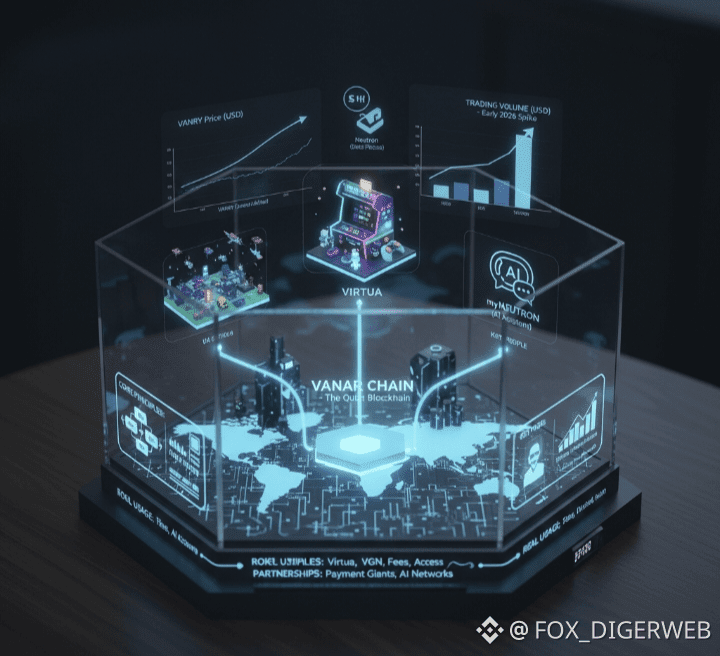
Recent developments have only reinforced that view. The V23 upgrade strengthened security, improved performance, and prepared the network for deeper AI integration. The move to paid AI services suggests confidence in the product rather than a lack of direction. In early 2026, trading activity increased sharply, hinting that broader market interest may be returning. Even more telling are the partnerships with payment providers, AI platforms, and data services, which show a clear effort to connect with real-world use cases instead of staying isolated within crypto.
Of course, challenges remain. Gaining widespread adoption is never easy, and competition in this space is fierce. Still, after looking closely at the project, Vanar Chain feels like it’s building something substantial without shouting about it. There’s no constant hype cycle, just steady execution. If the team continues delivering and users continue to adopt its products, Vanar could become one of those technologies people rely on daily without ever knowing what powers it. And in many ways, that’s probably the highest achievement a blockchain can reach.
