

The Agent Problem: Context Without Persistence
Autonomous AI agents are beginning to transition from theoretical concepts to practical tools operating in real-world systems. A lending agent approves mortgages. A trading agent rebalances portfolios. A compliance agent reviews transactions. A supply chain agent coordinates shipments. Each of these agents must make decisions based on information, yet they face a fundamental architectural constraint: they cannot remember what they learned yesterday or maintain context across sessions.
Traditional AI agents operate in isolation, starting fresh with every task. They are provided with a prompt, given access to some current data through an API, and expected to make a decision. But the quality of that decision depends entirely on what information is explicitly passed to them in that moment. If the agent needs to understand a complex regulatory framework, someone must include the full framework in every prompt. If the agent needs to learn from previous transactions, someone must explicitly pass historical data each time.
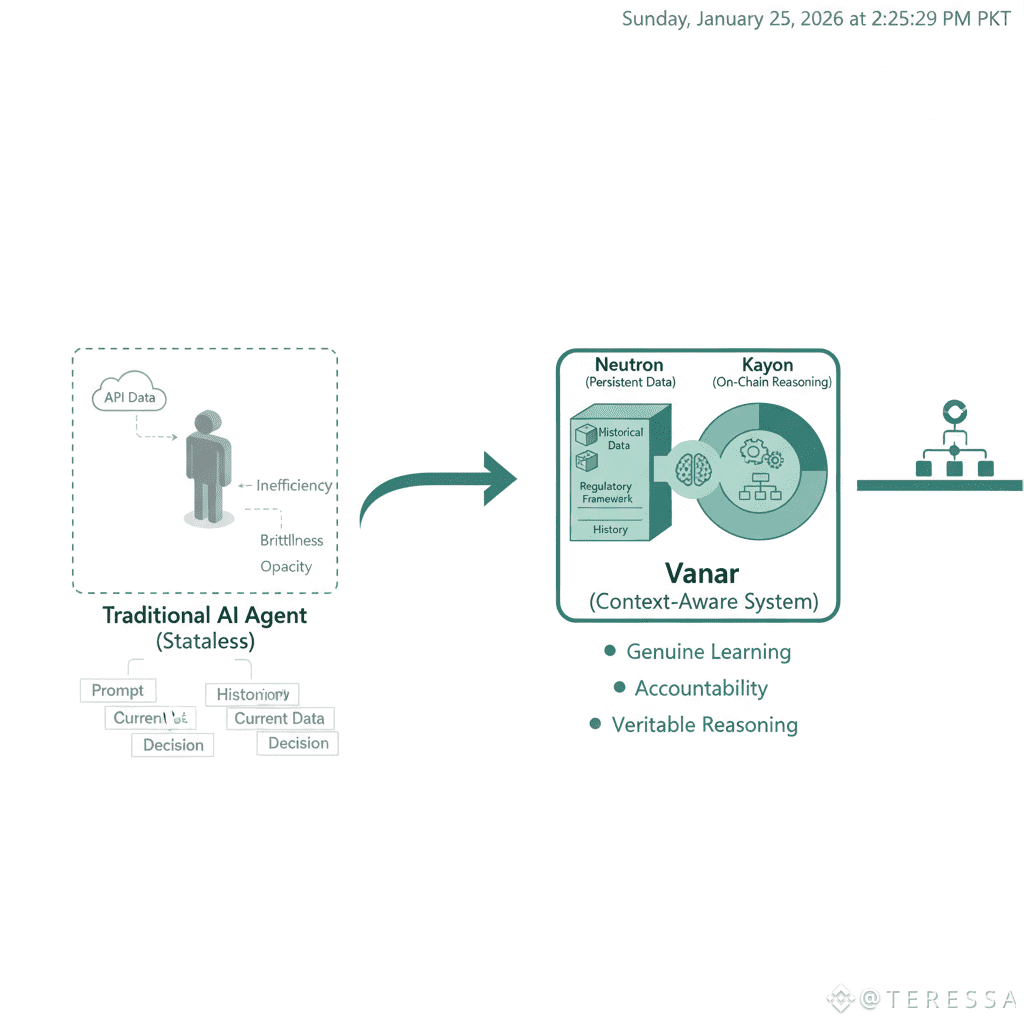
If the agent needs to understand a borrower's relationship history, someone must fetch that history and format it correctly. This creates three cascading problems: inefficiency (redundant data retrieval), brittleness (any change to data structure breaks the agent), and opacity (the reasoning chain becomes implicit, not verifiable).
Vanar addresses this through a tightly integrated pair of technologies: Neutron for persistent, queryable data, and Kayon for on-chain reasoning that understands that data. Together, they transform agents from stateless decision-makers into context-aware systems capable of genuine learning and accountability.
Neutron: Making Data Persistent and Queryable for Agents
Neutron compresses files up to 500:1 into "Seeds" stored on-chain, while Kayon enables smart contracts to query and act on this data. For agents, this compression is revolutionary because it solves the data availability problem entirely. Rather than repeatedly querying databases or APIs, agents can reference compressed, immutable Seeds that contain everything they need to know.
Consider a lending agent that needs to underwrite a loan. In a traditional system, the agent would query multiple databases: borrower credit history, income verification, collateral valuation, market conditions, regulatory frameworks. Each query is latent. Each system could be offline. Each database could change the format or access pattern. Worse, there is no audit trail showing what data the agent saw when it made the decision.
With Neutron and Kayon, the entire context is available in Seeds. The borrower's financial history is compressed into a queryable Seed. The regulatory framework is compressed into a queryable Seed. The collateral valuation methodology is compressed into a queryable Seed. Market conditions are compressed into a queryable Seed. The agent does not retrieve this data repeatedly; it queries compressed knowledge objects that remain unchanged. The entire decision trail is auditable because the data the agent consulted is immutable and verifiable.
The compression itself matters for agents. Unlike blockchains relying on external storage (e.g., IPFS or AWS), Vanar stores documents, proofs, and metadata natively. This eliminates network latency and dependency on third-party services. An agent does not wait for AWS to respond or worry that IPFS is temporarily unavailable. The data it needs is part of the blockchain consensus layer itself. For autonomous systems making consequential decisions, this reliability is non-negotiable.
The format of Neutron Seeds also matters for agents. A Seed is not just a compressed blob; it is a semantic data structure that agents can understand and reason about. Data isn't static - Neutron Seeds can run apps, initiate smart contracts, or serve as input for autonomous agents. A legal document compressed into a Seed retains its semantic meaning—an agent can query it for specific clauses, obligations, or conditions. A financial record compressed into a Seed remains analyzable—an agent can query it for income trends, debt ratios, or credit events. The compression preserves what matters while eliminating what does not.
Kayon: Intelligence That Understands Compressed Data
Kayon, a decentralized inference engine supporting natural language queries and automated decision-making, completes the architecture by giving agents the ability to reason about Neutron-compressed data. Kayon is not a simple query engine; it is a reasoning system embedded directly into the blockchain protocol.
The distinction matters profoundly. A query engine retrieves data based on exact matches or pattern matching. "Find all transactions from borrower X between dates Y and Z." A reasoning engine understands relationships, constraints, and implications. "Analyze borrower X's repayment history, assess their current debt-to-income ratio considering their recent job change, evaluate their collateral considering market volatility, and determine whether lending to them aligns with our risk framework." Kayon handles the second type of problem—not through external AI APIs, but through deterministic, verifiable, on-chain logic.
For agents, this means they can make complex decisions with full transparency. An agent consulting Kayon receives not just a data point, but a reasoned analysis. Kayon is Vanar's onchain reasoning engine that queries, validates, and applies real-time compliance. When an agent asks Kayon whether a transaction complies with regulations, Kayon returns not just "yes" or "no," but the exact logic that determined the answer. When an agent asks Kayon to analyze risk, Kayon returns not just a score, but the calculation path. This transparency is critical for regulated applications where decision-making must be auditable.
The integration between Neutron and Kayon creates a closed loop. Neutron provides persistent, verifiable context. Kayon reasons about that context. The agent leverages both to make informed, auditable decisions. The decision is recorded on-chain. Future agents can reference that decision as historical precedent. Over time, each agent interaction improves the institutional knowledge that subsequent agents can reference.
Agent Memory: Building Institutional Wisdom
The traditional view of agent memory is external: after an agent makes a decision, the human operator saves the interaction to a log or database. The agent itself has no memory of it. The next time that agent encounters a similar situation, it starts fresh. This is acceptable for narrow tasks but breaks down for agents operating across time and learning from experience.
@Vanarchain enables a different model: agent memory as on-chain assets. When an agent makes a decision, the context (Neutron Seeds it consulted), the reasoning (Kayon analysis it relied on), and the outcome (what actually happened) can all be stored as compressed Seeds on the blockchain. The agent can then access this memory indefinitely. The next time it encounters a similar decision, it can consult both its rules and its historical learning. Over time, the agent's reference library becomes richer, more nuanced, and more calibrated to real-world outcomes.
Consider a loan underwriting agent that learns across time. Initially, it relies on explicit regulatory frameworks and risk models provided by humans. As it processes loans and observes which borrowers default, it accumulates historical Seeds. These Seeds capture not just the data that was available, but the decisions made and outcomes observed.
An agent reviewing a future applicant can now query Kayon against Seeds of similar past applicants. "Of the five hundred borrowers with this profile, how many defaulted? What distinguished the ones who repaid from the ones who defaulted?" The agent's decision-making becomes increasingly informed by experience, not just rules.
This creates what could be called institutional memory—knowledge that belongs to the organization, not to individual agents or engineers. If a lending team member leaves, the institutional knowledge they accumulated remains accessible to successor agents. If an agent becomes deprecated or replaced, its accumulated learning can transfer to its successor. Institutional wisdom compounds across agents and time.
Verifiable Autonomy: Auditing Agent Decisions
The regulatory concern with autonomous agents is straightforward: how can we know they are operating correctly? If an agent makes a consequential decision—approving a loan, executing a trade, authorizing a payment—who is accountable? How can we audit whether the decision was justified?
Traditional approaches require external logging or human review. An agent makes a decision, and a human reviews the decision trail to understand what happened. But this creates a gap: the human reviewer cannot necessarily verify that the data the agent saw was accurate or that the reasoning was sound.
Vanar closes this gap through integrated verifiability. Neutron transforms raw files into compact, queryable, AI-readable "Seeds" stored directly onchain. When an agent makes a decision based on Neutron-compressed data, the data is cryptographically verifiable. A regulator can confirm that the agent consulted the exact data it claims to have consulted. Cryptographic Proofs verify that what you retrieve is valid, provable, and retrievable—even at 1/500th the size. When an agent reasons using Kayon's on-chain logic, the reasoning is deterministic and reproducible. A regulator can trace the exact calculation steps the agent followed.
This transparency is not optional for high-stakes domains. Financial regulators require audit trails showing the basis for lending decisions. Insurance regulators require explanation of claim approvals. Healthcare compliance requires justification of treatment decisions. Vanar enables agents to operate in these domains because their decisions are inherently auditable.
The Agent Fleet: Coordination Without Intermediaries
As organizations deploy multiple agents—one for lending decisions, one for portfolio management, one for compliance review, one for customer service—they face a coordination problem. These agents need to share context and learn from each other without losing transparency or control.
Neutron and Kayon enable what could be called a "cognitive infrastructure" for agent fleets. All agents operate on the same data substrate: immutable, verifiable, compressed Seeds. All agents access the same reasoning engine: Kayon. When one agent creates a Seed capturing a decision or insight, all other agents can reference it immediately. When Kayon evaluates a regulatory constraint, all agents benefit from the consistent reasoning.
This is more powerful than traditional API-based coordination. When agents coordinate through APIs, they are at the mercy of network latency and service availability. When agents coordinate through the blockchain, coordination is part of the consensus layer itself. When one agent records a Seed, it is immediately available to all other agents because it is part of the immutable ledger.
More importantly, this enables genuine learning across the agent fleet. If a lending agent discovers that borrowers with a certain profile have low default rates, it can record this insight as a Seed. Other agents in the organization can reference it. Portfolio management agents can adjust strategy. Risk management agents can adjust models. This kind of institutional learning requires persistent, shared context—exactly what Neutron and Kayon provide.
Scaling Intelligence: From Automation to Autonomous Economies
The ultimate vision Vanar is pursuing is autonomous economic systems—not just single agents making individual decisions, but entire ecosystems of agents cooperating, competing, and learning without centralized coordination. A gaming economy where agents manage supply and demand. A financial market where agents set prices based on information. A supply chain where agents coordinate logistics based on real-time constraints.
For these systems to work, agents need three capabilities. First, persistent memory that survives across transactions and time periods. Second, shared reasoning frameworks that prevent each agent from independently solving the same problem. Third, verifiability that allows humans to understand what autonomous systems are doing without constantly intervening.
Neutron provides the first: Seeds encoding persistent knowledge that agents can reference indefinitely. Kayon provides the second: shared reasoning logic that all agents access through the same protocol layer. Blockchain itself provides the third: immutable, auditable records of all agent interactions.
The combination creates infrastructure for autonomous systems that are not black boxes, but transparent systems operating according to verifiable principles. An autonomous gaming economy is not a mysterious algorithm adjusting item drop rates; it is an agent consulting Kayon logic against Neutron Seeds of market data and player behavior, with the full decision trail visible to any observer.
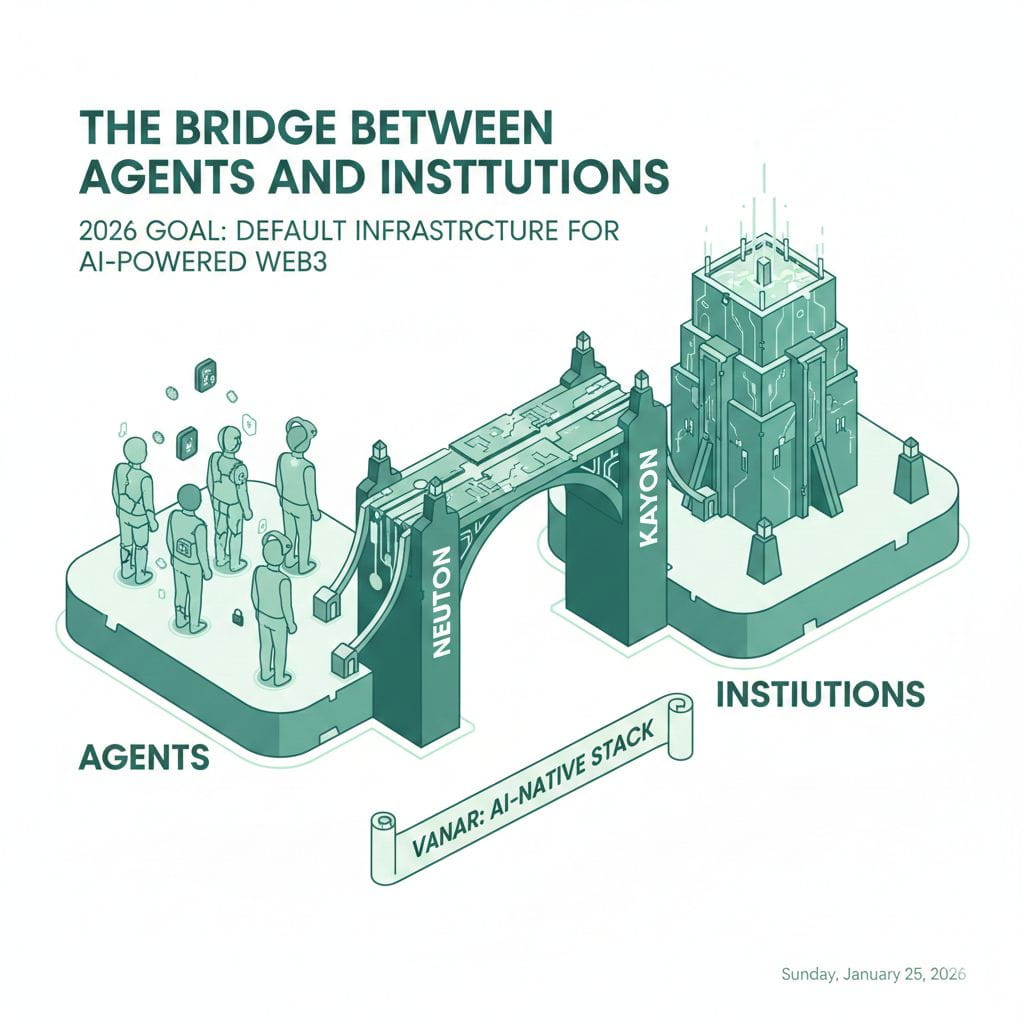
The Bridge Between Agents and Institutions
Perhaps the deepest insight Vanar brings to agents is that institutional adoption of autonomous systems requires institutional infrastructure. Agents built on top of unverifiable systems or dependent on centralized services are not institutions can adopt responsibly. They might reduce costs, but they increase risk and reduce accountability.
Vanar positions Neutron and Kayon as institutional infrastructure for agents. Vanar's roadmap centers on maturing its AI-native stack with the strategic goal for 2026 to solidify this infrastructure as the default choice for AI-powered Web3 applications. This is not infrastructure for toy agents in experimental systems. This is infrastructure for loan underwriting agents, compliance agents, risk management agents, and supply chain agents operating at enterprise scale where every decision is auditable and every action is verifiable.
For the next generation of autonomous systems—the ones that will actually matter economically and socially—the infrastructure layer itself must be intelligent, trustworthy, and transparent.
Vanar's Neutron and Kayon represent the first attempt to build that infrastructure from first principles, embedding intelligence and verifiability into the blockchain layer itself rather than bolting it on afterwards. Whether this approach becomes standard depends on whether enterprises value auditable autonomy enough to adopt infrastructure specifically designed for it. The evidence suggests they do.
