I’ve been around long enough to notice a pattern in decentralized projects that don’t make it. It’s rarely because the idea was bad. Most of the time, the concept actually made sense. What failed was the foundation underneath it, especially data. Blockchains are fine when all they need to do is move value or record ownership. But the moment you ask them to deal with large files, histories, or application data, they start to struggle. That’s where Walrus first caught my attention. Not with noise, but with restraint.
When I sat down and really read through Walrus, I remember thinking how familiar the problem felt. We’ve all seen “decentralized” apps quietly rely on some off-chain storage that, if we’re being honest, was basically one server pretending to be a network. And sooner or later, that setup breaks. Walrus doesn’t dance around this reality. It takes the uncomfortable part of crypto infrastructure and puts it right at the center.
What stood out to me right away was how narrow their focus is. Walrus isn’t trying to rebuild the internet or redefine finance. It’s asking a much simpler question: how do you store large amounts of data in a decentralized way without making it fragile or absurdly expensive? That question isn’t exciting, but it’s necessary. Crypto doesn’t collapse because of a lack of ideas. It collapses because the boring parts weren’t built properly.
Most applications today still make compromises when it comes to storage. Media files, datasets, even basic app assets often live outside the decentralized system. Developers know this isn’t ideal, but they accept it because the alternatives don’t scale well. Walrus starts from the assumption that this shortcut can’t last forever. If your data availability depends on trust, then decentralization is mostly cosmetic.
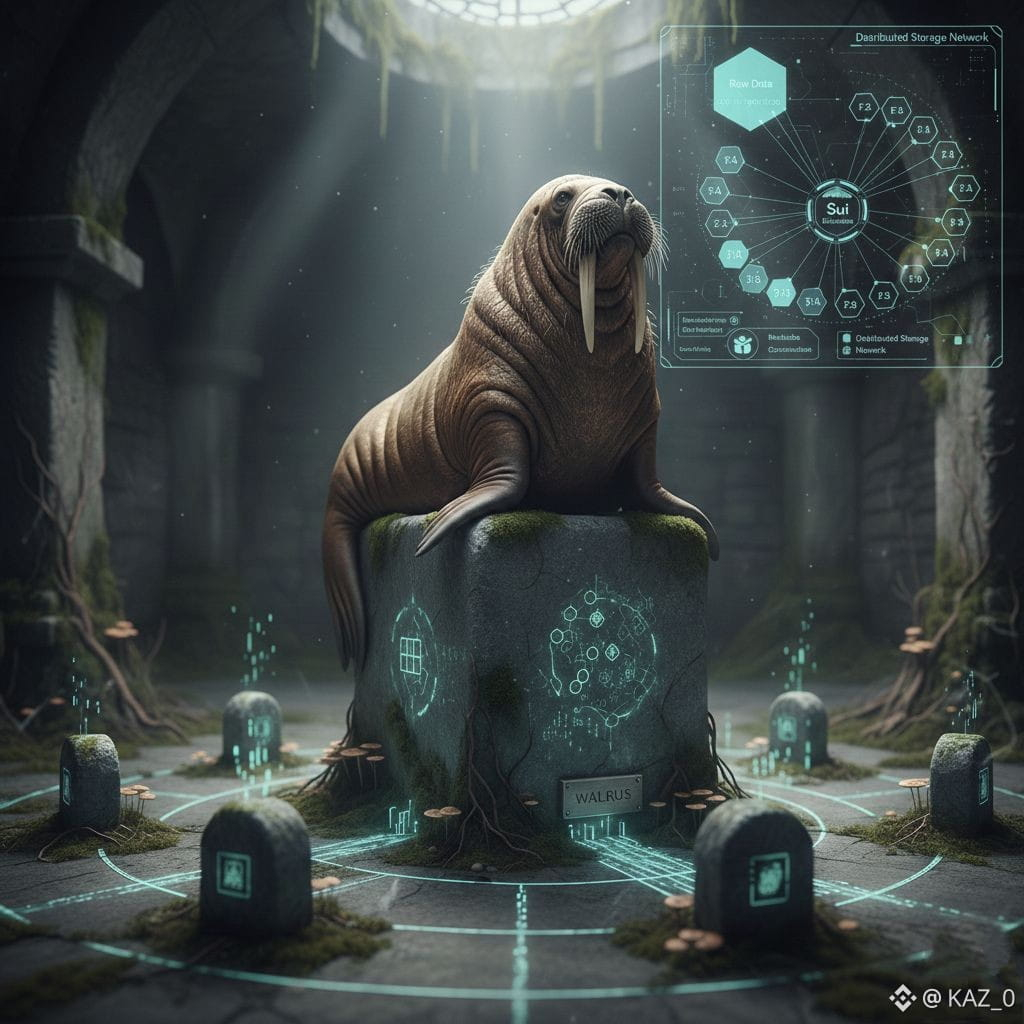
The way Walrus handles storage reflects that mindset. Large files aren’t pushed onto the blockchain. Instead, they’re broken down, encoded, and spread across independent nodes. I like this approach because it feels realistic. Things fail. Nodes disappear. Networks go down. Systems that assume everything will always be online don’t survive very long.
Using erasure coding instead of full replication is one of those decisions that won’t impress anyone on social media, but it actually matters. Rather than copying entire files everywhere, Walrus distributes fragments so the original data can be recovered even if several nodes drop out. It’s efficient. It’s resilient. And honestly, it’s how serious infrastructure should be built. Infrastructure survives by being boring. That’s the truth.
Sui’s role here also feels well thought out. Walrus doesn’t ask the blockchain to do work it isn’t designed for. The chain handles coordination, ownership, and payments. The heavy data lives elsewhere. Too many projects try to force everything on-chain and then act surprised when performance suffers. Walrus doesn’t fall into that trap, and I respect that.
From a financial perspective, the system is grounded in actual usage. WAL isn’t there just to exist. It’s used to pay for storage, secure the network through staking, and shape governance decisions. Storage operators have skin in the game, which means reliability isn’t optional. I’ll be honest, it’s actually pretty refreshing to see incentives that make sense without needing a long explanation.
Recent progress has been steady rather than dramatic. Moving from early testing into a live network is a bigger deal than most people realize. That’s usually where weak designs get exposed. Ongoing improvements to tooling and participation suggest that the focus is still on making things work before talking about scale or dominance. That tells me a lot about priorities.
To be fair, none of this guarantees success. Distributed storage is hard, and we’ve all seen solid-looking systems fade once real pressure showed up. But I’ll be honest here — Walrus doesn’t feel like it’s chasing attention. It feels like it’s trying to hold up under stress. And right now, crypto doesn’t need louder promises. It needs infrastructure that works quietly, even when nobody’s watching. Walrus seems built for exactly that kind of moment.