Plasma is basically built around one very human observation: most people don’t “use blockchains.” They send money. And right now, the thing they send most often is stablecoins—especially USDT. So Plasma stops pretending the blockchain is the product and treats stablecoin settlement as the product.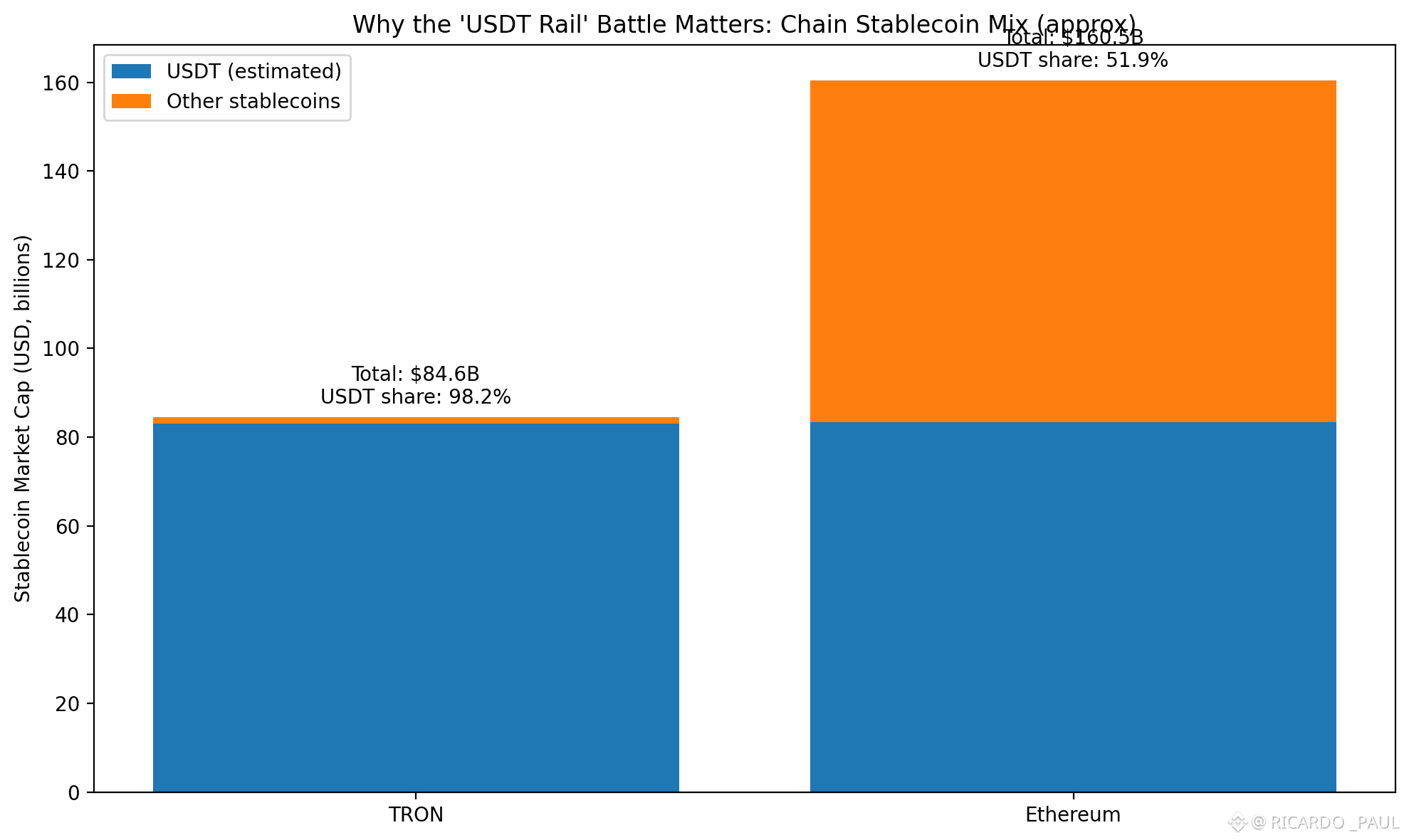
That changes the whole vibe. Instead of asking users to learn gas tokens, confirmation theory, and wallet gymnastics, Plasma is trying to make stablecoin transfers feel like what people already expect from money apps: fast, cheap, and final enough that you don’t have to second-guess it.
What makes Plasma interesting isn’t that it’s “another fast EVM chain.” It’s that it has a specific job and it’s designing everything around that job: move stable value cleanly, at scale, for both everyday users and serious payments businesses.
A lot of chains say they’re good for payments. But payments is a brutal category. It doesn’t forgive weird friction. If a user receives USDT and can’t move it because they don’t have gas, they don’t think, “Ah yes, the native token problem.” They think, “This is broken.” That one moment kills trust. Plasma is trying to remove that moment entirely.
Under the hood, Plasma stays fully EVM compatible using Reth (the Rust Ethereum execution client). In plain terms: if you’re building with Ethereum tools, Plasma wants you to feel at home. That’s a practical decision. Stablecoin infrastructure is already built around the EVM world—wallets, exchanges, compliance tooling, smart contracts, developer skills. Plasma isn’t trying to rebuild that universe; it’s trying to run it in a way that feels more like payments infrastructure than crypto infrastructure.
Then there’s finality. In payments, “maybe confirmed” isn’t good enough. For a merchant, a payroll desk, or a cross-border remittance flow, you want to know the transfer is actually done. Plasma’s consensus (PlasmaBFT) is built around fast BFT-style finality, with the goal of making confirmation feel immediate and reliable. Less waiting, less uncertainty, less “should I refresh again?” energy.
But the real Plasma personality shows up in the stablecoin-first features.
The headline one is gasless USDT transfers. The idea is straightforward: if the main thing people do is send USDT, then the chain should be willing to cover the cost of that action—at least at first—so sending stablecoins doesn’t require holding a separate token just to pay fees. It’s not “everything is free forever.” It’s more like: “We’ll sponsor the most important action so normal people can just use the system.” That’s a product decision, not a purely technical one, and you can feel the intent behind it.
The next step is stablecoin-first gas. Even when transfers aren’t sponsored, Plasma is aiming for a world where you can pay fees in USDT (or another approved token) instead of being forced to buy the chain’s native token. That sounds small until you’ve watched real adoption. This single detail can be the difference between “my wallet works” and “why do I need to buy another thing just to move my money?”
Now, if you’re thinking: “Okay, but if the user doesn’t need the token, what’s the token for?”—that’s the right question.
Plasma’s token (XPL) matters because the chain still needs to be secured. Validators need to stake something. The network needs a coherent incentive system. The token is how you make the infrastructure reliable even if the end user never thinks about it. In that sense, XPL isn’t meant to be your spending money. It’s more like the engine part. Users can ride the train without knowing how it runs, but the train still needs steel tracks and maintenance crews.
Plasma’s token model reflects that “infrastructure token” framing. There’s a defined supply, a clear allocation plan, vesting for team and investors, and an inflation schedule meant to reward validators, with a design that burns base fees (EIP-1559 style) to counterbalance emissions as the network gets used. It’s basically trying to build an economy that can survive the payments reality: lots of transactions, low fees per transaction, high expectations for reliability.
And that’s where Plasma’s real challenge sits.
Payments chains have a classic trap: if fees are too low, you can’t fund security; if fees are too high, users leave. Plasma’s way around this is to lean on volume and design the token economics to handle low-margin, high-throughput usage. It’s a reasonable strategy. It just means Plasma has to win the hard way—by becoming genuinely useful, not just exciting.
Another piece Plasma keeps pointing at is Bitcoin-anchored security and a trust-minimized Bitcoin bridge approach. Put simply: it wants a security story and liquidity pathway that feels more neutral and harder to capture. That’s important because anything that becomes a real payment rail eventually attracts pressure—commercial and regulatory. In practice, bridges are risky and complicated, so Plasma’s staged rollout approach (shipping core chain first, then adding heavier modules later) is the responsible path. It’s also a signal that the team is thinking in “infrastructure timelines” rather than “launch week hype.”
Plasma also gestures toward confidentiality features for stablecoin payments. And honestly, this may be one of the most important long-term pieces. People underestimate how much transparency blocks real-world finance. Businesses don’t want every supplier payment, payroll run, or treasury move visible forever. The trick is doing privacy in a way that still plays nicely with compliance and doesn’t break the whole ecosystem. Plasma’s approach is framed as opt-in and designed for selective disclosure. It’s hard, and it’s not fully there yet, but it points at a future where stablecoin settlement can work for institutions without forcing them into private databases.
So where does Plasma fit in the bigger world?
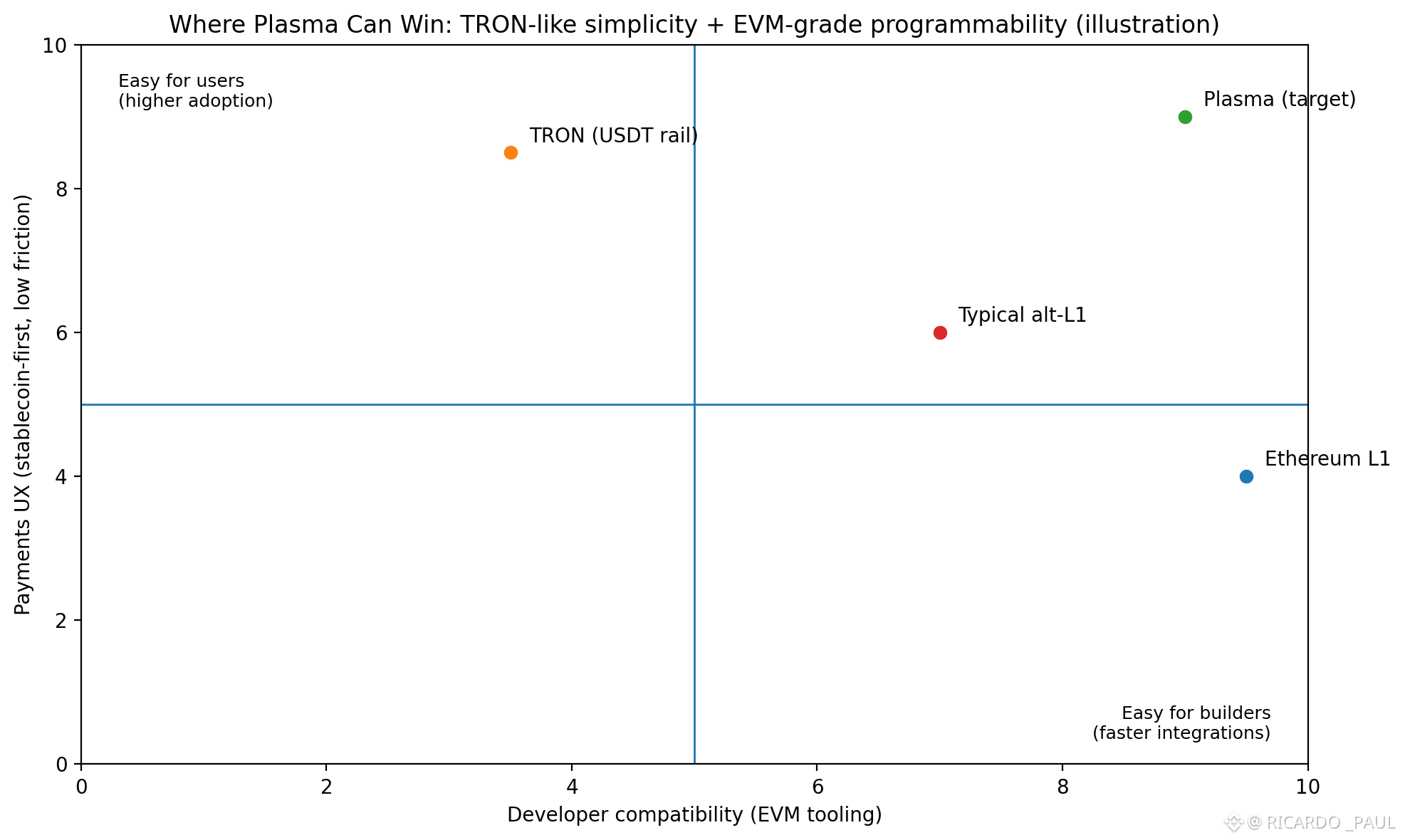
It’s aiming for a sweet spot: the usability that made TRON a dominant USDT rail in many retail markets, combined with the programmability and developer gravity of the EVM. That’s not an easy balance, but it’s a meaningful one. If Plasma nails it, it can become the chain that wallets choose as the default “send USDT” path, and that payment companies choose because it doesn’t make them rebuild everything from scratch.
Here’s the honest, human bottom line: Plasma is trying to make stablecoin settlement feel normal. Not “crypto normal,” but normal normal. And that’s a bigger ambition than it sounds. It requires not just speed, but consistency. Not just low fees, but a UX that doesn’t randomly collapse when someone forgets gas. Not just decentralization as a slogan, but neutrality in the places that usually become choke points—relayers, bridges, validator governance.
If Plasma succeeds, it won’t be because people fell in love with a new chain. It’ll be because people stopped thinking about the chain at all. They’ll just send USDT, it will land immediately, it won’t ask them to jump through hoops, and businesses will be able to use it without exposing their entire operating life to the public. And if Plasma can pull that off, XPL becomes something rare in crypto: a token whose value comes from quietly keeping a real piece of money infrastructure honest and running—like the kind of asset you don’t hype, you depend on.