

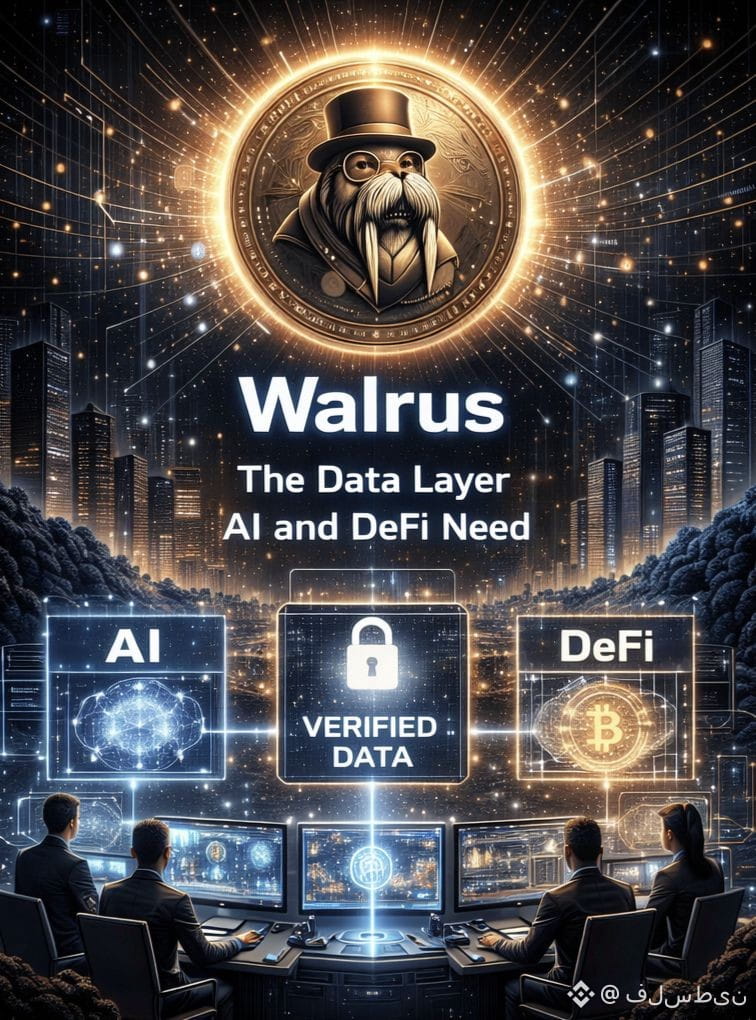
The future of digital technology will not be decided by faster blockchains or smarter algorithms alone. It will be decided by something far more fundamental: data. Artificial intelligence depends on it to learn. Decentralized finance depends on it to operate. Yet most digital systems today are built on data that is incomplete, unreliable, or impossible to verify.
This is the silent weakness of the modern internet.
Walrus is being built to solve this exact problem. Not as another product or platform, but as a data layer that brings structure, verification, and trust to the systems that will shape the next decade of technology.
Walrus is still early, but its role is already clear. It aims to become the foundation where AI and DeFi can safely scale without collapsing under bad data.
Why Data Is the Real Bottleneck
AI models can process billions of data points, but they cannot judge whether that data is true. DeFi protocols can move value instantly, but they cannot always detect whether transactions are risky or manipulated.
The problem is not speed.
The problem is data quality.
When AI trains on flawed datasets, it produces biased or incorrect outcomes. When DeFi relies on unreliable signals, it creates opportunities for fraud, exploits, and system failure.
Walrus approaches this from the root. Instead of fixing mistakes after they happen, it focuses on verifying data before it is used.
Walrus as a Data Layer
Walrus is designed as a decentralized data and verification layer that sits beneath applications, not on top of them. It does not compete with AI platforms or financial protocols. It supports them.
In the Walrus ecosystem, data has:
• A clear origin
• A transparent history
• A verifiable state
This allows systems to trace information, validate it, and rely on it with confidence.
Rather than trusting centralized sources, Walrus uses decentralized validators and cryptographic methods to confirm that data has not been altered or manipulated.
This turns data from a weak input into a strong foundation.
Why AI Needs Walrus
AI is only as intelligent as the data it consumes. Today, many AI systems are trained on massive but messy datasets. This leads to hallucinations, bias, and unpredictable behavior.
Walrus enables AI developers to work with clean and verified data pipelines. This improves model accuracy and transparency. It also makes AI systems more explainable, because their data sources can be audited.
As AI becomes more autonomous and integrated into real-world systems, trusted data will no longer be optional. It will be essential.
Walrus is positioning itself exactly where that need will be strongest.
Why DeFi Needs Walrus
DeFi removed intermediaries, but it also removed many safeguards. The result is an ecosystem where users face constant risks from false signals, smart contract exploits, and manipulated data.
Walrus introduces a verification layer that helps DeFi systems evaluate transactions, behavior patterns, and data inputs before acting on them.
This does not make DeFi centralized. It makes it intelligent.
Instead of reacting to damage, systems can prevent it.
A Foundation Still Being Built
What makes Walrus especially important is that it is still early. It is not locked into rigid structures. It is actively evolving as infrastructure.
Developers can build on it. Enterprises can integrate with it. Communities can help shape it.
This flexibility is what makes infrastructure projects powerful. They grow quietly, but they become impossible to replace once adoption begins.
Final Perspective
Most digital systems today are built on assumptions. Walrus is built on verification.
In a world moving toward AI-driven decisions and decentralized finance, the projects that survive will not be the loudest ones. They will be the ones that solve the deepest problems.
Data is the deepest problem.
And is building the layer that finally takes it seriously.
Walrus is not finished.
It is not even close.
It is just getting started.

