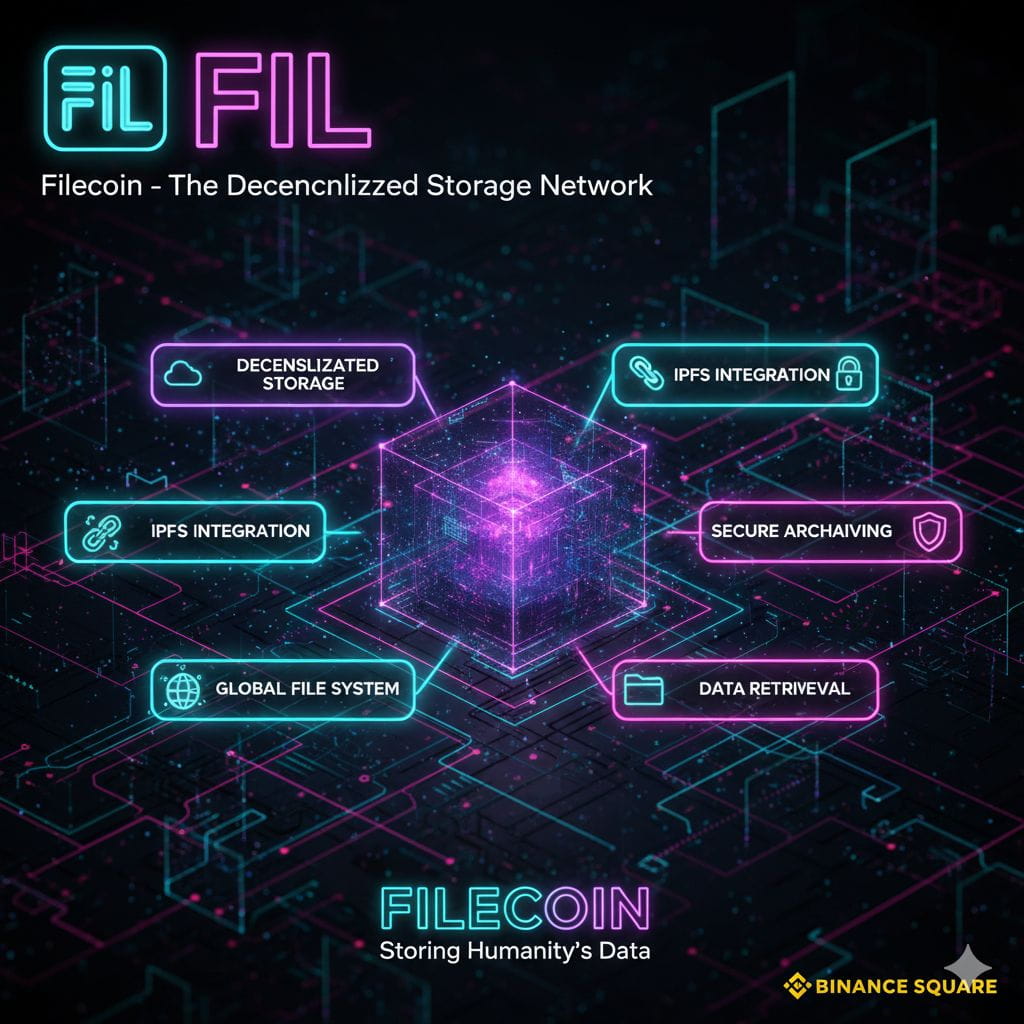
Filecoin $FIL isn’t just another blockchain token — it’s the native currency of a decentralized storage network designed to replace centralized cloud storage (like AWS or Google Cloud) with a peer-to-peer, blockchain-powered marketplace for data storage and retrieval. FIL drives a real utility: users pay for storing data, and storage providers earn FIL by offering space and proving they’re holding that data reliably over time.

🔍 What Is Filecoin (FIL)?
Filecoin is a decentralized storage protocol built on its own blockchain. It creates an open marketplace where:
Users pay FIL tokens to store data securely.
Storage providers (“miners”) earn FIL by offering hard drive space and proving that they are storing clients’ files correctly using Proof-of-Replication and Proof-of-Spacetime cryptographic systems.
A growing ecosystem of storage, retrieval, and programmable storage services is emerging, especially with the Filecoin Virtual Machine (FVM) supporting smart contracts and advanced use cases.
This positions Filecoin as an alternative to traditional cloud storage with a focus on censorship resistance, lower costs, and transparency.
📊 Outlook Ranges (Illustrative & Not Financial Advice)
ScenarioValue BehaviorPrimary InfluencesBullishRising toward higher rangesIncreased storage demand, enterprise adoption, AI/DePIN use casesNeutralSideways price actionBalanced market sentiment, slow utility uptakeBearishDownward pressureWeak macro conditions, lack of growth in storage utilization
These are sentiment frameworks — not price predictions.
🔑 Key Drivers
🗄️ 1) Real Utility in Decentralized Storage
Filecoin turns unused storage into an open marketplace, letting anyone — from individuals to enterprises — store data at competitive prices and verify its permanence on chain without a centralized intermediary. This is its core value proposition versus legacy cloud providers.
⚙️ 2) Cryptographic Proofs for Integrity
The network’s foundation relies on Proof-of-Replication (PoRep) and Proof-of-Spacetime (PoSt). These mechanisms ensure that providers truly store data and continue doing so over time, securing data integrity without trust.
🚀 3) Programmable Storage & FVM
Recent upgrades, including the Filecoin Virtual Machine (FVM), enable smart contracts and complex applications that interact with storage services. This opens doors for AI datasets, decentralized apps, and storage-backed services built directly into the protocol.
🧠 4) Enterprise Adoption Trends
Filecoin has seen enterprise interest grow, with more clients storing large datasets and capital inflows into storage markets. This hints at demand beyond retail or speculative use.
🔗 5) Cross-Chain Bridges & Ecosystem Expansion
Collaborations like Filecoin’s cross-chain bridge with Avalanche expand utility by enabling decentralized apps to combine Avalanche computation with Filecoin’s storage layer — potentially increasing real demand for FIL.
⚠️ Risks & Red Flags
📉 1) Adoption Is Still Evolving
Although Filecoin offers a decentralized alternative, widespread enterprise uptake is still emerging compared to giants like AWS or Google Cloud, and user demand needs consistent growth to support long-term price appreciation.
⚠️ 2) Market Volatility
FIL’s price remains tied to broader crypto market trends. Even infrastructure tokens can suffer in risk-off environments or periods of low retail interest.
⚠️ 3) Tokenomics & Minting
FIL supply dynamics include pre-mined tokens and structured minting related to storage contribution, which can affect issuance pressure and reward incentives over time.
⚠️ 4) Competitive & Tech Pressure
Other decentralized storage solutions (e.g., Arweave, Storj) and evolving tech present competitive pressure. Execution, reliability, and developer adoption will determine who leads decentralized storage.
📌 Brief Summary
Filecoin (FIL) is the native token of a decentralized, blockchain-based storage network where users pay for storage and providers earn FIL by delivering reliable space and proofs of continued storage. Its ecosystem combines on-chain storage markets, cryptographic proofs of data integrity, programmable storage via FVM, and growing enterprise interest — making it more than just a speculative token. FIL’s potential lies in providing a decentralized alternative to traditional cloud storage, with increasing relevance for AI datasets and Web3 data services.
FeatureNotesCore Use CaseDecentralized storage marketplaceConsensus ProofsProof-of-Replication & Proof-of-SpacetimeUtilityPay for storage, earn as provider, smart storage appsEcosystem GrowthFVM, cross-chain bridges, enterprise adoptionRisk ProfileMedium-High (utilization dependence & market exposure)
📜 Disclaimer
This article is informational and not financial advice. Cryptocurrencies and decentralized infrastructure tokens like FIL carry risks and volatility. Always do your own research (DYOR) and consider consulting a financial advisor before investing.
📊 Market View:
Neutral-Bullish
(Filecoin’s real utility in decentralized storage and expanding ecosystem supports long-term relevance, though actual adoption and market cycles will shape near-term performance.)