
A few months back, sometime in mid-2025, I was helping a couple of friends set up a small private fund. Nothing fancy. Just pooling money for a real-estate deal. We liked the idea of using a blockchain for ownership records, but we didn’t want every number, wallet, and transfer sitting out in the open for anyone to trace. I tried a few well-known chains with privacy layers bolted on, and honestly, it felt awkward. Proofs took longer than expected, fees jumped around, and I kept asking myself whether this would actually pass a serious compliance review. I’ve traded infrastructure tokens for years and played around with building on them, and it was frustrating that something as basic as a confidential transfer still felt like a workaround instead of a finished product.
That experience points to a bigger problem across the space. Most blockchains still force you to choose between privacy, speed, cost, and regulatory comfort. You rarely get all four. Transactions are either fully transparent, exposing things like position sizes and counterparties, or they’re so opaque that compliance teams immediately get uncomfortable. Developers end up stacking zero-knowledge tools on top of systems that weren’t designed for them, which slows execution and pushes fees higher. Institutions hesitate because the end result doesn’t line up cleanly with frameworks like MiCA or standard AML expectations. The real issue isn’t secrecy. It’s being able to keep sensitive details private while still settling fast and proving things when required. Until that balance exists, tokenized assets stay stuck in “pilot mode” instead of becoming part of everyday finance.
The analogy I keep coming back to is mail. When you send a sealed letter, the contents are private, but the envelope still gets delivered, tracked, and handled by the right authorities if needed. You don’t need special stamps or custom encryption just to make it work. A lot of blockchain privacy setups miss that. They protect the contents, but usability suffers.
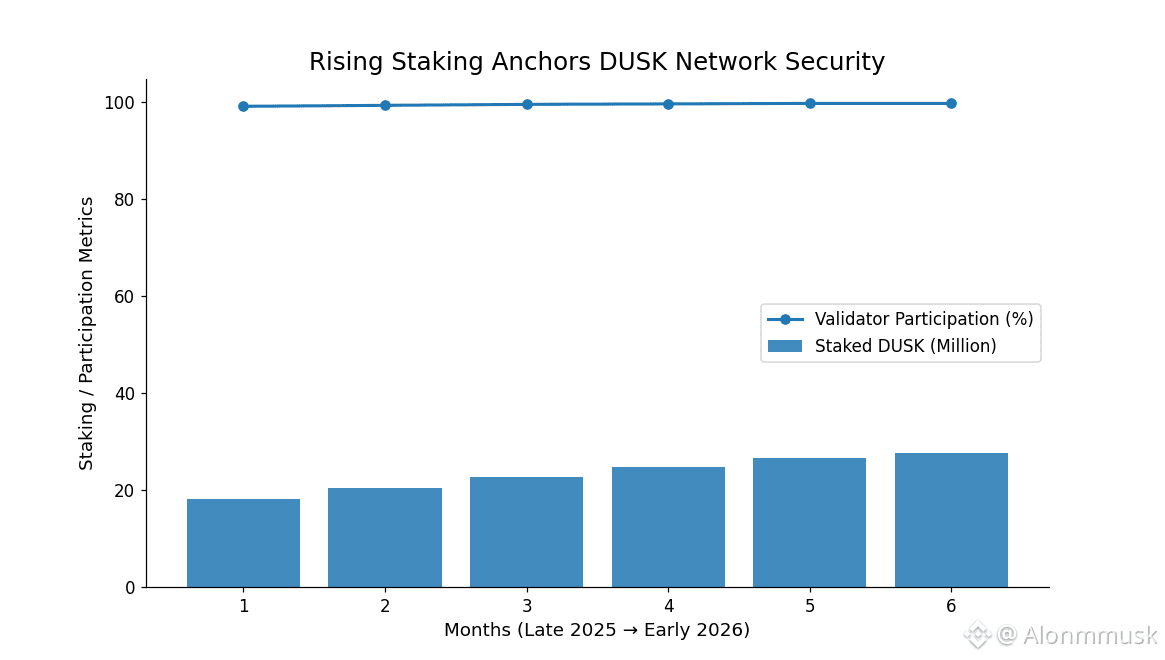
That’s why this particular network stood out to me. It’s built specifically for financial use cases, with privacy baked in from the start rather than patched on later. It’s a base-layer chain focused on confidential tokens and smart contracts, using zero-knowledge proofs so data stays hidden while settlement remains verifiable. Instead of trying to support every kind of dApp, it leans into compliance-friendly primitives like verifiable credentials and standards for tokenized securities. That focus matters in practice. Developers can build payment rails or exchanges that feel closer to traditional financial systems, but still run on-chain, without constantly worrying about data exposure or regulatory headaches. Since mainnet went live in January 2025, upgrades like the DuskDS rollout in December 2025 have improved consensus and data availability, and early 2026 brought DuskEVM, which makes it easier to port Ethereum tooling without sacrificing privacy. You can see participation picking up too, with liquid staking via Sozu reaching about 26.6 million in TVL by late January 2026, and the network holding steady around 10 to 20 TPS under normal conditions.
One part of the design that’s genuinely interesting is how block proposers are selected. It’s Proof-of-Stake, but with a blind-bid mechanism. Validators submit encrypted bids backed by zero-knowledge proofs, and the winner is chosen without revealing bid sizes upfront. That cuts down on MEV and front-running, though it does add some computational overhead. In practice, block times land around six seconds with strong finality, even when activity spikes. On the execution side, contracts run in the Rusk VM, which verifies state changes using PLONK proofs without exposing inputs. That makes private transfers and compliance checks possible directly on-chain, but with limits on complexity so proofs don’t become too heavy. Those constraints are part of why launches like the NPEX dApp can tokenize over €200 million in securities without overwhelming the base layer.
$DUSK itself plays a pretty clean role in all of this. It’s used for transaction fees, with a portion burned to manage supply. Validators stake DUSK to secure the network and earn rewards from a tail-emission model that started after mainnet, currently landing around 12 to 15 percent depending on participation. Settlement operations, including cross-chain activity through the Superbridge launched in mid-2025, consume DUSK as gas. Governance happens on-chain, with staked holders voting on upgrades like the DuskEVM rollout. Security is enforced through slashing, and recent metrics showed validator participation holding near 99.8 percent in January 2026. There’s no extra fluff layered on. The token does its job and stays tied to network health.
From a market perspective, as of January 29, 2026, DUSK trades around $0.137, with a market cap close to $70 million and about $19 million in daily volume. Circulating supply is roughly 464 million out of a 500 million total. Liquidity is there, but it’s not a meme-driven frenzy. Trend-wise, it’s been choppy. After a sharp 120 percent move earlier in January following the Chainlink data streams partnership, price pulled back about 38 percent from the $0.22 weekly high. Volatility is still elevated, with 30-day daily swings sitting around the 7 to 8 percent range, driven mostly by RWA-related news.
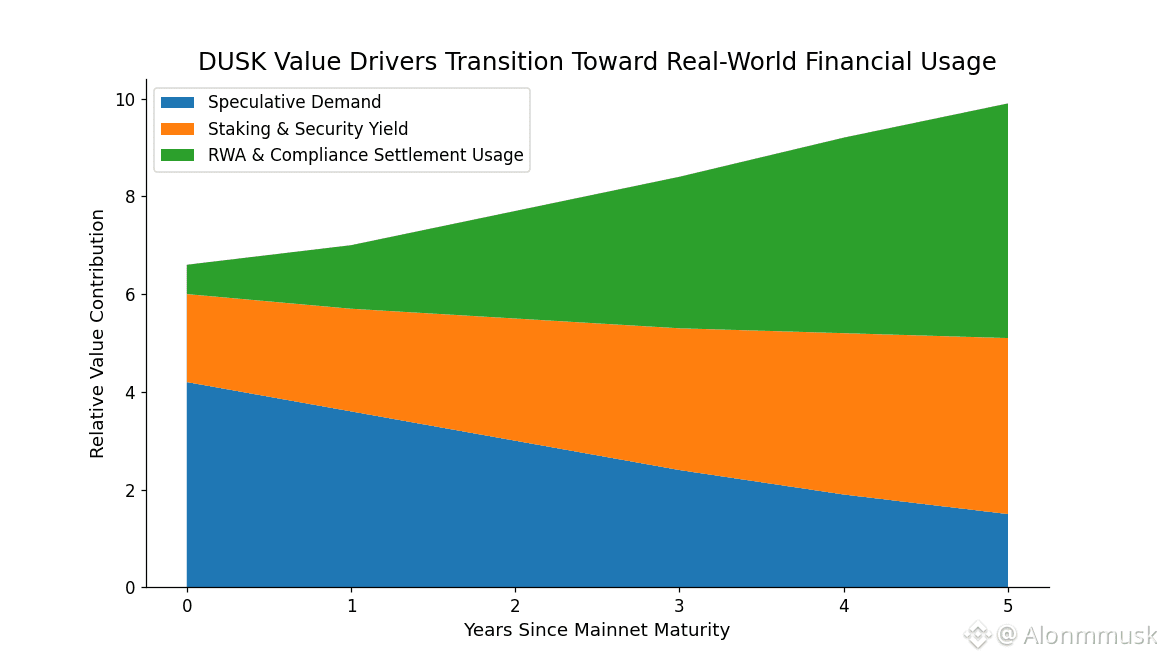
Short-term trading here is very narrative-driven. Privacy themes or RWA headlines can push volume past $50 million on announcement days, but those moves often fade once attention shifts. I’ve traded similar setups before. You catch a partnership pump, then step aside when profit-taking kicks in. Mid-January exchange inflows of roughly 6 million DUSK lined up with that kind of cooling. It’s easy to get chopped up if you treat it like a momentum coin. Long term, though, the story is different. If compliant privacy becomes something people actually use repeatedly, in tokenized funds or settlement flows, demand for DUSK through fees and staking could grow naturally. The NPEX rollout is a good example. If that €200 million figure turns into ongoing volume, it matters far more than a one-week pump.
There are real risks. Other privacy-focused chains like Aztec or Mina have broader ecosystems and could pull developers away if this niche stays too narrow. Regulation is another unknown. Even with MiCA alignment, interpretations can change. One scenario I keep in mind is congestion during a large issuance. If proposer selection were stressed during a high-volume NPEX event, settlement delays beyond the six-second window could trigger unstaking and weaken security. And there’s still the question of whether traditional finance fully embraces public chains at all, even with zero-knowledge protections.
In the end, real adoption doesn’t show up in headlines. It shows up quietly, when users come back for a second transaction or renew a stake without thinking about it. Over time, that’s what separates infrastructure that lasts from experiments that don’t. If this approach to compliant privacy becomes routine rather than novel, it has a real shot at sticking.
@Dusk #Dusk $DUSK
