😳To survive and thrive in the next era of trading, we must balance the pursuit of profit with the discipline of preservation.
🧘The Positive: Embracing the "New Era" of Professionalism
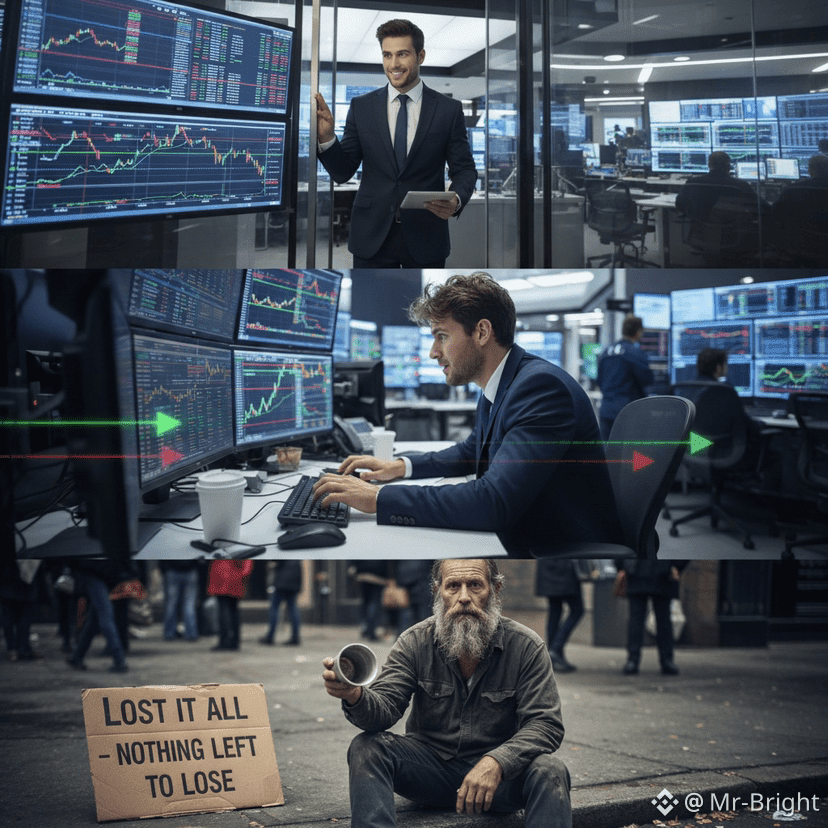
The first two panels represent the potential of trading: financial freedom, intellectual challenge, and the utilization of cutting-edge technology. To improve in this world, we must move away from "gambling" and toward strategic management.
* Democratic Access to Data: We live in an era where institutional-grade tools are available to retail traders. Improving means using this data not to predict the future, but to manage probability.
* The Rise of Algorithmic Discipline: By using automation and AI-assisted tools, traders can remove the "human element"—fear and greed—that leads to the bottom panel.
* The Ethical Shift: Improvement also means a world where education is prioritized over "get rich quick" schemes. A knowledgeable community that shares risk management strategies creates a more stable economic environment for everyone.
The Negative: The Path to Destruction 🧘
The bottom panel is the "Era of Destruction" that occurs when the psychological and systemic risks of trading are ignored. This isn't just a personal failure; it’s a systemic risk.
* The Gambler’s Fallacy: The middle image shows a man hyper-focused on screens. This intensity often masks an addiction. When trading becomes an emotional outlet rather than a business, destruction follows.
* Hyper-Leverage: The "next era" of destruction is fueled by excessive borrowing. When traders use 100x leverage, a 1\% market move against them creates the "Lost It All" scenario instantly.
* The Isolation Trap: Trading can be a lonely endeavor. Without a support system or a "stop-loss" on one's own life, a series of bad trades can lead to a total collapse of social and financial stability.
How to Protect Ourselves: The Shield of Survival
To prevent the third panel from becoming a reality, we must implement a defense-first mindset.
1. The 1% Rule
Never risk more than 1\% of your total account equity on a single trade. This ensures that even a "losing streak" of ten trades only draws down your account by roughly 10\%, leaving you with the capital to recover.
2. Psychological De-coupling
You must decouple your self-worth from your Net Worth. The man in the third panel has lost his dignity because he likely tied his identity to his P&L (Profit and Loss).
> Pro-Tip: If a losing trade makes you angry or ruins your day, your position size is too large.
>
3. Regulatory and Social Safety Nets
* Self-Regulation: Set "daily loss limits" on your brokerage account that lock you out if you hit a certain threshold.
* Diversification: Never have 100\% of your net worth in a trading account. Keep "survival capital" in Boring, safe assets (bonds, savings, real estate) that are disconnected from the volatility of the charts.
🕰️The goal of trading is not to "win big" once; it is to stay in the game long enough for the math to work in your favor. Would you like me to help you draft a specific Risk Management plan or a "Trading Manifesto" to help keep your strategy grounded?