
Metadata is frequently just as important as the actual data in decentralized storage systems. Metadata describes what the data is, where it resides, and how it can be validated and recovered, whereas blobs store the actual information. Walrus carefully designs its metadata to allow fault tolerance, scalability, and verifiability without adding central points of control, treating it as a first-class component of its architecture.
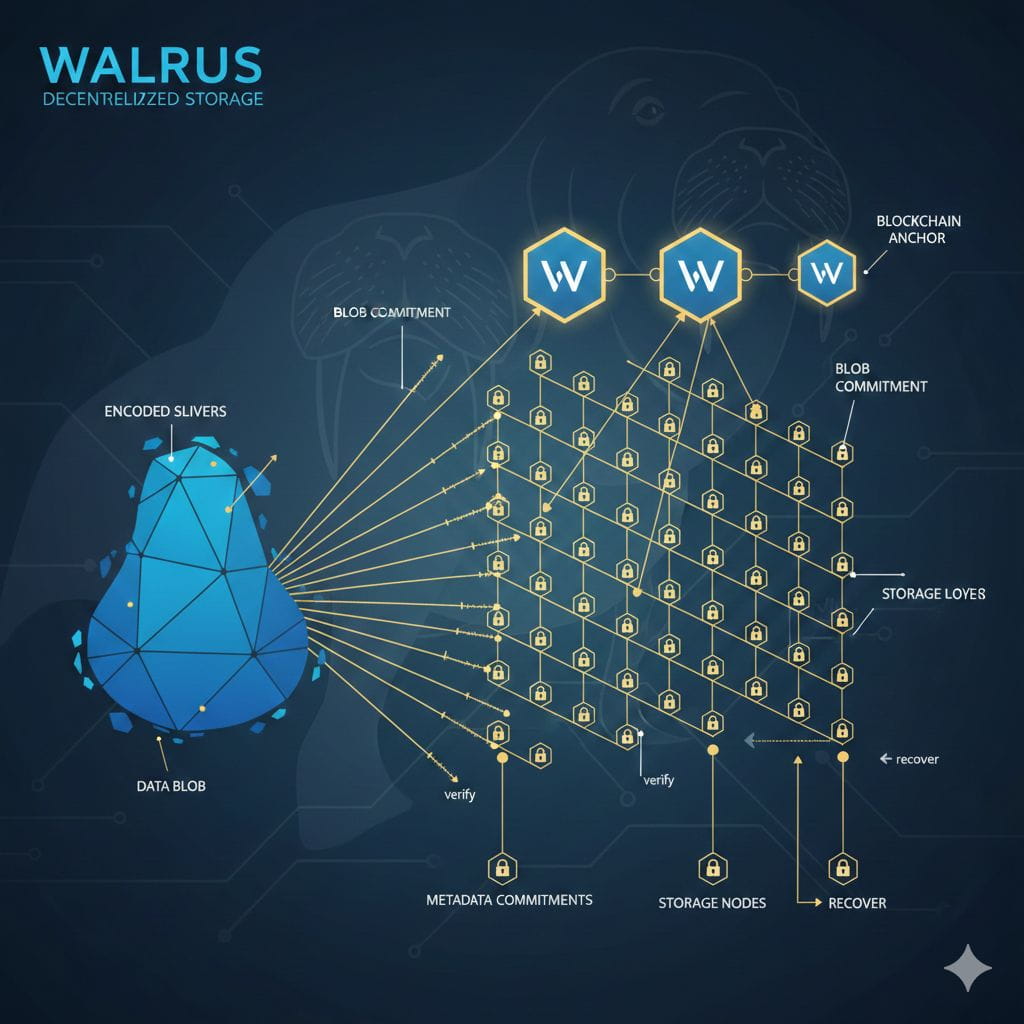
Commitments to encoded data pieces, also known as slivers, make up the majority of metadata in Walrus. Walrus's two-dimensional erasure coding algorithm is used to separate and encode a blob before it is written. The system calculates vector commitments over the encoded symbols for every sliver, primary and secondary. Without requiring the complete data to be saved or transferred again, these commitments serve as tiny cryptographic fingerprints that connect storage nodes to the precise data they are meant to hold.
All symbols in an extended row of the encoding matrix are represented by each main sliver commitment, and all symbols in an expanded column are represented by each secondary sliver commitment. Verifying consistency during recovery, readings, and reconfiguration is made possible by this structured method, which guarantees that metadata reflects the underlying data layout. Since any discrepancy will fail verification against the committed metadata, a storage node cannot covertly change or alter data without being discovered.
The client establishes a blob commitment—a commitment over the entire collection of sliver commitments—to finish the process. This blob commitment is registered on the external blockchain through Walrus's control layer and becomes the canonical identification for the stored data. Crucially, the blockchain only stores the bare minimum of metadata needed to demonstrate availability, accuracy, and system state transitions—not the actual data.
Metadata is kept lightweight and effective by this division. The blockchain handles global metadata like blob commitments and availability proofs, while storage nodes only keep track of the commitments pertinent to the slivers they store. Strong global consistency guarantees are maintained while avoiding bloating on-chain storage.
Walrus can handle sophisticated features like partial recovery, shard migration, and asynchronous problems by managing metadata in this manner. Without the need for reliable middlemen, nodes can recreate missing slivers using metadata alone during failures or reconfiguration events. Malicious writers can be identified by proven inconsistencies, and readers can independently confirm that retrieved data is accurate.
Walrus metadata design makes guarantee that reliability is not sacrificed in the name of decentralization. Walrus transforms metadata from a covert source of vulnerability into a potent weapon for accuracy, accountability, and long-term durability by fusing cryptographic commitments, structured encoding, and blockchain-anchored coordination. @Walrus 🦭/acc $WAL #walrus

