

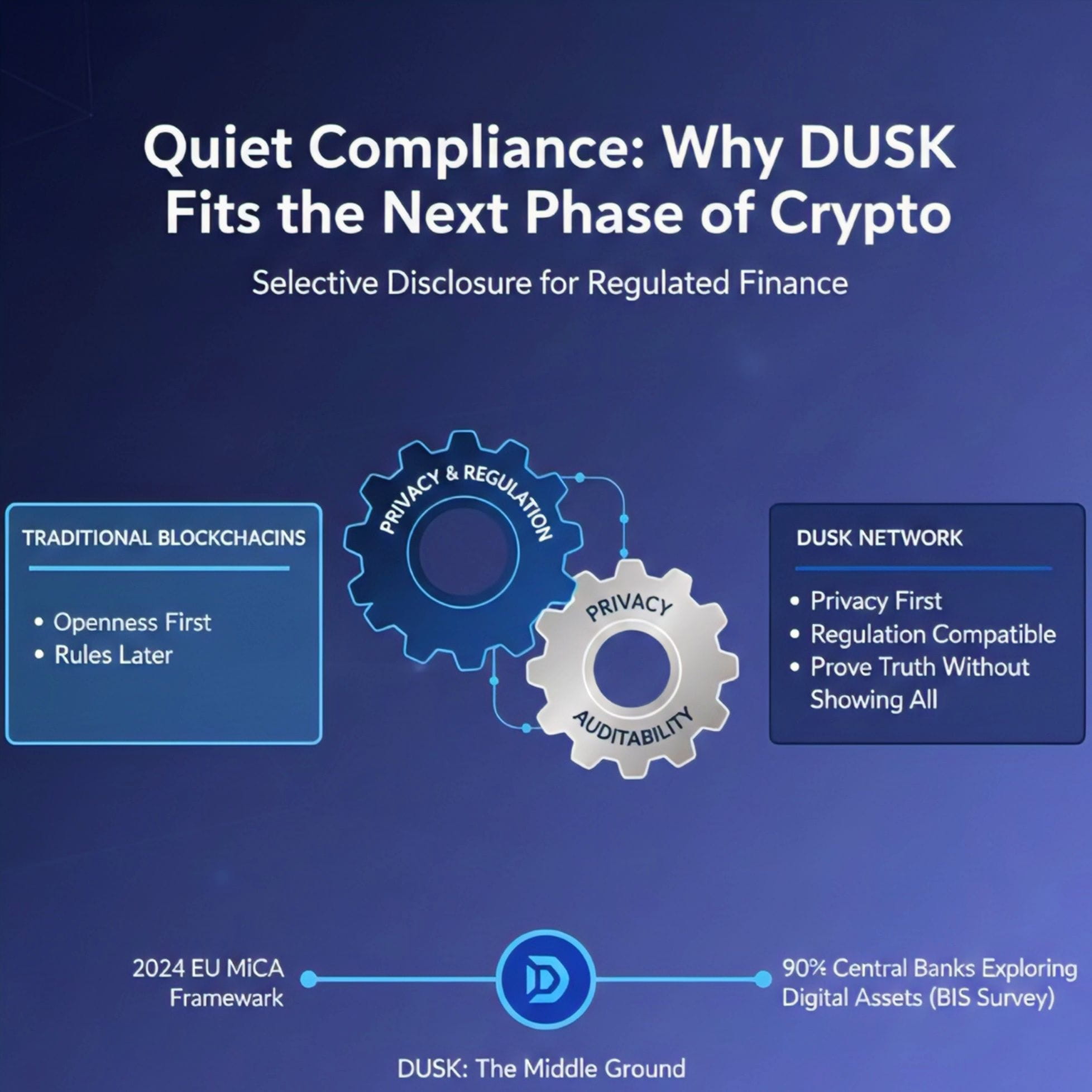
 @Dusk One of the quiet ways blockchain narratives fall apart is when they pretend the world has a single rulebook. It doesn’t. Finance is fragmented by jurisdiction, shaped by local regulators, and constrained by laws that often contradict each other. When I look at Dusk, it feels less like a system designed for a borderless ideal and more like one built for that messy reality. Not a world where rules disappear, but one where they multiply.
This is an important shift in perspective. Early crypto assumed global neutrality would be its greatest strength. One chain, one ledger, one set of rules for everyone. In practice, that assumption has become one of the industry’s biggest friction points. What’s permissible in one jurisdiction can be restricted in another. Disclosure requirements vary. Privacy expectations differ. Enforcement is uneven. Dusk feels like a blockchain that accepts fragmentation as permanent, not temporary, and designs around it rather than hoping it resolves itself.
That acceptance shows up first in how Dusk treats privacy. In a fragmented regulatory world, privacy cannot be absolute or static. Information that must remain confidential in one context may need to be disclosed in another. Regulators in different regions require different levels of visibility, at different times, under different authorities. Dusk’s selective disclosure model maps cleanly onto this reality. Data is not either public or hidden forever. It is controlled, contextual, and provable. That flexibility is not ideological; it’s practical. It allows the same underlying infrastructure to satisfy different regulatory expectations without forking the system or compromising accountability.
This becomes especially relevant as tokenized real-world assets move from concept to experimentation. Real assets don’t live in abstraction. They are governed by local property law, securities law, and enforcement mechanisms that vary widely. A system that assumes uniform treatment struggles the moment assets cross borders. Dusk’s architecture appears more compatible with this complexity. By separating confidentiality from verifiability, it allows assets to exist on-chain while still respecting jurisdiction-specific oversight. That doesn’t eliminate legal complexity, but it prevents the blockchain itself from becoming the bottleneck.
Another place this jurisdiction-aware mindset shows up is in Dusk’s refusal to be overly generic. Rather than positioning itself as a universal execution environment, it focuses on regulated financial infrastructure and compliant DeFi. That focus narrows the number of assumptions baked into the system. In a fragmented regulatory landscape, fewer assumptions mean fewer conflicts. Each additional use case introduces new legal interpretations, new disclosure expectations, and new enforcement risks. Dusk’s narrower scope reduces the likelihood that the system itself will violate rules simply by being used as intended.
Performance choices also look different through this lens. Global blockchains often chase uniform scalability and speed, assuming that more throughput benefits everyone equally. In reality, performance requirements vary by jurisdiction and use case. Some markets value speed. Others value certainty. Others value auditability above all else. Dusk doesn’t anchor its identity to a single performance narrative. Instead, it emphasizes predictability and correctness qualities that matter regardless of local regulatory flavor. A system that behaves consistently is easier to reason about across borders than one that optimizes for peak performance under ideal conditions.
From an industry perspective, this approach feels increasingly relevant. Regulatory fragmentation is intensifying, not converging. Institutions are exploring on-chain infrastructure, but they’re doing so unevenly, region by region, under different constraints. Many blockchains struggle here because they were designed for uniformity. Dusk feels like it was designed for plurality. Not one rulebook, but many. Not one authority, but layered oversight.
That doesn’t make adoption faster. In fact, it often makes it slower. Each jurisdiction introduces new questions. Each integration requires careful alignment. Progress happens unevenly, through pilots and localized deployments rather than sweeping rollouts. But this is how real financial infrastructure spreads. Rarely all at once. Almost never uniformly.
There are, of course, open questions. Can selective disclosure scale efficiently across many regulatory regimes? How much customization can exist before fragmentation reintroduces complexity at the protocol level? How does governance evolve as legal expectations diverge further? These are hard problems, and no blockchain has solved them completely. What sets Dusk apart is not that it claims to have final answers, but that it seems to have accepted these questions as permanent.
The latest relevance of Dusk isn’t about a new feature or upgrade. It’s about fit. As the industry moves away from global abstractions and toward jurisdiction-aware deployment, systems that assumed uniformity are being forced to adapt. Dusk doesn’t feel like it’s adapting. It feels like it’s being met by the world it anticipated.
If on-chain finance matures, it’s unlikely to do so through a single global leap. It will advance through careful, local permissions, layered oversight, and gradual confidence-building. Infrastructure that can tolerate fragmentation without breaking becomes valuable in that environment.
Dusk doesn’t promise a world without borders. It quietly prepares for one where borders still matter. And right now, that realism may be its most underappreciated strength.
