
The evolution of Web3 has hit a significant bottleneck: storage. While blockchains are excellent at processing transactions, they are notoriously inefficient at storing large-scale data like high-resolution NFTs, AI training sets, or entire frontend applications. This is where Walrus Protocol (@walrusprotocol) enters the scene as a game-changer for the Sui ecosystem and beyond.
Beyond Simple Storage: What Makes Walrus Different?
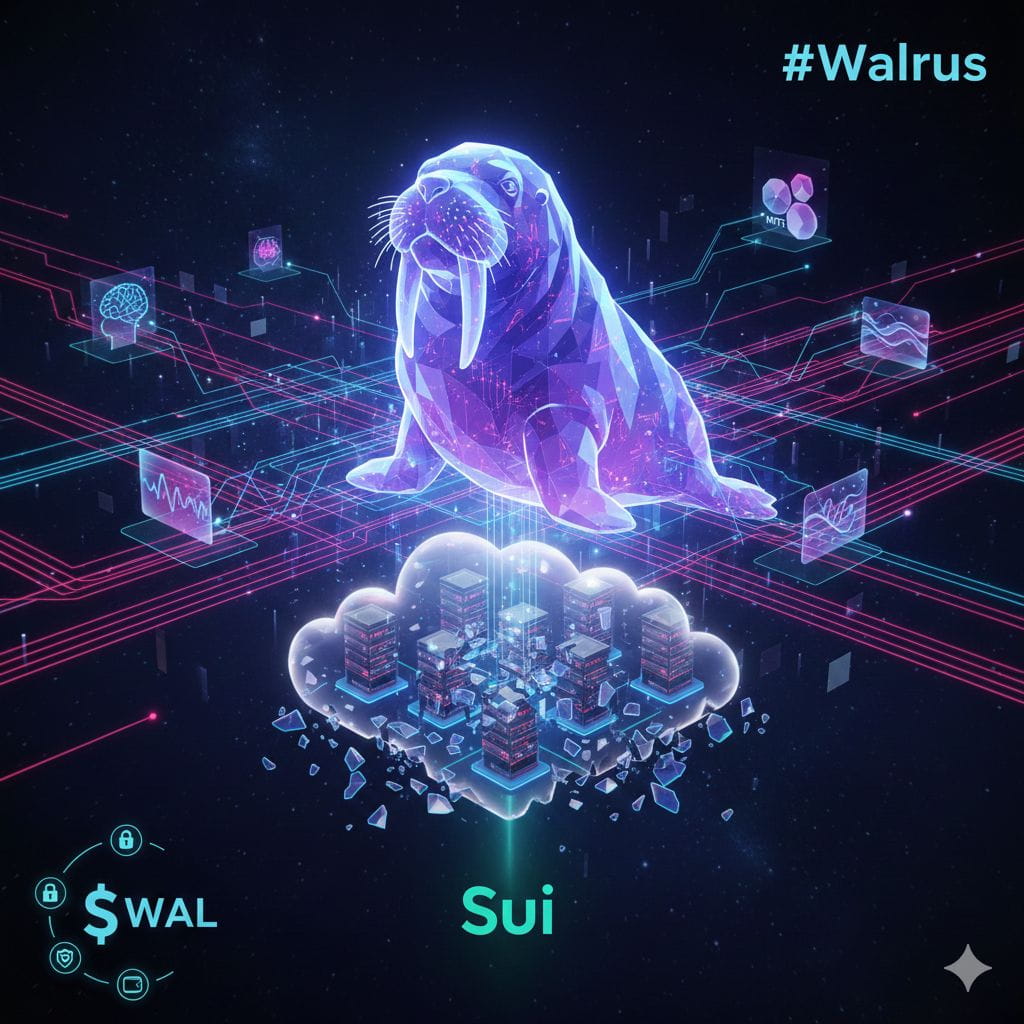
Unlike traditional decentralized storage solutions that often feel like slow, clunky archives, Walrus is designed for the "AI-First Web." It doesn't just store "blobs" (large binary files); it makes them programmable assets. By leveraging the Sui blockchain’s object-oriented architecture, every file stored on Walrus can be managed directly by smart contracts. This means developers can set automated lifecycles, access permissions, and even monetize data streams in real-time.
At the heart of its technical edge is "Red Stuff"—a specialized erasure-coding algorithm. Instead of creating expensive 10x copies of your data, Walrus breaks files into slivers. This allows for massive 4x–5x efficiency while ensuring that even if 2/3 of the storage nodes go offline, your data remains perfectly reconstructible and available.
The Role of wal in 2026
The native token, $WAL, is the fuel powering this decentralized engine. It serves three critical functions that ensure the network's health and longevity:
* Storage Payment: Users pay for storage capacity in $WAL. In Q1 2026, the protocol is introducing USD-anchored pricing, bringing the predictability that enterprise-level AI and media companies need to move away from centralized providers like AWS.
* Network Security: Through a delegated proof-of-stake (DPoS) model, wal holders can stake their tokens to support reliable storage nodes, earning rewards while securing the infrastructure.
* Governance: The community uses $WAL to vote on protocol parameters, such as storage costs and slashing penalties for underperforming nodes.
Looking Ahead: The 2026 Roadmap
As we move through 2026, @walrusprotocol is scaling rapidly. With the upcoming support for XL Blobs and enhanced SEAL access controls, Walrus is positioning itself as the primary data layer for decentralized social media and AI agents. The project’s ability to provide "blockchain-grade" security at "cloud-like" costs makes it one of the most exciting developments in the DePIN (Decentralized Physical Infrastructure Networks) space.
Whether you are a developer looking for censorship-resistant hosting or an investor watching the next wave of infrastructure, Walrus is proving that the future of data isn't just about where it's kept—it's about how it's used.
Would you like me to help you draft a shorter version of this for a social media post or provide a breakdown of the $WAL tokenomics?


