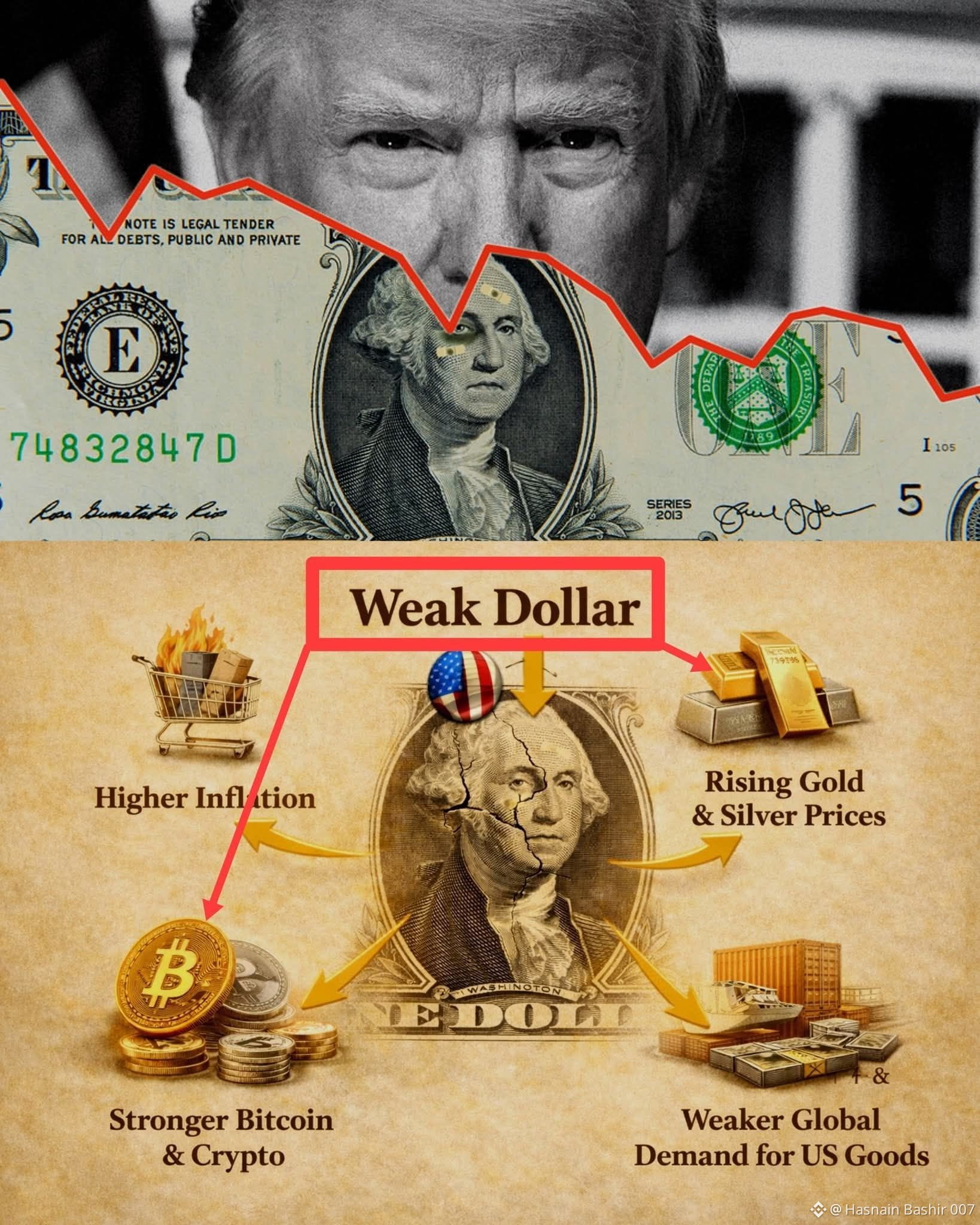
What we are witnessing in global markets is not a random move or a short-term anomaly. It is a chain reaction—one that almost always begins with a weakening U.S. dollar. When the dollar loses strength, the effects do not remain confined to currency markets. They spread across asset classes, economies, and households worldwide, quietly reshaping financial realities.
The Inflation Effect of a Weak Dollar
A declining dollar directly reduces purchasing power. Imports become more expensive, production costs rise, and everyday goods slowly cost more. This is why many people feel financially squeezed even when equity markets appear strong. Inflation, in this sense, is not just a statistic—it acts as a silent tax on savings and income, eroding real wealth over time.
Why Gold and Silver Respond
Precious metals tend to strengthen when confidence in fiat currencies weakens. Gold and silver are not driven by hype; they respond to trust, or the lack of it. Historically, they have served as inflation hedges, currency protection tools, and indicators of systemic confidence. When both metals rise together, it often signals that large pools of capital are shifting defensively—not chasing returns, but preserving value.
Bitcoin and Crypto in a Weak-Dollar Environment
Bitcoin and the broader crypto market often perform best when fiat currencies lose credibility. Unlike traditional money, Bitcoin is not controlled by central banks, cannot be printed, and cannot be diluted by policy decisions. In periods of dollar weakness, capital naturally looks for scarcity and asymmetric upside. This is why crypto assets frequently move ahead of traditional markets, acting as early indicators of monetary stress.
Impact on Global Trade and Growth
While a weaker dollar can initially appear supportive for U.S. exports, prolonged currency weakness tied to inflation and instability tells a different story. As confidence declines, global trade slows, demand softens, and economic growth comes under pressure. Over time, currency weakness translates into real economic strain rather than competitive advantage.
The Bigger Picture Many Overlook
This moment is not about a single chart or asset. It reflects a broader adjustment within the global monetary system. A weak dollar typically results in higher nominal asset prices, lower real purchasing power, and a steady rotation of capital into hard assets. Markets may look strong on the surface, but the measuring stick itself—the currency—is losing reliability.
Final Thought
Gold is not rising without reason. Bitcoin is not moving in isolation. Inflation is not a temporary glitch. All of these signals point to the same underlying reality: confidence in fiat money is being repriced.
Those who recognize these shifts early focus on protecting their capital. Those who ignore them often learn through loss. Staying informed, thinking strategically, and closely watching the dollar remain essential in navigating what comes next.