
What made me pause when reading through Dusk’s architecture was not a headline feature or a roadmap promise. It was a quiet assumption embedded deep in the system: that settlement should not be something you argue about later.
In financial systems, execution is easy to demonstrate. Settlement is hard to defend. That distinction becomes obvious only after systems have been running long enough to face audits, disputes, and operational stress. Dusk seems to be designed with that moment in mind, not the demo phase.
At the base of the stack sits DuskDS. This layer is deliberately boring in the way serious infrastructure often is. It does not host applications. It does not encourage experimentation. Its responsibility is narrower and stricter. DuskDS is where state stops being negotiable.
If a state transition reaches this layer, it is expected to already satisfy eligibility rules, permissions, and protocol constraints. There is no assumption that correctness can be reconstructed later. There is no soft interpretation phase. Settlement on Dusk is treated as a line you cross only once ambiguity has already been removed.
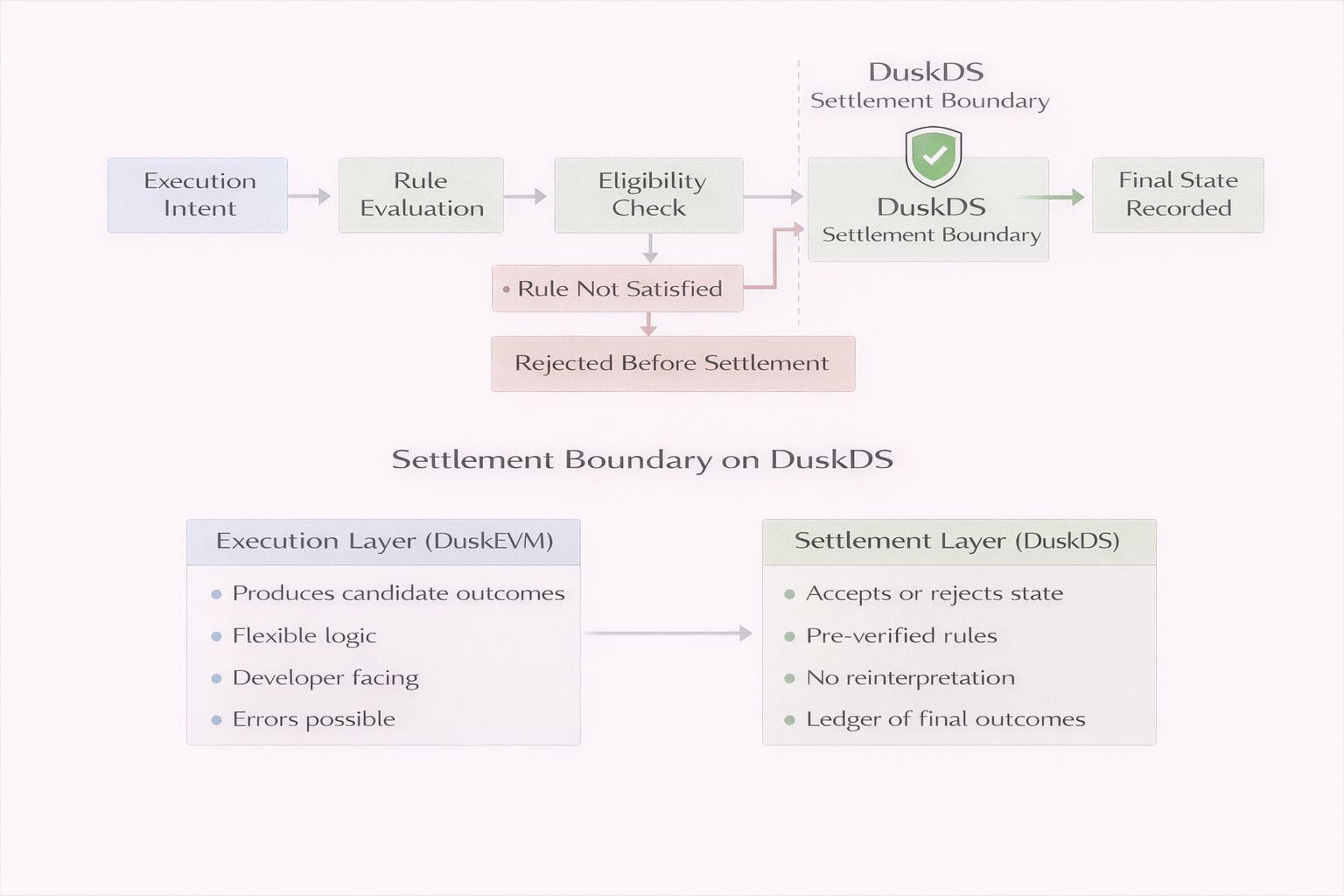
That choice immediately separates Dusk from many systems I have watched over the years. Not because those systems were poorly engineered, but because they accepted a different trade off. They allowed execution to move fast and pushed enforcement downstream. When something broke, they relied on governance, coordination, or human process to restore coherence.
DuskDS refuses that trade.
By gating settlement, Dusk shifts cost away from operations and into protocol logic. Every ambiguous outcome that never enters the ledger is an audit that never happens. Every invalid transition that is excluded is a reconciliation that never needs to be explained months later. This is not visible progress, but it is cumulative risk reduction.
This is also where DuskEVM fits, and why its authority is intentionally limited. DuskEVM exists to make execution accessible. It gives developers familiar tooling and lowers integration friction. But it does not get to define reality on its own.
Execution on DuskEVM produces candidate outcomes. Those outcomes only become state after passing the constraints enforced at the DuskDS boundary. That separation is not accidental. It allows execution to evolve without letting complexity leak directly into settlement.
I have seen enough systems where an application bug quietly turned into a ledger problem because execution and settlement were too tightly coupled. Dusk seems determined not to repeat that pattern. Complexity is allowed to exist, but it is not allowed to harden unchecked.
This design also explains why Dusk often appears quiet. There are fewer visible corrections. Fewer reversions. Fewer moments where the system has to explain itself publicly. Not because nothing happens, but because fewer mistakes survive long enough to matter.
From the outside, this can look restrictive. From the inside, it looks disciplined.
Financial infrastructure rarely fails because execution was slow. It fails because settlement could not be defended later under scrutiny. DuskDS is built around that reality. It treats settlement not as an endpoint, but as a boundary that protects everything beneath it.
Many systems ask how much execution they can support. Dusk asks how little ambiguity its settlement layer is willing to absorb.
That is not an exciting question. It does not generate noise. But it is the kind of question that determines whether infrastructure survives pressure, audits, and time.
And once that boundary becomes clear, the rest of Dusk’s architecture stops looking conservative and starts looking deliberate.
