
When I look at @Plasma , I don’t see a chain trying to win attention. I see something built for a single job: move stablecoins like they’re real money, not “just another token.” That sounds boring until you remember what stablecoins actually are in 2026 — they’re the cash leg of crypto markets, the default rails for cross-border transfers, and (quietly) a survival tool in a lot of places where local currency is unreliable. Plasma’s bet is simple: if stablecoins are already economic activity, then the chain should behave like settlement infrastructure, not a playground.
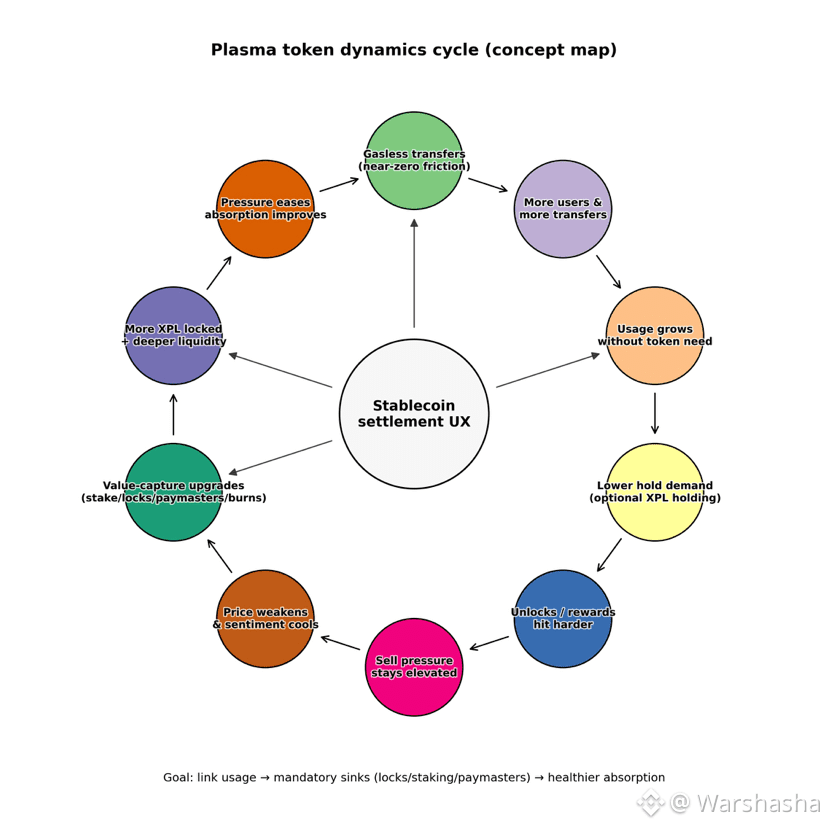
That design choice shows up everywhere: fast, deterministic finality via PlasmaBFT (a Fast HotStuff-style BFT implementation), plus a familiar EVM environment for builders so adoption doesn’t require a new mental model. And the headline feature people keep circling back to is the one that creates both the growth story and the price pressure: gasless stablecoin transfers. Plasma One, for example, positions “zero-fee USD₮ transfers” as a core product promise.
Now here’s the part most investors underestimate: a chain can be amazing to use and still be rough to hold, if the token’s value capture isn’t structurally tied to usage.
The Utility Paradox: When “Free to Use” Can Mean “No Need to Hold”
Plasma’s gasless experience is adoption fuel. But gasless UX also removes the oldest, simplest reason to hold the native token: “I need it to transact.”
In other ecosystems, that’s the baseline: users hold the token because they must pay fees. #Plasma tries to make stablecoins feel like everyday money, so it abstracts that away. That’s great product design — but it creates a vacuum in organic token demand unless the protocol introduces other mandatory sinks:
validator staking that must be held/locked
paymaster collateral requirements that scale with usage
app-level benefits (tiers, limits, rebates) that require locking XPL
burns or fee-share tied to throughput or settlement volume
If those sinks aren’t big enough yet, you get what I call the “infrastructure irony”: the chain grows, people use it more, and the token still bleeds because the use is not the same thing as holding demand.
The January Supply Shock: Why Unlocks Hurt Harder in Gasless Economies
The second piece is mechanical: supply events hit harder when demand is optional.
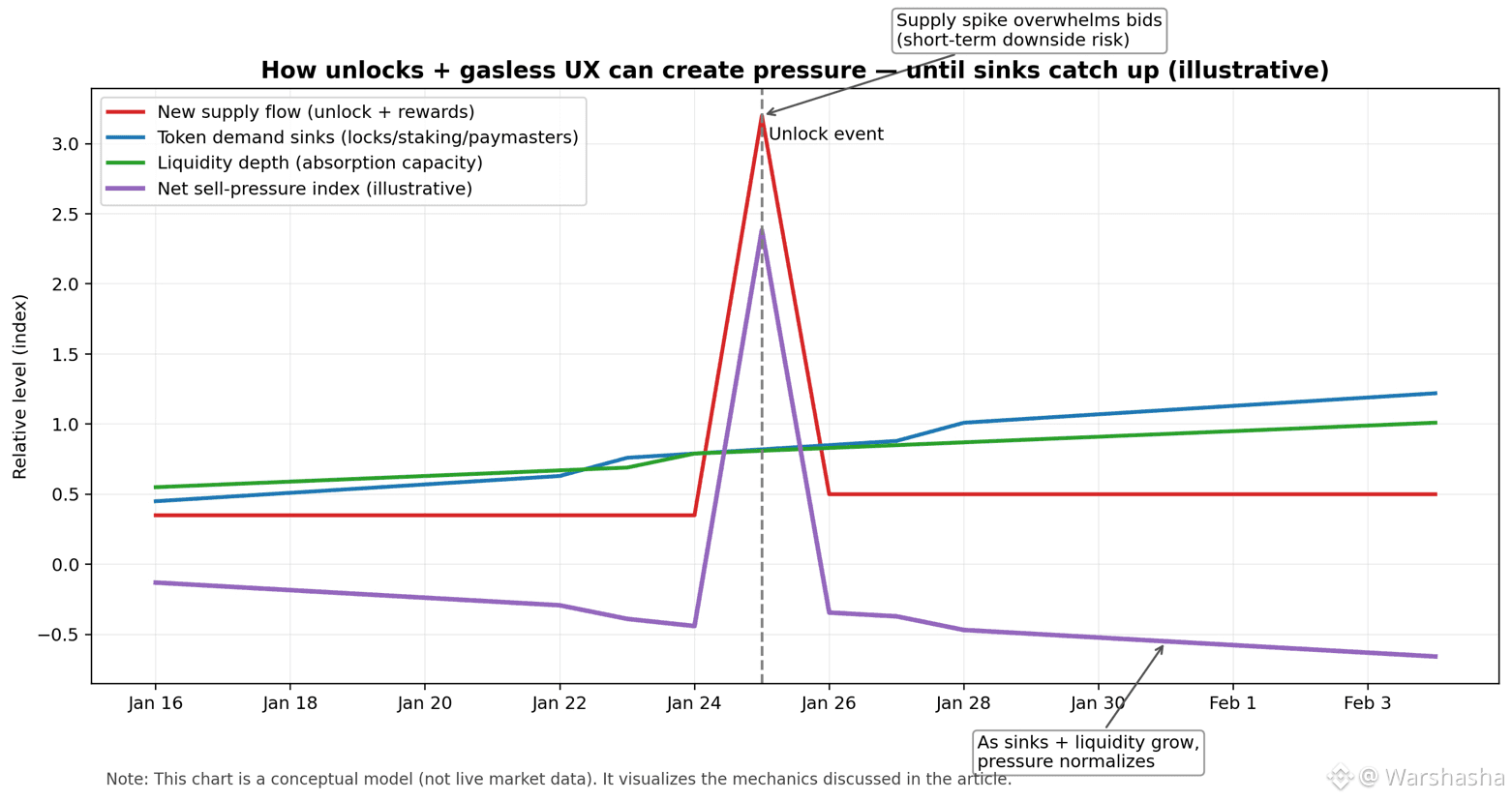
On January 25, 2026, Plasma had a widely tracked unlock of 88.89M $XPL (about 4.33% of released supply per trackers). In any market, a large unlock can pressure price — but on a chain where many users don’t need to buy XPL to transact, the market has fewer “natural buyers” to absorb it.
So the narrative isn’t “something is wrong,” it’s “the market structure is temporarily one-sided”:
unlock injects supply
token demand is not directly forced by usage
liquidity must absorb the gap
price finds lower levels until a new equilibrium forms
And that’s why you can see a strong product + rising activity + falling token at the same time.
Cashback Selling: Rewards That Behave Like Constant Emissions
Plasma One adds another dynamic. It offers up to 4% cashback paid in XPL. That sounds bullish until you zoom in on user behavior: many people treat cashback like “free money,” not a long-term position. They convert it quickly to realize spending power — which effectively becomes ongoing sell flow.
Rewards are not automatically bad. They’re powerful when they create sticky demand (lockups, tiers, multipliers, staking boosts). But if rewards are paid liquid and users have no reason to hold, then rewards become a polite version of “sell pressure.”
The Quiet Bull Case That Actually Matters: Liquidity, Access, and Cross-Chain Convenience
Here’s where recent updates shift the story in a more constructive direction.
Plasma integrated NEAR Intents / 1Click Swap API, which is basically a “chain abstraction” on-ramp for liquidity and assets across ecosystems. The important part isn’t the headline — it’s the implication: it becomes easier for users to arrive on Plasma with what they already have, and for builders to route swaps/settlements without making users think about bridges, networks, or multi-step friction.
That matters because it strengthens a different kind of demand:
builder demand (routing volume through Plasma)
paymaster/infra demand (collateral needs scale with throughput)
ecosystem liquidity demand (market makers and DeFi rails deepen)
And it’s exactly the kind of update that can help Plasma escape the utility paradox — not by reintroducing annoying UX, but by making XPL structurally necessary for the chain’s reliability and incentives as the settlement load increases.
What I’d Watch Next: The “Value Capture Checklist” for a Stablecoin Settlement Token
If you want to understand whether $XPL is bottoming because the tokenomics are improving (not just because price got cheap), I’d track these signals:
1) Does staking become a real sink, not a checkbox?
Plasma’s consensus stack is designed around fast finality and deterministic settlement guarantees. If validator staking expands meaningfully (and is required at scale), that’s a direct hold/lock driver.
2) Do paymasters need XPL as risk capital?
Gasless systems still pay for execution somehow. If Plasma pushes a model where paymasters must post XPL collateral proportional to volume or risk, then usage can finally force token demand without forcing users to buy gas.
3) Do rewards evolve from “liquid emissions” to “lock-based incentives”?
Cashback can be transformed:
higher cashback tiers that require locking XPL
multipliers for staking or long holding periods
burn/fee-share funded by settlement activity
4) Are upcoming unlocks absorbed more smoothly?
A big unlock with thin absorption is brutal. A big unlock with deeper liquidity, staking sinks, and ecosystem routing is survivable. Track the next scheduled releases and whether the market “shrugs” instead of “panics.”
Plasma can genuinely be a “quiet winner” because the world needs stablecoin settlement rails that feel boring, predictable, and instant. That’s the whole point. But $XPL won’t automatically reflect that utility unless Plasma tightens the link between usage → required holding/locking → reduced liquid supply.


So if price has been falling, I wouldn’t jump to the lazy conclusion. The more accurate read is: Plasma is winning on product, and still early on token value capture. Once staking, paymaster collateralization, and lock-based tiers become the default — the utility paradox starts flipping from a weakness into a moat.