
@Walrus 🦭/acc is not simply another cryptocurrency project competing for attention. It comes across more like a steady, unseen force beneath the internet, gradually transforming how information is stored, moved, and preserved. For a long time, the online world has relied on centralized cloud systems, where a small number of corporations hold power over data storage, access, and even censorship. Walrus emerged from the belief that this model is both unstable and unjust, and that ownership of data should remain with its creators rather than with remote, corporate-controlled servers.
At the heart of the Walrus network lies the WAL token, which functions as the driving force of the entire protocol. WAL goes beyond being a simple medium of exchange. It links users, builders, and storage operators into one interconnected ecosystem. Whether storing data, contributing resources, or participating in governance, WAL enables and incentivizes every action. It supports security, rewards involvement, and ensures the community has a meaningful role in shaping the protocol’s future. As a result, Walrus operates as a dynamic, community-led system rather than one dictated by a central authority.
Technically, Walrus is built on the Sui blockchain, a high-performance network designed to support large volumes of activity efficiently. This infrastructure allows Walrus to handle large files and intensive data workloads while keeping expenses manageable. Instead of placing files in a single location, the protocol divides them into encrypted fragments using sophisticated erasure coding techniques. These fragments are distributed across numerous independent nodes worldwide. Even if some nodes go offline, the original data can still be reconstructed, making it highly durable, resistant to deletion, and difficult to censor.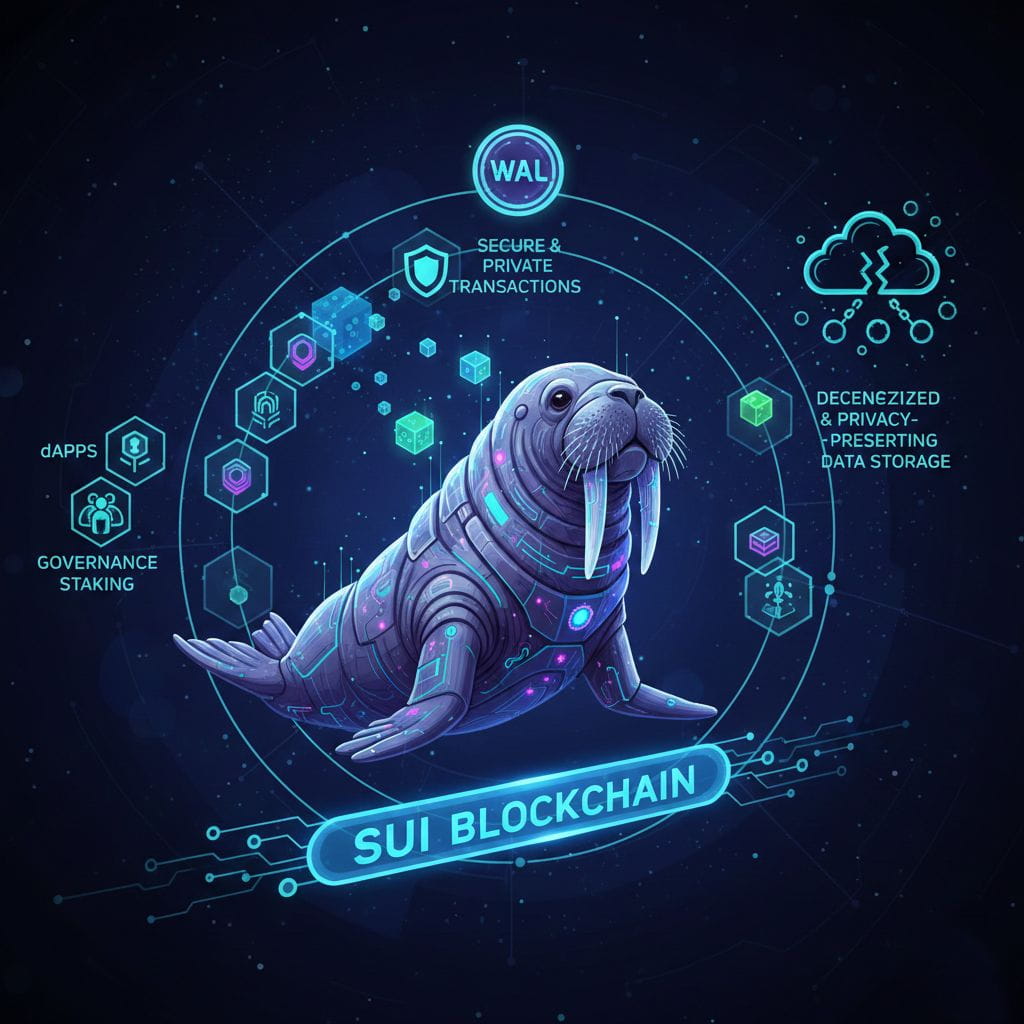
Privacy is a core principle embedded throughout Walrus’s design. In an era where personal information is routinely monitored, traded, or leaked, Walrus takes a more protective approach. Users can store, interact with, and transfer data without exposing unnecessary details. While privacy is preserved, blockchain verification still ensures transparency and trust. This careful balance creates an environment where individuals feel secure and organizations feel confident building practical, real-world applications.
Looking ahead, Walrus aspires to become a foundational layer of the decentralized web. Its goals extend far beyond basic file storage. The protocol aims to support the next wave of decentralized applications that depend on data that is secure, long-lasting, and private. From digital media platforms and NFTs to enterprise solutions and personal cloud replacements, Walrus positions itself as the unseen infrastructure holding everything together. As adoption increases, governance is expected to evolve so that the community, rather than a closed leadership group, guides major decisions.
User experience is also a major focus for the future. Walrus envisions decentralized storage becoming as intuitive as today’s mainstream cloud services. People should be able to upload, share, and manage files without needing to understand blockchains, cryptography, or node networks. The technical complexity stays behind the scenes, while users enjoy clear advantages such as control, security, and true ownership.
@Walrus 🦭/acc Ultimately, Walrus represents more than an advancement in technology. It seeks to redefine how individuals relate to their data. By eliminating centralized control points and distributing trust across a global network, Walrus promotes a future where information is harder to suppress and easier to safeguard. It is a subtle yet impactful move toward a more resilient and equitable internet, one where blockchain technology quietly empowers users to reclaim authority over their digital lives.

