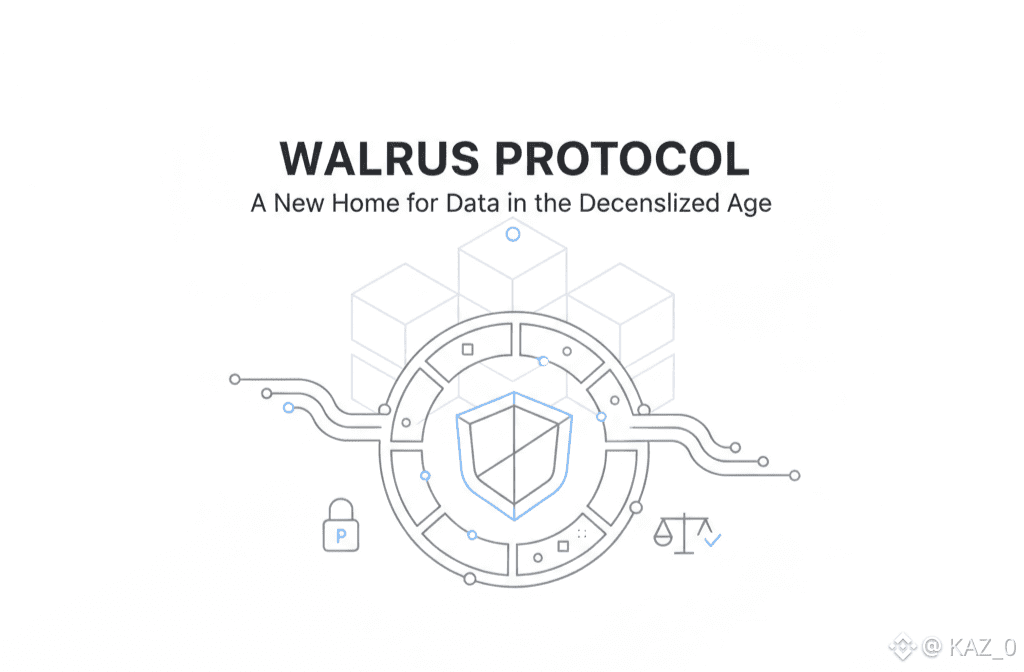
Walrus begins with a simple but powerful belief that data should not live at the mercy of centralized gatekeepers. In a world where applications are becoming decentralized, intelligent, and global, the information that powers them must also evolve. Walrus is built to answer that need, offering a new way to store, move, and own data without sacrificing privacy, security, or performance.
From the very first layer, Walrus is designed around resilience. Instead of copying entire files again and again across servers, it breaks data into intelligently encoded fragments and spreads them across a wide network. Even if many parts of the network go offline, the original data remains safe and recoverable. This approach makes Walrus not just decentralized in theory, but dependable in practice. It is storage that survives failures, censorship, and disruption by design.
Walrus lives on the Sui blockchain, and that choice matters. Sui is fast, object-centric, and built for real usage, not just experimentation. Walrus uses Sui as its coordination brain, managing ownership, permissions, payments, and logic on chain while keeping large data off chain where it belongs. This balance allows Walrus to stay efficient while remaining fully verifiable. Every stored file is connected to on-chain proof, turning data into something programmable, ownable, and composable.
What truly sets Walrus apart is how it treats data as a living asset. Stored content is not locked away in silent vaults. It can interact with smart contracts, power applications, and move seamlessly between users and systems. Developers can build decentralized websites, media platforms, AI pipelines, and digital worlds knowing their data layer is as open and censorship-resistant as the blockchain itself. For users, this means control returns to the creator, not the platform.
Privacy is woven deeply into the protocol. Data can be encrypted before storage, ensuring that only authorized parties can access it. At the same time, the network can still prove that the data exists and remains available without revealing its contents. This creates a rare balance between confidentiality and transparency, making Walrus suitable not only for public content but also for sensitive and enterprise-grade use cases.
The WAL token sits at the heart of this ecosystem. It is used to pay for storage, secure the network through staking, and shape the future of the protocol through governance. Token holders can delegate their stake to storage operators, earning rewards while helping maintain the health of the network. Decisions about upgrades, parameters, and long-term direction are guided by the community, aligning incentives between builders, users, and infrastructure providers.
Economically, Walrus is built for sustainability rather than hype. Storage pricing is designed to be predictable and competitive, while rewards encourage long-term participation instead of short-term speculation. A significant portion of the supply is dedicated to community growth, development grants, and ecosystem expansion, reinforcing the idea that Walrus is infrastructure first, not a fleeting trend.
As decentralized applications mature, the demand for reliable data availability grows. Artificial intelligence needs large datasets. Games and virtual worlds need rich media. Digital ownership needs guarantees that content will not disappear when a company shuts down or changes its rules. Walrus steps into this moment as quiet but critical infrastructure, enabling a future where data is permanent, portable, and free from centralized control.
Walrus is not trying to be everything. It focuses on one essential layer and builds it well. By combining efficient storage, strong cryptography, and seamless blockchain integration, it creates a foundation that others can build upon. In doing so, Walrus does not just store data. It restores trust in where data lives and who truly owns it.
In the expanding landscape of decentralized technology, Walrus stands as a reminder that the next evolution of the internet is not only about faster chains or smarter contracts. It is about giving data a home that matches the values of decentralization itself.