
Most people talk about privacy in crypto like it is a moral debate: surveillance versus freedom, transparency versus secrecy. Institutions do not start there. Market makers and funds see privacy as a market-structure tool. In their world, confidentiality is not about hiding wrongdoing. It is about protecting execution.
That is exactly where Dusk becomes more than “a private blockchain.” Dusk’s core value is not simply that transactions can be confidential. It is that confidentiality can be engineered to support healthy markets, reduce predatory behavior, and make on-chain liquidity feel closer to traditional finance.
In short, Dusk frames privacy as a competitive advantage.
The hidden cost of public-by-default markets
On most public chains, the market operates like a fishbowl. Wallets can be clustered, strategies can be inferred, and flows can be tracked in near real time. That is not a small inconvenience. For professional liquidity providers, it is a structural penalty.
A market maker’s edge depends on risk management and inventory control. A fund’s edge depends on timing, discretion, and minimizing impact. When the ledger broadcasts behavior, three things happen that directly degrade market quality:
Front-running and priority games
If intent becomes visible before settlement or becomes predictable through patterns, bots and sophisticated actors race to position ahead. The result is worse pricing, more slippage, and a constant tax on anyone trying to move meaningful size.Strategy leakage
Funds do not want the market to know they are accumulating, rotating, hedging, or rebalancing. When wallets and patterns are trackable, competitors mirror trades, fade them, or trade against them. Over time, smart actors reduce activity or shift execution off-chain where discretion is normal.Adverse selection
Transparency makes informed flow easy to identify. That invites predators. Quotes widen. Liquidity becomes selective. The market charges you more simply because it knows you are serious.
This is why transparency can paradoxically produce weaker markets. It rewards surveillance and extraction instead of genuine liquidity provision.
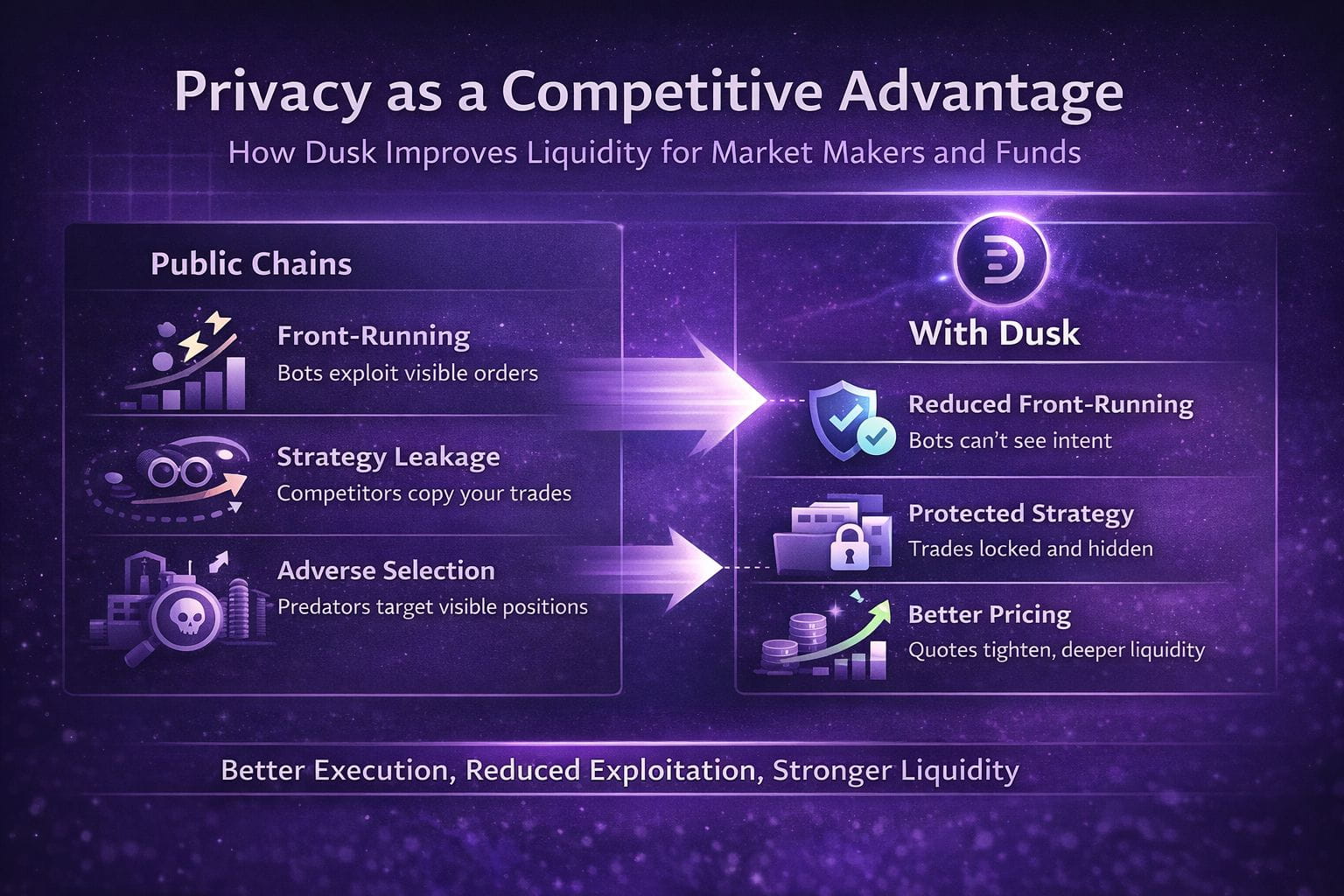
Dusk’s privacy changes incentives, not only visibility
Dusk’s approach matters because it targets the real problem: the incentives created by full transparency.
When transactions and positions are not broadcast to the entire world, market makers can quote tighter spreads without being targeted for their inventory. Funds can execute larger orders without signaling intent to the market. Counterparties can trade without turning their business relationships into public intelligence.
This is not an exotic concept. It is how serious finance already operates. Large trades, RFQ systems, and discreet execution exist because exposure has a price. Dusk brings that logic on-chain.
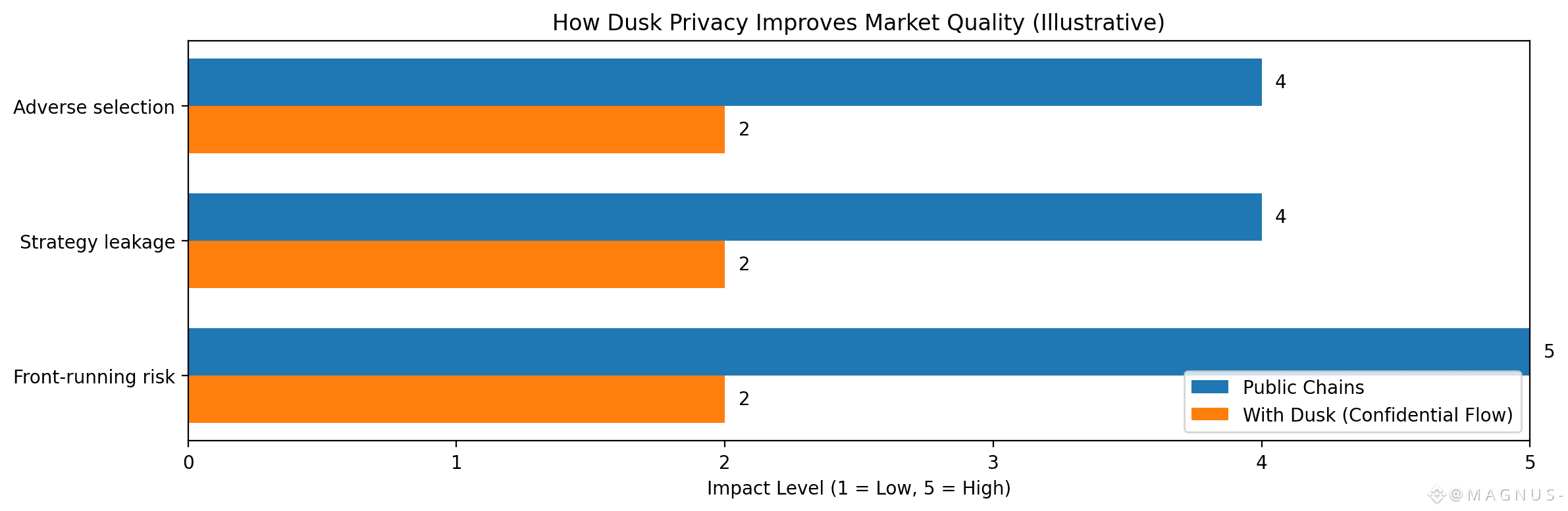
The goal is not “more private.” The goal is “more liquid.”
A common misunderstanding is that privacy is mainly about secrecy. Dusk’s more useful framing is market integrity.
A liquid market is a market where participants believe they can manage risk without being exploited for showing their hand. That is why professional capital prefers environments where:
validity can be proven without revealing every detail,
settlement can occur without advertising strategy,
and oversight can exist without turning the ledger into a public surveillance system.
Dusk aligns with that reality. It creates conditions where institutions can trade like institutions, rather than being forced into retail-style transparency.
An example: why a fund hesitates to trade on public rails
Consider a fund trying to build a position over several days. On a fully transparent chain, every buy reveals direction. Analysts connect wallets. Bots notice recurring behavior. The market anticipates future buys and drifts the price upward before the fund finishes. The fund ends up paying a premium simply for existing.
In an environment like Dusk, that same fund can execute with far less signaling. That reduces slippage, protects the strategy, and makes on-chain execution viable at larger size. That is not a loophole. That is normal market behavior in traditional finance.
Why this matters for Dusk’s long-term relevance
If on-chain markets want institutional liquidity, they need institutional-grade microstructure. That means reducing the ability to extract value from visibility alone.
Dusk’s privacy can act as a defensive layer against predatory dynamics. It protects legitimate participants from being harvested by bots and copy-traders. And when you remove that structural penalty, you get the outcome that matters most: more serious participants are willing to quote, trade, and stay active.
More activity leads to deeper books.
Deeper books lead to better execution.
Better execution attracts larger capital.
That is how liquidity compounds.
The mature endpoint: confidentiality with accountability
Dusk is not about creating black-box markets. The sustainable future is selective transparency: confidentiality by default for market integrity, and controlled visibility when legitimate oversight is required.
That balance is the difference between privacy as a slogan and privacy as infrastructure.
