
When people first look at Dusk, they often focus on the familiar parts. Compliance, privacy, and lately the arrival of DuskEVM. What tends to be missed is that none of these pieces are meant to stand on their own. They only make sense once you understand where Dusk decides truth should live.
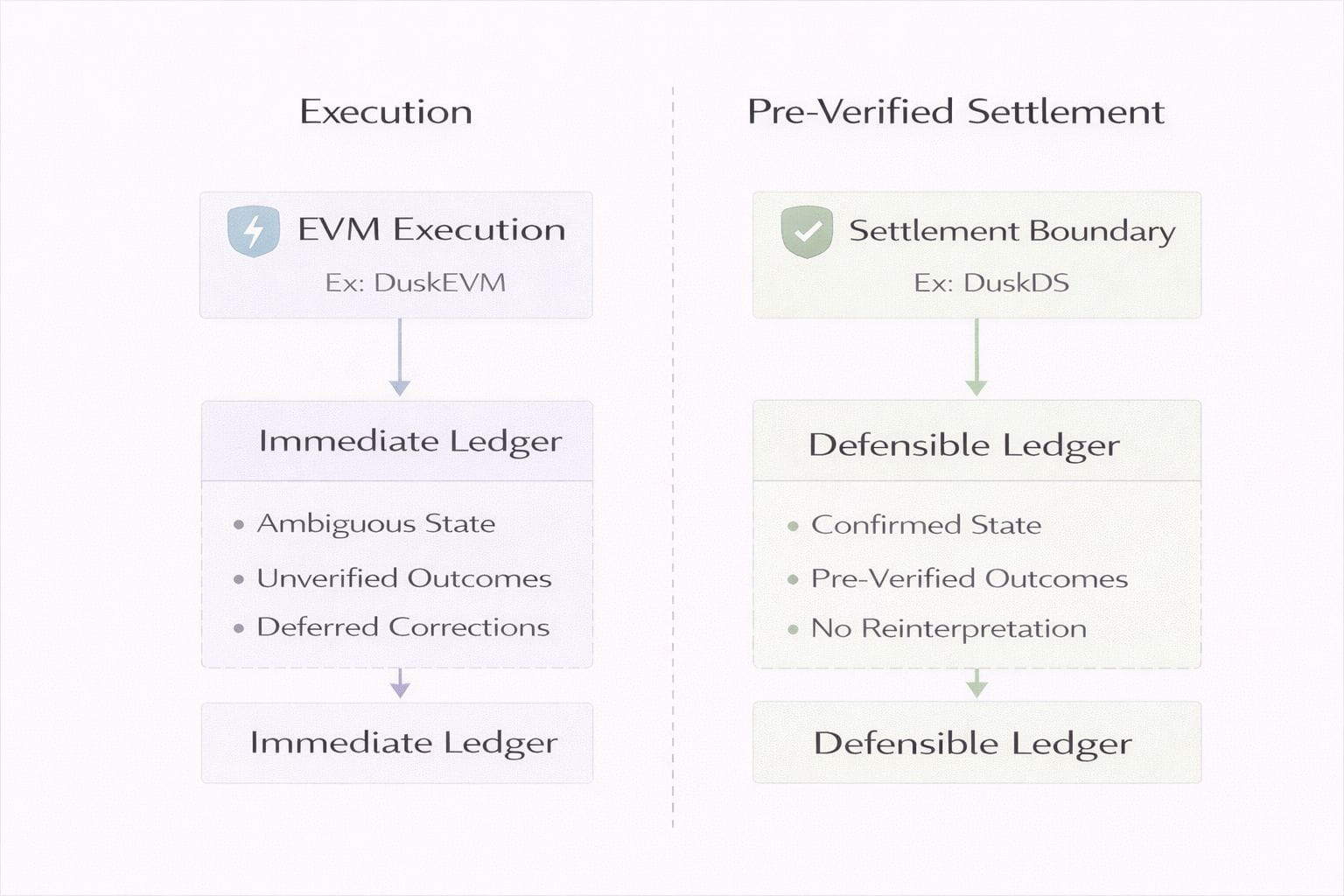
Dusk is not trying to be a faster execution environment. It is trying to be a financial system where execution does not automatically become reality.
At the base of the stack sits DuskDS. This is not where applications run and it is not where developers experiment. DuskDS exists to do one thing well, to act as the system of record. Consensus, staking, data availability, settlement, and native bridging all live here. Anything that reaches this layer is expected to already be correct. State transitions are pre verified before inclusion. There is no assumption that errors can be resolved later through governance or social coordination.
That design choice already separates Dusk from most blockchain architectures. Many systems treat settlement as the result of execution. Dusk treats settlement as a boundary. What crosses that boundary must already satisfy the rules that matter under audit.
This is the context in which DuskEVM exists.
Originally, building directly on Dusk meant using bespoke tooling and custom virtual machines. The guarantees were strong, but the friction was real. Integrations took months. Developers had to relearn basic workflows. The cost of onboarding was simply too high for a market that moves quickly.
DuskEVM removes that friction without moving authority away from the settlement layer. It provides a familiar execution environment for Solidity contracts, standard tooling, and faster integration paths. What it does not do is define truth on its own.
Execution on DuskEVM produces candidate outcomes. Those outcomes are not automatically accepted as state. They only become real once they pass through the constraints enforced by DuskDS. Eligibility rules, permissions, and compliance requirements are evaluated before settlement, not after. If an outcome does not qualify, it never enters the ledger. There is no reverted state left behind to explain later.
This separation matters more than it appears.
In many EVM based systems, execution and settlement are tightly coupled. If a contract runs, its effects become state, even if the interpretation of that state changes later. Corrections happen through governance, social pressure, or delayed dispute mechanisms. That model works until the cost of ambiguity becomes larger than the cost of execution itself.
Dusk refuses that tradeoff. It does not assume that post execution correction is acceptable infrastructure. It assumes that the most expensive failures happen after settlement, when outcomes are questioned months later under regulatory or operational pressure.
Above both layers sits DuskVM, the environment designed for fully private applications. This is where privacy is not selective or conditional. It is the default. By extracting privacy heavy execution into its own layer, Dusk avoids forcing every application to carry the same complexity. Some applications require full confidentiality. Others require auditability with controlled disclosure. The architecture allows both to exist without compromising the settlement layer.
Taken together, this structure explains why Dusk often feels restrained. Execution is allowed, but not trusted by default. Complexity is permitted, but not allowed to leak into settlement. Risk is contained before it propagates.
This is not a system designed to maximize experimentation speed. It is designed for environments where mistakes are expensive and explanations must hold up long after execution. DuskEVM is not an expansion of power. It is a controlled interface into a system that prioritizes correctness over activity.
That choice will never look exciting on a dashboard. But in finance, infrastructure is rarely judged by how impressive it looks while running smoothly. It is judged by how little needs to be explained when something goes wrong.
Dusk is building for that moment.
