


For more than a decade, Bitcoin has stood as the unquestioned apex asset of the digital economy. It is the most secure, most liquid, and most widely trusted cryptocurrency ever created. Yet despite this dominance, Bitcoin’s role has remained surprisingly narrow. It stores value exceptionally well, but it rarely does anything. Outside of simple transfers, Bitcoin has remained largely idle—its vast liquidity locked away from the programmable world of decentralized finance. The promise of “productive Bitcoin” has existed for years, but it has consistently run into the same barriers: trust-heavy bridges, fragmented liquidity, and systems that ask Bitcoin holders to compromise the very security they value most.
Plasma changes this equation fundamentally. Through its native Bitcoin bridge and the emergence of pBTC, Plasma does not merely import Bitcoin into DeFi—it redefines Bitcoin’s role within it. pBTC transforms BTC from a passive store of value into a first-class, high-performance financial primitive, capable of powering lending markets, stablecoin systems, derivatives, and programmable payments at internet speed, all while remaining anchored to Bitcoin’s own security guarantees.
This shift is not cosmetic; it is architectural. On most chains, bridged Bitcoin is treated as an accessory—useful, but peripheral. On Plasma, pBTC sits at the center of the system. Its security model, liquidity design, and economic purpose are aligned directly with Plasma’s core mission: to serve as the settlement layer for stablecoins and high-velocity financial activity. Bitcoin is no longer something “wrapped” and set aside; it becomes the backbone of the economy itself.
The reason pBTC can play this role lies in how it is constructed. Every unit of pBTC is verifiably backed one-to-one by Bitcoin held on the Bitcoin blockchain. This backing is not enforced by trust in a company or custodian, but by cryptography and transparent on-chain verification. Anyone can independently confirm that the supply of pBTC corresponds precisely to the Bitcoin locked to mint it. This alone sets pBTC apart from many legacy wrapped assets, but Plasma goes further.
By adopting the Omnichain Fungible Token standard, pBTC exists as a single, unified asset across multiple ecosystems. Liquidity does not fracture into chain-specific variants with uneven backing and isolated markets. Whether pBTC is used on Plasma, Ethereum, or other connected networks, it remains the same Bitcoin-derived asset, preserving depth and composability. Combined with Plasma’s Bitcoin-state anchoring, this means that pBTC inherits a compounded security posture—any attempt to corrupt its supply or backing would require simultaneous attacks on Plasma and Bitcoin, a scenario that is economically irrational at scale.
With these foundations in place, pBTC naturally emerges as the highest-quality collateral asset in Plasma’s DeFi ecosystem. In decentralized finance, collateral quality is destiny. It determines how much capital can be unlocked, how stable markets remain under stress, and how resilient the system is to volatility. Bitcoin, with its unmatched liquidity and global credibility, is already the ideal base layer. Plasma’s sub-second finality elevates it further.
When pBTC is used as collateral in Plasma-native lending markets, users can unlock stablecoin liquidity with unprecedented efficiency. High loan-to-value ratios become viable not because of reckless risk-taking, but because liquidation systems can operate in real time. Plasma’s instant finality allows smart contracts to respond to price movements almost immediately, reducing bad debt and protecting protocol solvency. What was once slow, auction-based, and fragile becomes fast, automated, and robust.
The same properties make pBTC the perfect anchor for decentralized stablecoin issuance. By locking pBTC into over-collateralized positions, users can mint Plasma-native stablecoins backed by the hardest asset in crypto. Positions can be adjusted, topped up, or unwound instantly, allowing the system to remain responsive even during volatile market conditions. This creates a stablecoin economy rooted not in abstraction, but in Bitcoin’s tangible scarcity and demand.
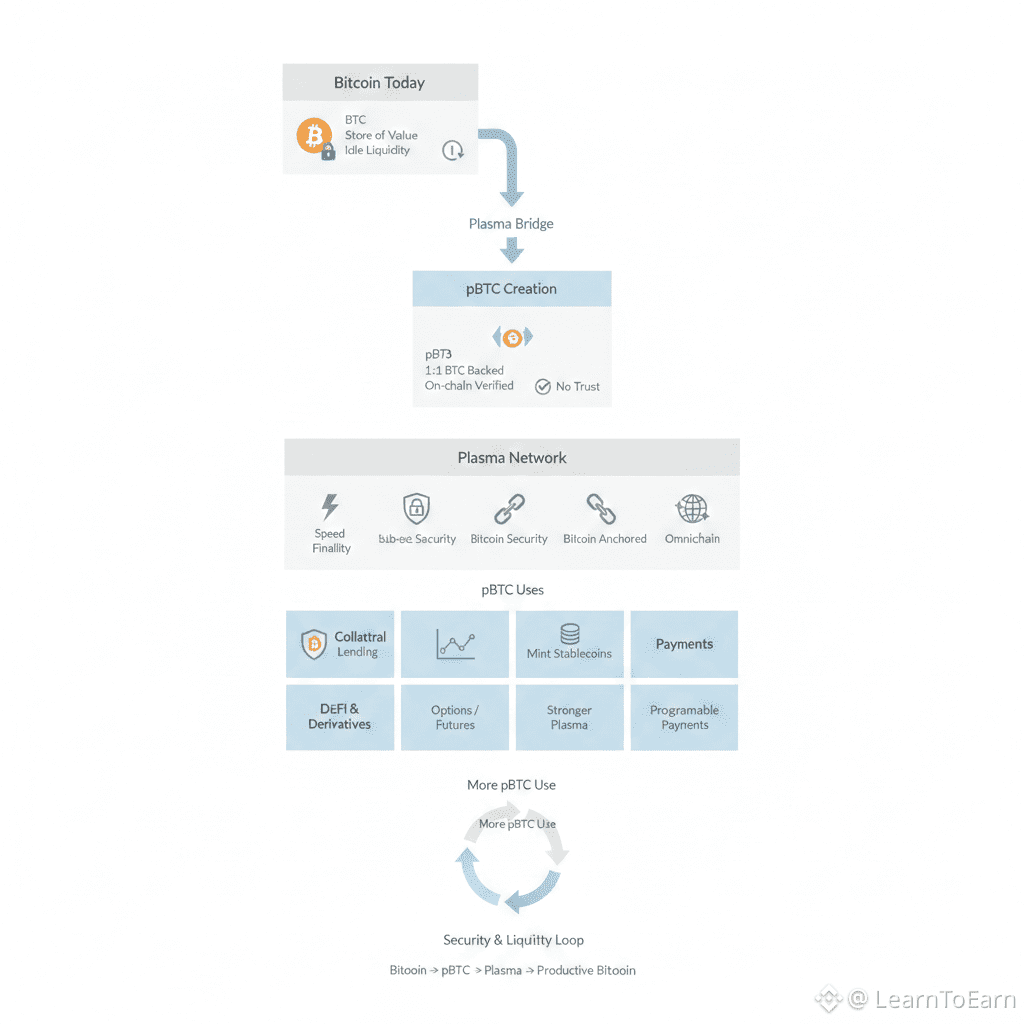
Beyond collateral, Plasma unlocks something even more transformative: truly programmable Bitcoin. With full EVM compatibility, developers can finally treat Bitcoin as a first-class input to smart contracts rather than an external reference. Financial instruments that were previously cumbersome or impossible become straightforward. Bitcoin-denominated options, futures, and structured products can be deployed with low fees and near-instant settlement. Hedging, leverage, and yield strategies that once required centralized intermediaries can now exist entirely on-chain.
For institutions, this programmability opens the door to a new form of treasury management. Bitcoin holdings no longer need to sit idle on balance sheets. Through smart contracts, BTC reserves can be dynamically allocated—part used as collateral to mint operational liquidity, part deployed into liquidity pools for yield, and part hedged through automated derivatives strategies. All of this can occur transparently, governed by code rather than discretion.
The implications extend to payments and governance as well. Bitcoin-denominated salary streams, vesting schedules, subscriptions, and DAO treasuries become trivial to implement. Funds move with the predictability of traditional finance but without its intermediaries or geographic constraints. Bitcoin becomes not just a reserve asset, but a medium of programmable coordination.
As pBTC activity grows, it strengthens Plasma itself. Increased total value locked, higher transaction volume, and deeper liquidity make the network more economically valuable to secure. This creates a reinforcing loop: Bitcoin liquidity strengthens Plasma, and Plasma’s performance and security make Bitcoin more useful. Stablecoins minted against pBTC inherit this strength, becoming more resilient and credible in the process.
Looking forward, the scope only expands. pBTC could evolve into a native gas option for Bitcoin-centric transactions, aligning fee economics with asset usage. Cross-chain collateralization could allow a pBTC position secured on Plasma to unlock liquidity on other networks, extending Bitcoin’s reach without duplicating trust assumptions. As Bitcoin-native verification technologies mature, even deeper levels of trust minimization become possible.
What Plasma ultimately delivers is not a workaround for Bitcoin’s limitations, but an extension of its philosophy. Bitcoin remains sovereign, scarce, and secure. Plasma provides the environment where that sovereignty can express itself economically, at speed, and at scale. Together, they realize a long-standing vision: Bitcoin not just as digital gold, but as programmable digital capital.
With pBTC, Bitcoin is no longer confined to waiting. On Plasma, it works.
In Plasma’s architectural philosophy, the Bitcoin bridge is not a peripheral convenience—it is a structural necessity. Designed as a stablecoin-optimized Layer 1, Plasma understands that the future of on-chain finance cannot be built in isolation from Bitcoin, the most valuable and secure digital asset ever created. The bridge exists to solve a long-standing paradox in crypto: how to unlock Bitcoin’s immense liquidity and credibility inside a fast, programmable economy without compromising on self-custody or decentralization. By enabling BTC to enter Plasma as pBTC, Plasma does more than import capital. It imports trust—while refusing to outsource it.
Bitcoin represents the deepest pool of liquidity in the crypto ecosystem, yet it remains largely inert. On its native chain, BTC excels as a store of value and settlement asset, but it lacks the programmability required for modern financial systems. It cannot natively power complex payments, automated liquidity markets, or stablecoin-based credit systems. For Bitcoin to become productive, it must interact with other networks. Historically, that interaction has come at a cost.
Most existing Bitcoin bridges rely on custodians, federations, or tightly controlled multisig wallets. These models concentrate risk, introduce censorship vectors, and demand trust in human institutions rather than verifiable systems. The industry has already paid the price for these assumptions. Bridge failures have consistently ranked among the most catastrophic events in crypto, not because of exotic bugs, but because centralized trust was treated as a shortcut rather than a liability.
Plasma’s Bitcoin bridge rejects that shortcut entirely. It is engineered from first principles around trust minimization, decentralization, and verifiability, and it is tightly coupled with Plasma’s broader security design—most notably its practice of anchoring chain state to Bitcoin itself. The result is not just a safer bridge, but a coherent security loop where Bitcoin secures Plasma, and Plasma productively deploys Bitcoin.
At the core of the bridge lies a decentralized verifier network—independent entities whose sole mandate is to observe truth, not to control funds. These verifiers run both Bitcoin and Plasma nodes, allowing them to independently validate deposits and redemptions without relying on a central coordinator. When a user sends BTC to the bridge address on Bitcoin, each verifier confirms the transaction directly from the Bitcoin blockchain. Only after a supermajority reaches cryptographic agreement is an equivalent amount of pBTC minted on Plasma. No single entity can mint, halt, or manipulate the process. The bridge does not “trust” verifiers in the traditional sense; it requires collective, observable consensus.
The asset created through this process, pBTC, is fundamentally different from legacy wrapped Bitcoin tokens. It is not backed by an opaque custodian balance sheet or a corporate promise. It is minted directly from verified Bitcoin deposits and governed by protocol logic. Built on LayerZero’s Omnichain Fungible Token standard, pBTC is designed to remain a single, unified asset across chains. Liquidity does not fracture into dozens of incompatible wrappers. Whether pBTC moves within Plasma or to external ecosystems like Ethereum or BNB Chain, it remains the same Bitcoin-backed instrument, preserving depth, composability, and capital efficiency.
What truly distinguishes Plasma’s bridge, however, is how deeply it integrates with Plasma’s Bitcoin-anchored security model. Every unit of pBTC in circulation is provably backed one-to-one by BTC held on the Bitcoin blockchain. This is not an attestation published by a company or a dashboard maintained by a foundation. It is a verifiable fact anyone can confirm by inspecting public ledgers. The minting and burning of pBTC are events that can be audited end-to-end, independent of Plasma’s internal state.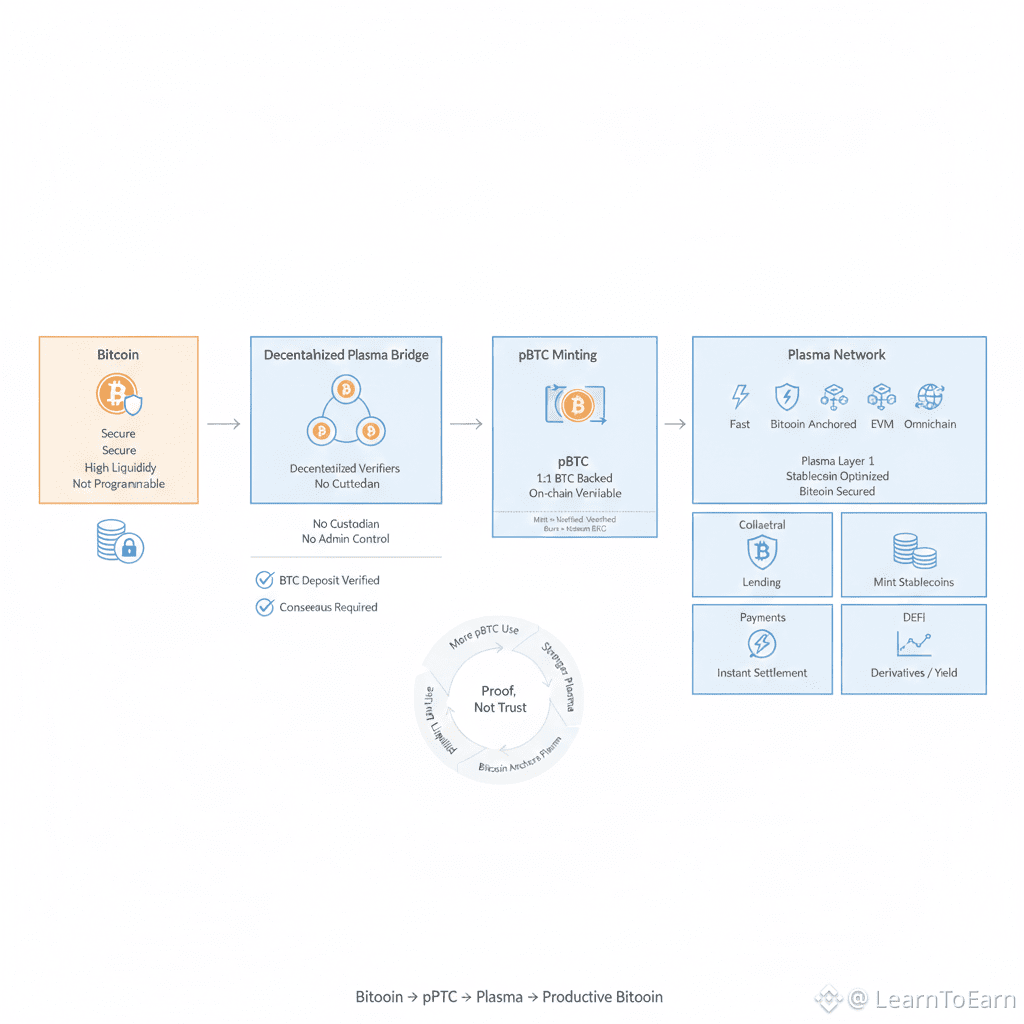
Redemption follows the same trust-minimized logic. When a user burns pBTC on Plasma, verifiers independently observe the burn, reach consensus, and authorize the release of BTC back to the user’s Bitcoin address. Once again, no single party controls withdrawals, and no administrator can arbitrarily freeze funds. Even in adversarial scenarios, Plasma’s anchoring of state to Bitcoin ensures that historical bridge events remain objectively provable.
The economic implications of this design are substantial. With pBTC natively integrated into Plasma’s high-speed environment, Bitcoin becomes premium collateral for a new class of stablecoin-centric financial primitives. Users can borrow stablecoins against pBTC with near-instant liquidation guarantees, create Bitcoin-backed synthetic assets, or deploy BTC into payment flows that settle in milliseconds rather than minutes. For institutions, the transparency of the bridge unlocks use cases previously considered incompatible with decentralized infrastructure—treasury management, structured yield products, and Bitcoin-backed credit instruments that can be audited without trusting internal records.
This, in turn, strengthens Plasma itself. As more value flows into pBTC-based applications, the economic weight secured by Plasma’s Bitcoin-anchored ledger grows. The chain becomes more valuable to defend, and its security assumptions harden accordingly. Liquidity, utility, and security reinforce one another rather than competing.
Plasma does not claim this is the endpoint. The verifier model already represents a major advance over custodial bridges, but the roadmap points toward even deeper trust minimization. Research into BitVM could eventually allow users to enforce redemptions directly on Bitcoin via fraud proofs, further reducing reliance on active verifiers. Advances in Bitcoin light-client technology may one day allow Plasma itself to verify Bitcoin state transitions with minimal overhead, tightening the bridge even further.
What emerges from this design is not merely interoperability, but alignment. Bitcoin remains sovereign, Plasma remains fast, and neither is forced to compromise its core strengths. Plasma becomes the environment where Bitcoin’s dormant capital can finally participate in a programmable economy—without sacrificing the principles that made Bitcoin valuable in the first place.
In this sense, Plasma’s Bitcoin bridge is not just a conduit for liquidity. It is a conduit for legitimacy. It allows the world’s most trusted digital asset to evolve from passive store of value into active financial primitive, inside a system optimized for stablecoins, payments, and global settlement. By doing so, Plasma positions itself not only as a stablecoin Layer 1, but as the natural high-performance extension of the Bitcoin economy itself—secured by proof, not promises, and built for a financial future that demands both speed and truth.
In the race toward faster and more scalable blockchains, one uncomfortable truth is often ignored: speed means nothing if history can be rewritten. For a stablecoin settlement network expected to handle billions—eventually trillions—of dollars, the ability to alter past transactions is not a minor flaw. It is an existential failure. Plasma confronts this risk head-on by making a radical design choice: it anchors its history to Bitcoin itself. Through periodic cryptographic checkpoints written directly onto the Bitcoin blockchain, Plasma transforms Bitcoin into an external, incorruptible arbiter of truth. With this single mechanism, Plasma stops being just another fast chain and becomes something far rarer—a system where the past is effectively untouchable.
The weakness Plasma addresses is fundamental to most standalone blockchains. On any independent network, history is only as secure as the validators currently protecting it. If an attacker gains majority control—whether through economic power, collusion, or coercion—they can reverse transactions, double-spend funds, and reshape recent blocks. Even when the cost is high, it remains finite, often measured in millions rather than billions of dollars. For institutions moving real economic activity on-chain, this risk is impossible to ignore. Financial infrastructure cannot rely on “unlikely attacks” as a security model.
Plasma’s native consensus, PlasmaBFT, already delivers instant finality through a professional, incentive-aligned validator set. Transactions settle quickly, predictably, and efficiently. But Plasma recognizes a deeper truth: while validators are excellent at ordering transactions in real time, they should not be the final guardians of history itself. The integrity of the ledger’s past demands a defender with overwhelming and globally distributed power. That defender already exists in the form of Bitcoin.
The checkpointing process is deliberately simple but profoundly powerful. At fixed intervals, Plasma compresses its entire global state into a single cryptographic commitment—a Merkle root that represents every balance, every smart contract, and every transaction outcome up to that moment. This compact fingerprint is unforgiving. Change even a single byte anywhere in Plasma’s history, and the resulting root becomes completely different. Plasma then embeds this root into a transaction on the Bitcoin blockchain, effectively publishing it to the most secure decentralized ledger ever built. Once mined and buried beneath additional Bitcoin blocks, that checkpoint becomes part of Bitcoin’s proof-of-work history.
From that point forward, Plasma’s past is no longer negotiable. Any attempt to rewrite history would require an attacker to fight on two fronts simultaneously. First, they would need to overpower Plasma’s own validator set to fabricate an alternative version of events. Second—and far more daunting—they would need to reorganize the Bitcoin blockchain deeply enough to erase or replace the checkpoint transaction. This is not merely expensive; it borders on the absurd. It would require competing with the entire global Bitcoin mining network, backed by tens of billions of dollars in specialized hardware and an energy footprint comparable to that of sovereign states.
This is what makes Plasma’s design “prohibitively expensive” in a meaningful sense. Security is no longer limited to Plasma’s internal incentives and staking mechanisms. By anchoring to Bitcoin, Plasma effectively inherits Bitcoin’s vast security budget for its historical data. The cost of an attack explodes from “painful but conceivable” to “economically irrational and logistically near-impossible.” Theoretically, such an attack could exist on paper. In reality, it collapses under its own cost.
The benefits of this architecture go far beyond abstract security economics. Bitcoin checkpoints provide a form of finality that extends beyond algorithms and validators into the realm of social and institutional certainty. Even in a worst-case scenario—where Plasma’s live consensus is disrupted or validators fail—there is no ambiguity about what the canonical history was. Anyone, anywhere, can independently verify Plasma’s last known valid state by referencing Bitcoin. Chain recovery becomes objective rather than political, eliminating contentious splits and subjective “community decisions.”
Censorship resistance is strengthened in a similarly tangible way. Validators may influence which future transactions are included, but they lose all power over the past once a checkpoint is anchored. No government, corporation, or consortium can pressure Plasma to erase or modify settled transactions after the fact. The historical record becomes independent of Plasma’s ongoing operations, frozen in Bitcoin’s immutable ledger.
For institutions, this model changes the trust equation entirely. Auditors, regulators, and counterparties no longer need to rely on internal attestations or privileged access. They can verify Plasma’s transaction history themselves, directly against Bitcoin’s public blockchain. This creates a cryptographically provable audit trail that exists outside the system being audited—the highest standard of financial integrity. Trust is minimized not by promises, but by mathematics and energy expenditure.
Importantly, Plasma’s vision does not stop at periodic checkpoints. The roadmap points toward deeper integration with Bitcoin’s emerging computation layer. Concepts like BitVM open the door for Bitcoin itself to validate claims about Plasma’s state through fraud proofs, allowing the network to evolve from a passive notary into an active judge. Over time, checkpointing could become more frequent and more interactive, with optimistic attestations and challenge windows that further compress the gap between transaction execution and permanent historical anchoring.
What Plasma demonstrates is a rare clarity of design. It does not attempt to reinvent Bitcoin, nor does it pretend that speed alone is sufficient for global finance. Instead, it assigns each network the role it performs best. Plasma handles fast, low-latency settlement at scale. Bitcoin secures history with unmatched decentralization and economic gravity. Together, they form a system that is both agile in the present and immovable in the past.
For the stablecoin economy—poised to become the payment layer of global commerce—this guarantee is not optional. Money that moves at internet speed must be backed by history that cannot be revised. Plasma’s Bitcoin-anchored ledger ensures exactly that. Transactions may flow quickly, but once settled, they are carved into digital stone, secured by the most powerful decentralized network humanity has ever built.


