


Most people hear “native bridge” and mentally file it under nice-to-have infrastructure. That is a mistake. On Dusk, the bridge is not an accessory. It is part of the protocol’s spine.
The goal is simple and strict: one asset, one security model, one economic system across three layers. No wrapping. No custodians. No synthetic representations pretending to be neutral.

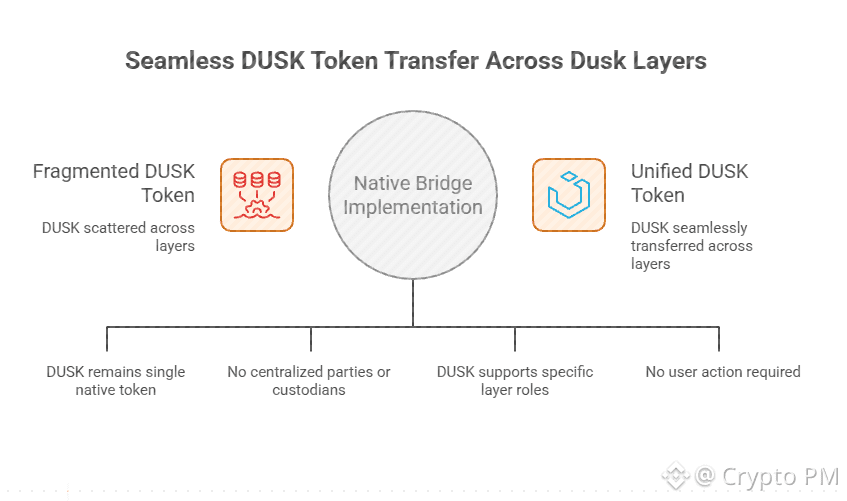
No Wrapped Assets Means No Hidden Risk
Wrapped assets are a compromise, not an innovation. They introduce custodial risk, legal ambiguity, and extra attack surfaces, then hope users do not notice until something breaks.
Dusk avoids this entirely.
DUSK remains the same native asset whether it is used on DuskDS, DuskEVM, or DuskVM. The bridge does not lock tokens on one layer and mint IOUs on another. It moves value directly inside the protocol.
That matters because wrapped assets are where bridges fail. If you remove wrapping, you remove an entire class of exploits and trust assumptions.
This is not about elegance. It is about reducing failure modes.
Validator Run and Trustless by Design
The bridge is not outsourced. It is validator run and embedded into the core protocol.
That means the same security assumptions that protect consensus also protect value movement between layers. There is no separate trust domain. No multisig committee. No “temporary admin keys” that stay around forever.
If you trust the chain, you trust the bridge. If the chain fails, everything fails equally. That symmetry is intentional.
This is how infrastructure should be built, even if it is harder.
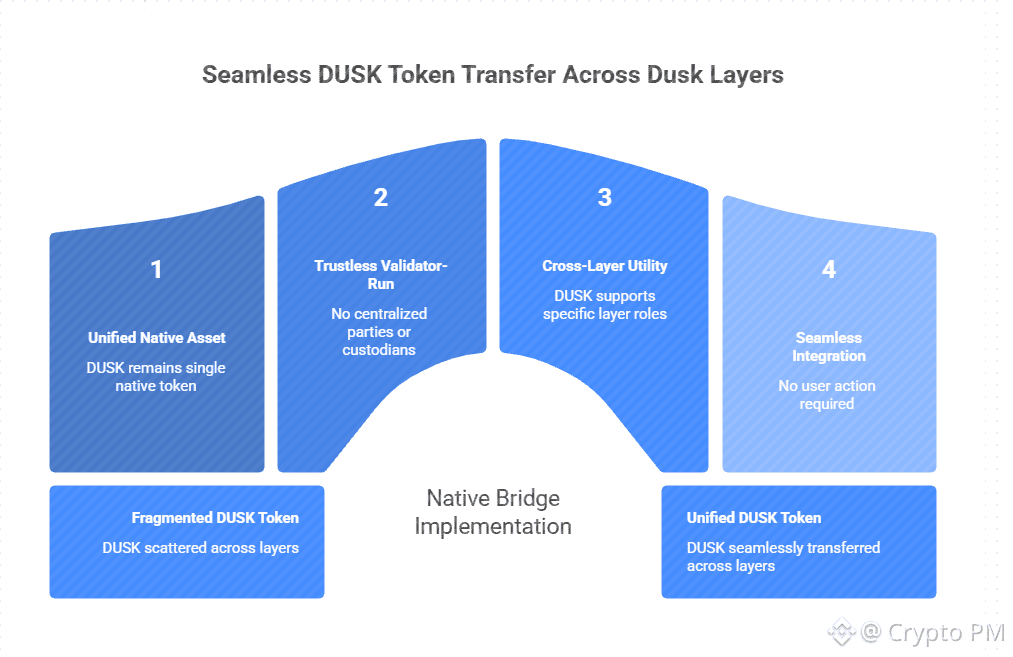
One Token, Three Roles, Zero Confusion
The bridge exists to let DUSK perform different jobs without fragmenting the economy.
On DuskDS, DUSK secures the network through staking, governance, and settlement finality.
On DuskEVM, the same DUSK becomes gas for Solidity contracts and exchange activity. No second token. No fee abstraction games.
On DuskVM, DUSK pays for full privacy preserving computation where costs are higher and cryptography is heavier.
Different roles, same asset, same supply.
This avoids the classic trap where each layer launches its own token, dilutes value, and competes internally for relevance.
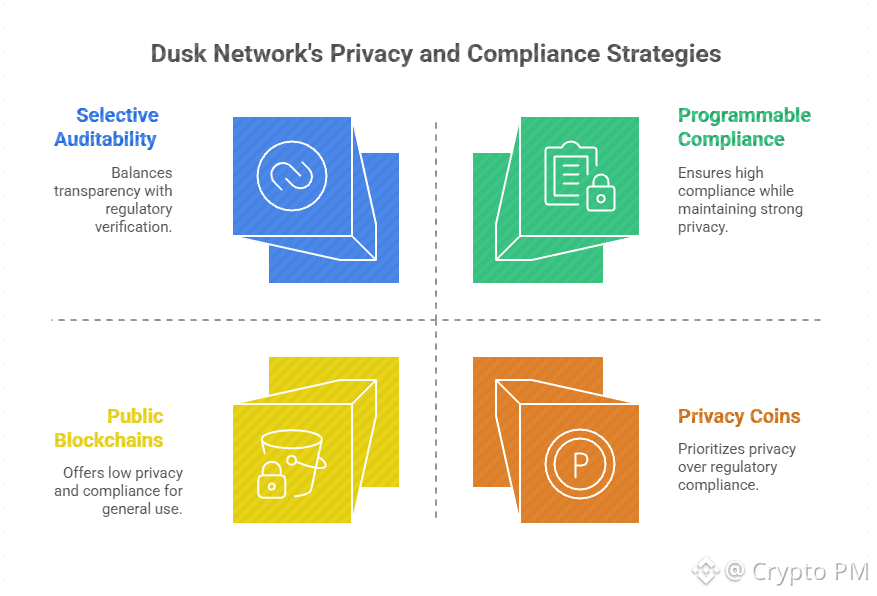
Seamless For Users Because Complexity Is Contained
From the user side, this is intentionally boring. Existing stakers do not need to rebalance or migrate manually. Balances remain intact while gaining access to new layers automatically.
The bridge also supports migration from ERC-20 and BEP-20 DUSK into the native environment, which is necessary cleanup, not growth hacking.
The key point is this: complexity lives inside the protocol, not on the user.
Most systems do the opposite and then blame UX teams when things break.
Why This Matters More Than People Think
Bridges are the most exploited component in crypto history. That is not an accident. They sit between systems with different rules and ask users to trust glue code.
Dusk removes that category entirely inside its own stack.
If you are building regulated markets, custody compliant systems, or privacy sensitive applications, you cannot afford wrapped assets and external bridges as core infrastructure. Regulators will not accept it. Institutions will not tolerate it.
This native bridge is boring, conservative, and correct.
And like most correct infrastructure decisions, it will only be appreciated after enough flashy alternatives fail.