
Ethereum explained
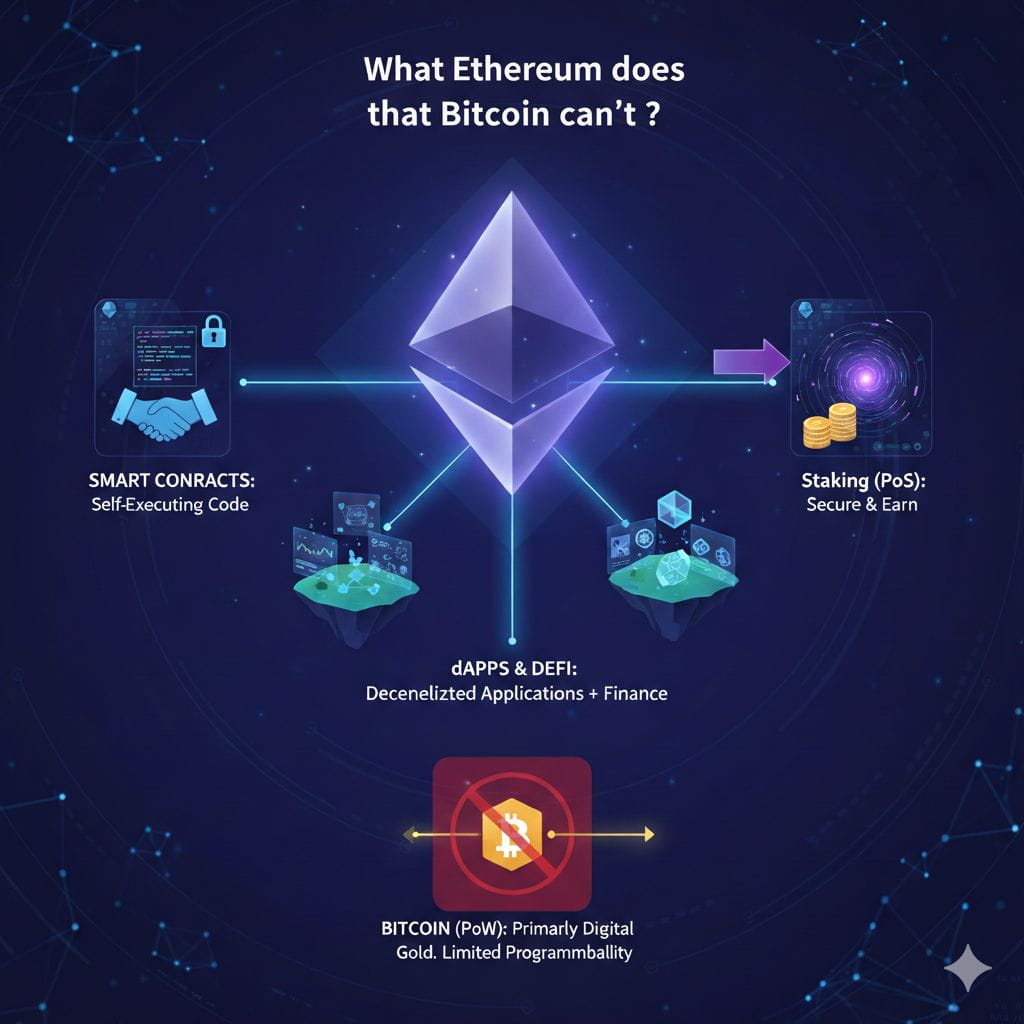
Today's topic: Ethereum - the chain that turned crypto from "internet money" into "internet apps."
 Source: @dubzyxbt
Let's clear this up right away: Ethereum is not just a cryptocurrency.
Yes, it has a coin (ETH).
But Ethereum's real purpose is being a decentralized platform where anyone can build applications without a company, server, or central authority running the show.
If Bitcoin answered the question,
👉 "What if money didn't need banks?"
Ethereum followed up with,
👉 "What if apps didn't need companies?"
Here's the core idea:
Ethereum is a blockchain that lets developers write smart contracts - pieces of code that automatically run when certain conditions are met. No middleman. No manual approval.
Once those contracts are live, they can't be changed or shut down by a single party.
That's the magic (and sometimes the chaos).
Here's how that plays out in practice:
Ethereum runs on a network of computers called nodes. These nodes all store the blockchain and agree on what's happening - who sent what, which contracts ran, and in what order.
When you do anything on Ethereum (swap tokens, mint an NFT, vote in a DAO, etc.), you're interacting with a smart contract. The network processes that action, records it permanently, and moves on.
That processing requires resources - and that's where ETH comes in.
ETH is Ethereum's native asset and is used to pay for transactions and computation (aka gas).
So ETH isn't just money - it's the fuel that keeps Ethereum running.
To keep this system secure, Ethereum relies on validators.
Validators lock up (stake) ETH as collateral and help verify transactions and smart contract activity.
👉 If they follow the rules, they earn ETH rewards.
👉 If they try to cheat, they can lose part of their stake.
This setup makes attacking the network expensive and aligns incentives so it's in everyone's best interest to play fair - all without a central authority in charge.

At this point, the difference between Ethereum and Bitcoin becomes clear.
👉 Bitcoin is intentionally limited. It focuses on being secure, predictable, and good at one thing: digital money.
👉 Ethereum is intentionally flexible. It's designed to be programmable.
Same foundation (blockchain). Very different goals.
And because Ethereum is programmable, entire ecosystems grew on top of it. This is where:
👉 decentralized finance (lending, borrowing, trading without banks),
👉 NFTs and on-chain ownership,
👉 blockchain games,
👉 DAOs run by smart contracts,
👉 and thousands of tokens
... all took off.
Ethereum became the default place to build in crypto.

Of course… it's not perfect.
Ethereum's biggest pain points:
👉 High gas fees: when lots of people use the network, fees can spike;
👉 Scalability: the base layer can only handle so much at once;
👉 Smart contract risk: code bugs can (and have) caused major losses.
A lot of Ethereum's upgrades and Layer-2 solutions exist specifically to fix these issues.
Bottom line:
Ethereum isn't just a coin - it's a platform. A programmable blockchain that lets developers build apps, organizations, and financial systems without a central authority calling the shots.
👉 Bitcoin showed the world decentralized money was possible.
👉 Ethereum showed the world decentralized everything else might be too.
Source: Binance News / #BitDegree / Coinmarketcap
"Place a trade with us via this post mentioned coin's & do support to reach maximum audience by follow, like, comment, share, repost, more such informative content ahead"
#crypto #Ethereum #bitcoin #ETHvsBTC $ETH $BTC

