
Plasma is a Layer-1 blockchain created with a very simple but powerful idea in mind: people don’t use money to experiment, they use it to live. They send it to family, pay for goods, receive salaries, move funds across borders, and settle business transactions. Stablecoins already play this role for millions of people, yet most blockchains still treat them like a side feature. Plasma flips that thinking completely and builds the entire network around stablecoin settlement.
Instead of asking users to adapt to blockchain complexity, Plasma tries to adapt the blockchain to real human behavior. It is designed for speed, clarity, and reliability. When someone sends a stablecoin on Plasma, the expectation is that it should feel natural and boring in the best possible way: fast, cheap, and final, without technical surprises.
One of the reasons Plasma exists is because current blockchain payments still feel too complicated for normal users. On many networks, sending stablecoins means worrying about gas tokens, fee spikes, slow confirmations, and failed transactions. For people who just want to move digital dollars, this friction feels unnecessary. Plasma’s goal is to remove those obstacles so stablecoins behave more like digital cash and less like a technical experiment.

Under the surface, Plasma is fully compatible with Ethereum. This matters because Ethereum already has the largest developer base, tooling, and wallet ecosystem. By staying EVM-compatible, Plasma does not force builders to start over. Smart contracts, developer tools, and existing infrastructure can move over with minimal changes. This lowers the barrier for adoption and helps Plasma grow into existing crypto workflows instead of trying to replace them.
Speed is another core focus. Plasma uses a fast Byzantine Fault Tolerant consensus system that allows transactions to reach finality very quickly. For everyday users, this means payments do not sit in limbo. For merchants and businesses, it means they can trust that once a payment is received, it is truly settled. This type of fast finality is essential if stablecoins are going to be used at scale for real commerce and financial operations.
Perhaps the most human-friendly part of Plasma is how it handles fees. Traditionally, blockchains require users to hold a native token just to send a transaction. This is one of the biggest sources of confusion for new users. Plasma introduces a stablecoin-first approach where many stablecoin transfers can be gasless from the user’s point of view. Through sponsored transactions, the network or applications can cover the cost of gas in the background. The user simply sends stablecoins, without needing to think about fees, tokens, or balances beyond what they are actually transferring. This small change has a big impact on usability.
Behind the scenes, Plasma still relies on strong economic incentives to stay secure. The network uses a native token primarily for validator staking, security, and ecosystem support. Validators stake this token to help run the network and are rewarded for honest participation. The token also helps fund infrastructure such as gas sponsorship and developer incentives. Importantly, Plasma is designed so everyday users do not have to interact with this token unless they want to. The complexity stays in the background, where it belongs.
Security and neutrality are especially important because Plasma is built for money movement. To strengthen trust and long-term integrity, Plasma uses a design that anchors parts of its history to Bitcoin. Bitcoin is widely seen as the most secure and neutral blockchain in existence. By referencing Bitcoin as an external security anchor, Plasma makes it much harder for past transactions to be altered or censored. This does not mean Plasma runs on Bitcoin, but it does mean it borrows Bitcoin’s strength to reinforce confidence, especially for institutions and large payment flows.
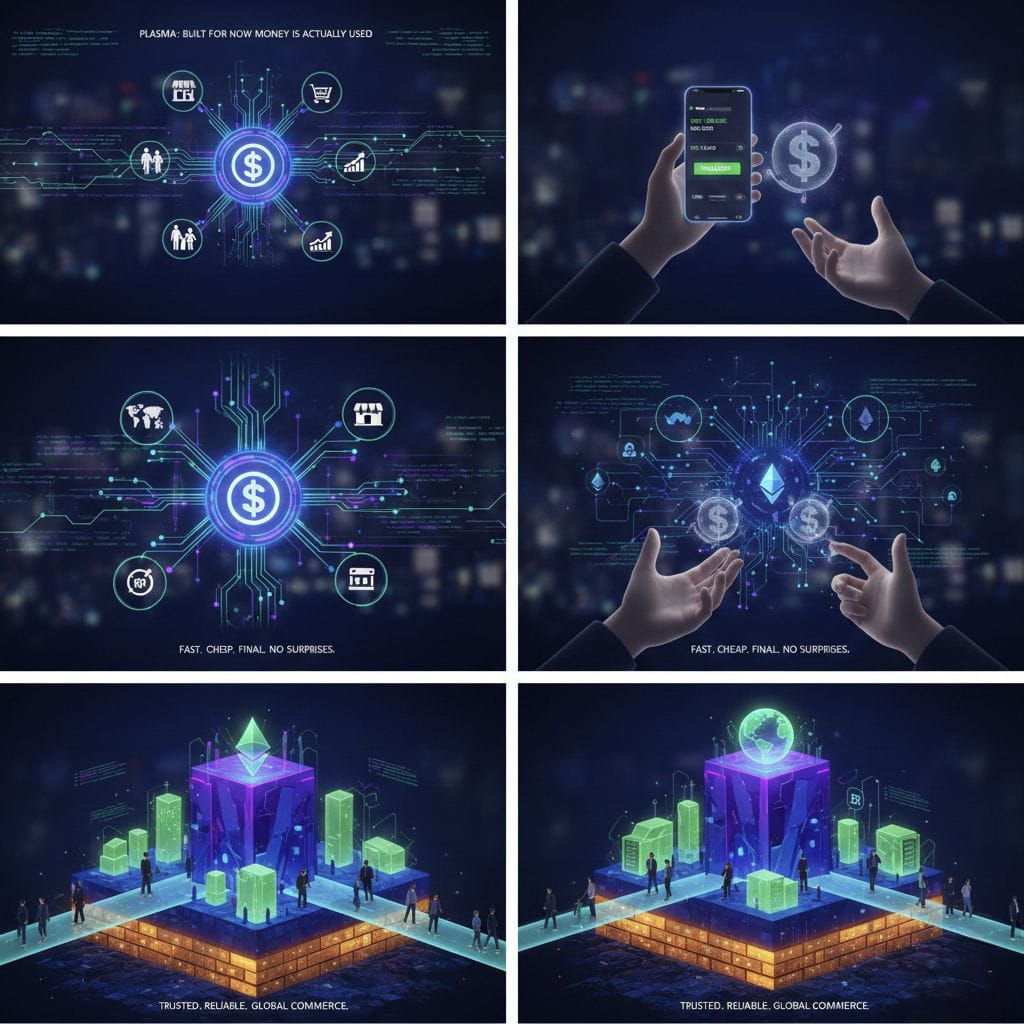
Plasma’s vision naturally attracts two main groups. The first is everyday users in regions where stablecoins are already part of daily life. In many countries, people rely on stablecoins because local currencies are unstable or banking systems are slow and expensive. For them, Plasma offers a smoother, faster way to move value without extra friction. The second group is institutions such as payment processors, exchanges, fintech companies, and treasury teams. These organizations care deeply about predictable settlement, fast finality, and long-term security. Plasma is designed to meet those expectations without sacrificing openness.
The development path for Plasma reflects its practical mindset. Early efforts focus on making the core system reliable: fast consensus, gasless stablecoin transfers, and developer compatibility. Later stages expand into deeper liquidity, integrations with wallets and exchanges, merchant tools, and cross-chain settlement options. Rather than chasing trends, the roadmap stays centered on making stablecoin payments work better year after year.

Of course, Plasma also faces real challenges. Stablecoins themselves come with regulatory and issuer risks, and relying heavily on them means Plasma must adapt to changing legal environments. Gas sponsorship must be carefully balanced so it remains sustainable and resistant to abuse. The technical design is powerful but complex, which makes security audits and cautious upgrades essential. Competition is also intense, as many blockchains are trying to become the default payment layer for crypto.
Still, Plasma stands out because of its clarity. It does not try to be everything. It tries to be useful. By focusing on how people actually use money, Plasma aims to turn stablecoins into a truly global payment tool. If it succeeds, it may not be the loudest blockchain in the room, but it could quietly become one of the most important — the kind of infrastructure people rely on every day without even thinking about it.

