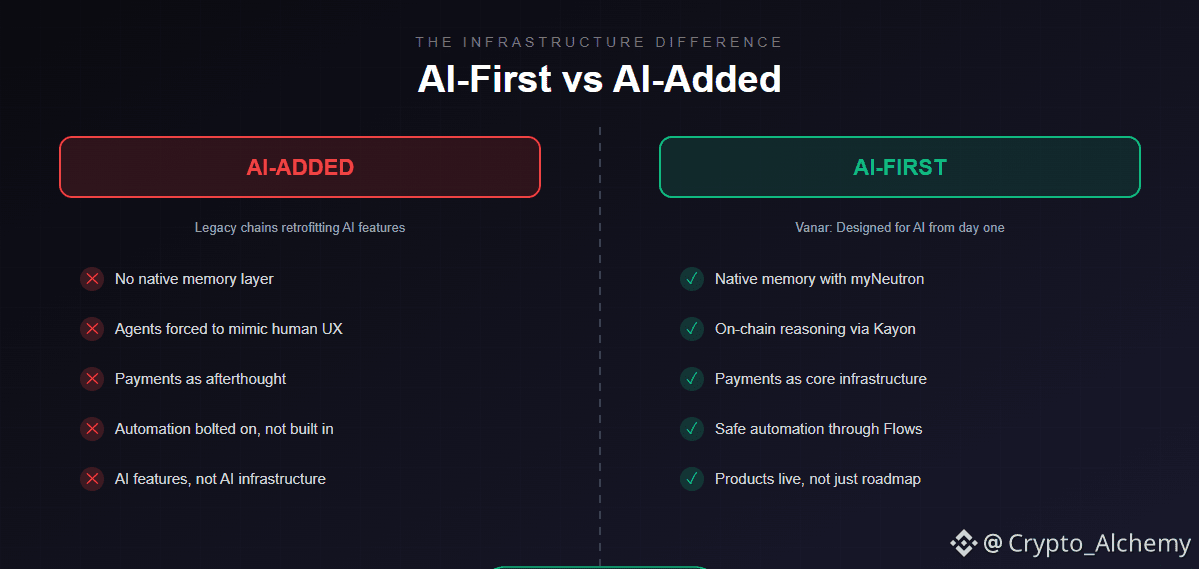
Vanar stopped asking permission from legacy assumptions and built for what actually matters when AI systems need to run in the real world. Most conversations about AI chains skip the boring middle and jump straight to throughput numbers or token price targets.
That misses the plumbing that determines whether anything compounds over time. Vanar began by asking a different question: what do autonomous agents actually need to function reliably on chain?
The answer is simple and practical. They need memory that survives between sessions so work can continue. They need reasoning that is auditable so humans and regulators can inspect decisions.
They need execution that triggers when conditions are met so processes do not stall waiting for a human click. They need settlement so value actually moves and workflows reach finality.
Treating those four needs as optional turns automation into a fragile experiment. Agents that forget everything between conversations cannot build on prior outcomes. Agents that make decisions without a trace cannot be trusted in regulated settings.
Agents that can think but cannot act leave work half done. Agents that act but cannot settle leave value unresolved.
Vanar built myNeutron, Kayon, and Flows to address each of these gaps as foundational protocol capabilities rather than someday roadmap items. myNeutron gives persistent context so agents do not start from zero. Kayon records reasoning with clear audit trails. Flows enables bounded automation so actions run inside safe limits. These are live products you can use now, not promises for the future.
That product-first approach changes how the token behaves. VANRY is not positioned as a speculative play on the next narrative rotation. It is positioned as the settlement and utility layer that captures real activity when AI-native usage grows. When agents run, compute cycles are consumed, execution fees occur, and settlement closes loops.
Those are steady, structural sources of demand. That is different from token moves driven by hype and short lived sentiment.
Cross chain availability matters because agents do not respect ecosystem boundaries. Liquidity and users already live on networks like Base. Confining Vanar capabilities to an isolated testnet would only slow adoption. Expanding where demand already concentrates makes integrations practical and lowers friction for developers and users. That is why Vanar focused on being available where builders and capital already are.
None of this guarantees instant adoption. Building infrastructure is not glamorous. It looks boring on dashboards.
But boring infrastructure is what systems rely on when they scale. Vanar focused on the filter that matters when automation becomes routine rather than the headlines that trend for a week.
If you want agents that compound work over months and years, you need a stack that treats memory, reasoning, execution, and settlement as first class. Vanar did that. The difference between a feature and infrastructure is whether people can stop thinking about it and just use it. Vanar built to be the kind of infrastructure people stop thinking about.