Introduction: The Systems We Built Are Now Building Us $WAL
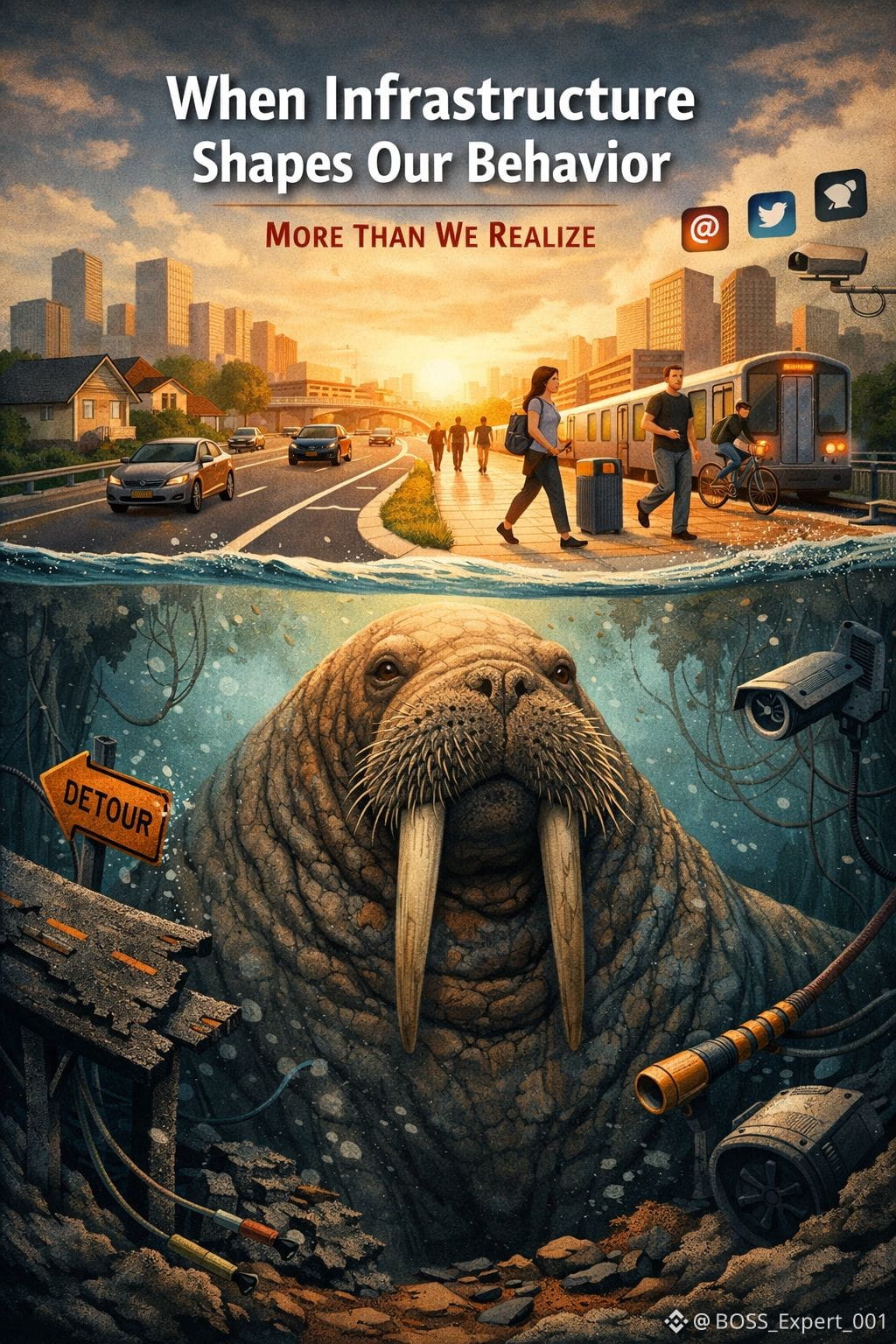
We usually think of infrastructure as something simple and supportive. Roads help us move. Electricity keeps the lights on. The internet connects us. It all sounds neutral, almost invisible.But here’s the uncomfortable truth: infrastructure doesn’t just support our lives anymore — it shapes them.The systems we build slowly guide how we behave, where we go, what we choose, and even how we think. Most of the time, we don’t notice it happening. Like a massive walrus resting quietly beneath the surface, infrastructure moves slowly, heavily, and with long-lasting impact.This article explores what happens when infrastructure crosses a line — when it stops being a tool in our hands and starts becoming a force that directs our behavior.
Infrastructure Was Never Neutral — We Just Treated It That Way,infrastructure is often presented as technical and objective. Engineers design it. Governments fund it. People use it. End of story.Except… that’s never really how it works.Every road layout, every transit system, every digital platform is built on assumptions:Who is this for?Who will benefit?Who can afford to use it?
Who gets left out?
Once those assumptions are physically or digitally locked in, they begin shaping daily life. People adapt. Habits form. Norms emerge. Over time, infrastructure stops responding to behavior — behavior starts responding to infrastructure.How Infrastructure Quietly Shapes Human Behavior
1. It Creates “Default” Choices
Most people follow the easiest path. Infrastructure decides what “easy” looks like.If your city is built for cars, you drive — even for short distances.If public transport is unreliable, you avoid it.If an app keeps autoplaying videos, you keep watching.These are not strong decisions. They’re default behaviors created by design.
2. It Limits What Feels Possible
Infrastructure doesn’t need to ban something to discourage it — it just needs to make it inconvenient.No sidewalks? People stop walking.No affordable internet? People stop learning online.No local public spaces? Communities slowly disappear.When options disappear, so do behaviors.
3. It Normalizes Certain Lifestyles
Over time, infrastructure teaches us what a “normal” life looks like.Car-centric cities normalize long commutes and isolation.Social media platforms normalize constant attention and comparison.Surveillance systems normalize being watched.What once felt strange slowly becomes routine.Physical Infrastructure: Shaping How We Live TogetherTransport Systems and Social Division,Transportation isn’t just about moving people — it decides who meets whom.Highways built through neighborhoods often divide communities. Poor transit access traps people in economic bubbles. Well-connected areas attract investment, while disconnected ones fall behind.
Over time, infrastructure hardens social boundaries — not through laws, but through design.
Cities That Teach Us How to Behave,Think about how different spaces make you act differently:A wide, open park invites relaxation and conversation.A narrow, noisy road makes you rush.A dark, poorly maintained area makes you cautious or afraid.,The built environment quietly trains behavior — posture, pace, interaction.Digital Infrastructure: The New Behavior Engine,If physical infrastructure shapes movement, digital infrastructure shapes attention.Algorithms decide what we see. Platforms decide how we interact. Interfaces decide when we stop.You don’t scroll endlessly because you’re weak — you scroll because the system is designed to pull you forward without friction.Digital infrastructure doesn’t just support communication anymore. It:Rewards certain opinions,Punishes silence,Encourages speed over reflection
Turns behavior into data
And once behavior becomes data, it becomes something that can be optimized, predicted, and steered.When Support Turns Into Control,The most dangerous infrastructure is the kind that feels helpful.Navigation apps tell us where to go — but slowly remove our sense of direction.Recommendation systems suggest content — but narrow our worldview.Smart systems promise efficiency — but quietly monitor and influence choices.The problem isn’t infrastructure itself.
The problem is unquestioned infrastructure.
Who Loses When Infrastructure Shapes Behavior?Not everyone is shaped equally.People without access to good infrastructure don’t just face inconvenience — they face restricted lives:Limited mobility,Fewer opportunities,Less visibility,Reduced voice,When infrastructure shapes behavior, inequality becomes structural — baked into roads, networks, and systems.Rethinking Infrastructure: Designing for Humans, Not Habits,If infrastructure shapes behavior, then designing it is a moral act.
1. Design With People, Not Just For Them,Communities should help decide the systems that shape their lives.2. Build Flexibility, Not Lock-In,Infrastructure should evolve as people evolve — not trap future generations in old assumptions.3. Demand Transparency in Digital Systems,If a system influences behavior, people deserve to know how and why.Conclusion: The Walrus Beneath the Surface,Infrastructure doesn’t scream for attention. It doesn’t argue. It doesn’t announce its power.,It just sits there — shaping routines, guiding movement, influencing decisions — slowly, steadily, and deeply.The real danger isn’t that infrastructure shapes behavior.The danger is forgetting that it does.
Once we recognize infrastructure as an active force — not a neutral backdrop — we can begin to design systems that serve human values, not quietly replace them.