


Most blockchains are busy chasing attention. New buzzwords, new narratives, loud launches. Vanar Chain is doing the opposite — and that’s exactly why it caught my attention.
Instead of trying to look revolutionary, Vanar is focused on something much harder: making on-chain systems actually intelligent. Not “AI slapped on later,” not off-chain bots pretending to be smart — real memory, real reasoning, and real automation built into the chain itself.
And the wild part? It’s already working.
Built for the AI era, not retrofitted for it
Vanar is a modular Layer 1 designed from day one for AI-driven applications. That matters more than people realize. Most chains were built for transfers and DeFi, then later tried to duct-tape intelligence on top using oracles and external servers. Vanar flipped that approach.
Here, intelligence lives inside the protocol.
Every application deployed on Vanar starts with access to built-in AI primitives. No extra infrastructure. No messy integrations. Just native intelligence at the base layer.
The project started in 2023 and quietly scaled into a serious operation, with over 50 specialists working across blockchain, AI, and payments. This isn’t a weekend hackathon chain — it’s infrastructure.
A five-layer stack that actually makes sense
Vanar’s architecture is where things get interesting. Instead of cramming everything into one layer, it separates responsibilities cleanly:
• Core Layer 1: Fast, scalable, and optimized for real usage.
• Neutron: The memory layer.
• Kayon: The reasoning engine.
• Axon (coming soon): Automation and autonomous execution.
• Flows: Industry-specific workflows built on top.
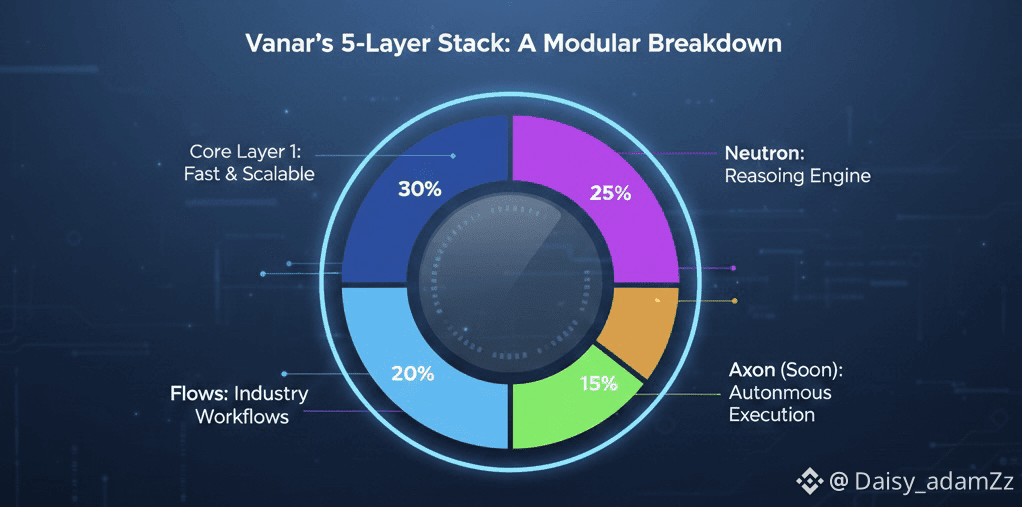
Each layer does one job well. Together, they create something most chains can’t: a system that remembers, understands, and acts.
Neutron: blockchain finally gets memory
One of crypto’s biggest weaknesses has always been memory. Chains store transactions, but they don’t understand data. Neutron changes that.
Neutron compresses complex information — legal agreements, financial reports, proofs, documents — into compact, structured units called Seeds. These Seeds aren’t just blobs of data. They’re searchable, AI-readable, and cryptographically anchored.
Most of the heavy data stays off-chain for efficiency, but the critical fingerprints live on-chain. That means integrity without bloat. Context without chaos.
The result? Applications that remember why something happened, not just that it happened. This alone unlocks an entirely new class of on-chain use cases.
And this isn’t theoretical. Vanar has already produced millions of blocks and supports tens of millions of wallets. The system scales because it was designed to.
Kayon: reasoning directly on the chain
If Neutron is memory, Kayon is the brain.
Kayon is Vanar’s on-chain reasoning layer. It analyzes patterns, checks compliance rules, and triggers logic in real time — without relying on off-chain computation. That’s huge for regulated industries.
Think about tokenized assets that automatically enforce compliance. Financial records that drive logic instead of sitting idle. Transactions that adjust behavior based on history and context.
Kayon doesn’t just execute code. It understands conditions.
This is especially powerful for real-world assets, payments, and autonomous agents — areas where static smart contracts simply fall short.
And for builders, it’s accessible. Vanar supports EVM and provides SDKs in JavaScript, Python, and Rust. You don’t need to relearn everything to build here.
Built for real-world adoption, not crypto-only loops
Vanar isn’t positioning itself as a niche AI chain. It’s aiming straight at mainstream usage.
The network is carbon-neutral by default. Costs are low. Infrastructure is abstracted away so developers don’t need to manage servers or custom AI stacks.
This focus is why Vanar is already attracting serious partners. Its collaboration with Worldpay at Abu Dhabi Finance Week wasn’t marketing noise — it was about agent-based payments and bridging traditional finance with AI-native blockchain systems.
The hiring of payments veterans like Saiprasad Raut signals the same direction: global settlement, compliance, and real financial rails for AI agents.
Tokenomics that align with usage
$VANRY isn’t built around hype cycles.
The supply caps at 2.4 billion, with half released at genesis and the rest distributed gradually over 20 years. There are no team tokens, which is rare and telling.
Even more important: revenue from AI services like myNeutron and Kayon is used for buybacks and burns. That ties token value directly to actual usage, not speculation.
Vanar is also cross-chain, already live on Base, which keeps it open and composable rather than isolated.
Why Vanar stands out
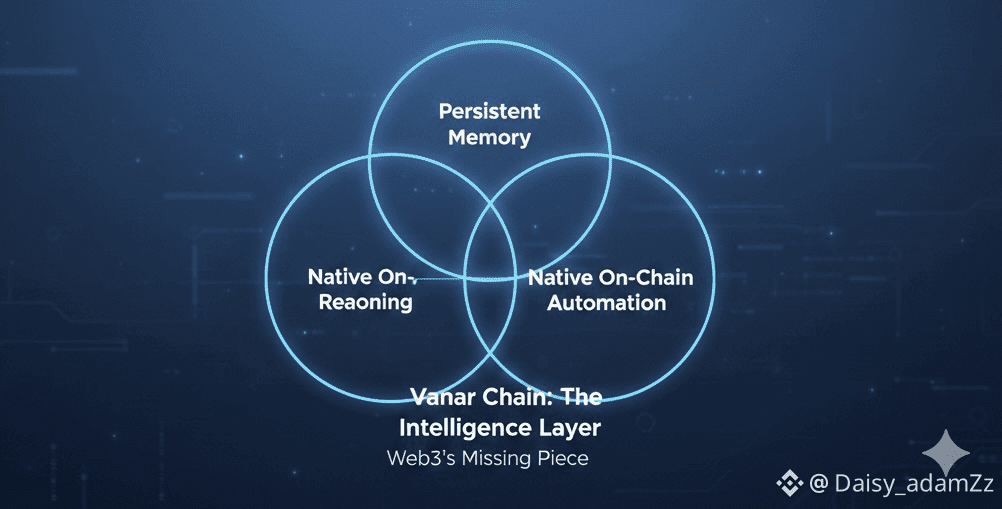
What makes Vanar different isn’t one feature — it’s the combination.
• Persistent memory at the infrastructure level
• Native reasoning on-chain
• Automation designed for agents
• Real partnerships, not slide decks
• A focus on compliance, not avoidance
In a space full of promises, Vanar is shipping.
They’re showing up at real events like Step Conference Dubai, engaging builders, and pushing forward quietly while others shout.
Vanar isn’t trying to be loud. It’s trying to be foundational.
And if on-chain applications are going to survive the AI era, they’ll need exactly what Vanar is building: systems that can remember, reason, and act responsibly.
This isn’t just another blockchain
It’s the intelligence layer Web3 has been missing.
