

Public blockchain infrastructure is entering a phase where technical novelty alone is no longer enough to justify long-term relevance. After years of experimentation, markets are increasingly focused on whether a network can support sustained, non-financial usage without sacrificing reliability or economic coherence. This shift places pressure on Layer-1 blockchains to move beyond abstract scalability claims and demonstrate that their design choices translate into products people actually use. Vanar sits directly within this transition, positioning itself not as a general-purpose experiment, but as infrastructure deliberately shaped around consumer-facing digital environments.
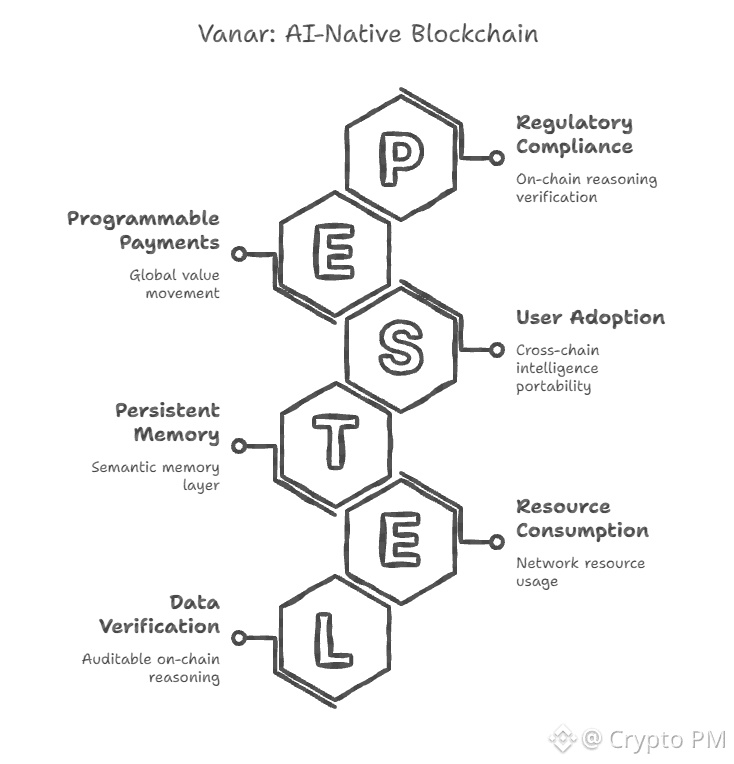
What makes this approach timely is the growing mismatch between blockchain capabilities and mainstream expectations. Many networks are optimized for capital movement, governance votes, or yield mechanisms, while everyday users interact with digital products through games, media platforms, and brand ecosystems. These users expect fast response times, predictable costs, and seamless interaction without needing to understand the underlying technology. Vanar’s architecture reflects an understanding that consumer adoption will not be driven by ideological decentralization alone, but by whether blockchain fades into the background while enhancing ownership and interoperability.

At the protocol level, #vanar is engineered to prioritize consistent execution and low-latency performance. Instead of maximizing theoretical throughput under ideal conditions, the network emphasizes stability under continuous use. This distinction matters in environments like gaming or virtual worlds, where frequent interactions and state updates are part of normal behavior rather than edge cases. The chain’s execution model is designed to handle these patterns without introducing fee volatility or unpredictable confirmation times, which are common friction points for interactive applications on many existing networks.
Smart contracts on #vanar are treated as living components of applications rather than isolated financial instruments. They support evolving logic tied to user progression, digital identity, and asset interaction across environments. This design aligns with products such as the Virtua Metaverse and the VGN games network, where on-chain state must persist over long periods while remaining flexible enough to accommodate updates and new features. The result is an infrastructure layer that complements traditional development workflows instead of forcing developers to redesign experiences around blockchain limitations.
The $VANRY token plays a central role in aligning network activity with economic incentives. Its function extends beyond transaction settlement into ecosystem participation, particularly within applications that rely on frequent micro-interactions. By embedding token usage into product-level mechanics, Vanar reduces reliance on external speculation to drive demand. Economic activity becomes more closely linked to actual usage, which can lead to more stable circulation patterns over time, provided applications continue to attract users.
Governance within the ecosystem is structured to balance adaptability with accountability. Rather than pursuing rigid decentralization from inception, Vanar’s governance framework allows for iterative decision-making as the network grows. This approach acknowledges that early-stage infrastructure benefits from faster coordination, while still preserving pathways for broader stakeholder involvement as adoption increases. For developers and partners, this reduces uncertainty around protocol evolution and long-term support.
On-chain behavior offers insight into how this design translates into real usage. Transaction patterns tend to align with application activity cycles rather than speculative market swings, suggesting that a portion of network demand is organic. Wallet interactions show repeat engagement, a signal that users are returning to applications rather than interacting once and leaving. Token movement reflects circulation within ecosystems rather than prolonged inactivity, indicating that VANRY is functioning as an operational asset rather than solely a store of value.
From a market perspective, this usage-driven model shapes how value accrues. Investors evaluating Vanar are effectively assessing the growth potential of its application ecosystem rather than short-term liquidity incentives. Developers benefit from infrastructure tailored to their needs, reducing the trade-offs between performance and decentralization that often complicate consumer-facing blockchain projects. Liquidity dynamics, while potentially less explosive during speculative cycles, may prove more resilient if tied to steady application growth.
That said, the strategy carries structural risks. Concentration on gaming, virtual environments, and branded experiences exposes the network to sector-specific downturns. Scaling consumer applications also introduces operational complexity, particularly around security and user experience. As interactions increase, so does the importance of rigorous auditing and infrastructure reliability. Regulatory uncertainty around digital assets, especially in branded or entertainment contexts, could further influence adoption trajectories.
Looking forward, Vanar’s success will depend less on broad narratives and more on execution. Incremental improvements to scalability, developer tooling, and onboarding will be critical as user numbers grow. The network’s ability to support long-lived products without disruption will ultimately define its credibility as consumer infrastructure. If current usage patterns continue to mature, Vanar may establish itself as a reference point for how Layer-1 blockchains can integrate into everyday digital life without demanding that users think about blockchains at all.
In the broader crypto landscape, Vanar represents a deliberate narrowing of focus rather than an attempt to be everything at once. This specialization may limit short-term appeal but strengthens long-term positioning if consumer Web3 adoption materializes as expected. The network’s design choices highlight a trade-off between breadth and depth, favoring deep integration with specific use cases over generic flexibility. As the industry moves toward practical utility, such trade-offs are likely to define which infrastructures endure and which remain theoretical.
