Most stores that sell things try to get people to buy stuff fast. Plasma is doing something. They are trying to sell people on the idea that they do not have to watch what is happening with their transaction all the time. Plasma wants people to feel okay with not watching their transaction.
That seems like a thing until you think about what it is really like when you make payments. You click Send and for a second you start to worry about what might go. Did the payment go through. Not? Will the money come back, to you? Will someone stop the payment? Is the system even working now? The wait is not very long. You really start to wonder what is going on. Payments make you think about all the things that could go wrong.
Plasma is about that pause. The thing is Plasma does not want to make stablecoins sound too good but it wants to make them work like money should work. Money should be final it should be neutral. It should always be available when you need it.. Plasma has something called XPL. XPL is there to make sure all these promises happen. It does this in a way in a way that is good, for the economy and even when things get tough.
Finality: not a metric, a commitment
So people often talk about finality like it is something that can be turned on or off.. The truth is, real finality is more like a promise: when the network says something is finished it is really finished. Changing what the network has decided is final must be so hard and expensive that it is not even worth trying. This is what makes finality so important the networks finality is what gives us trust, in the network.
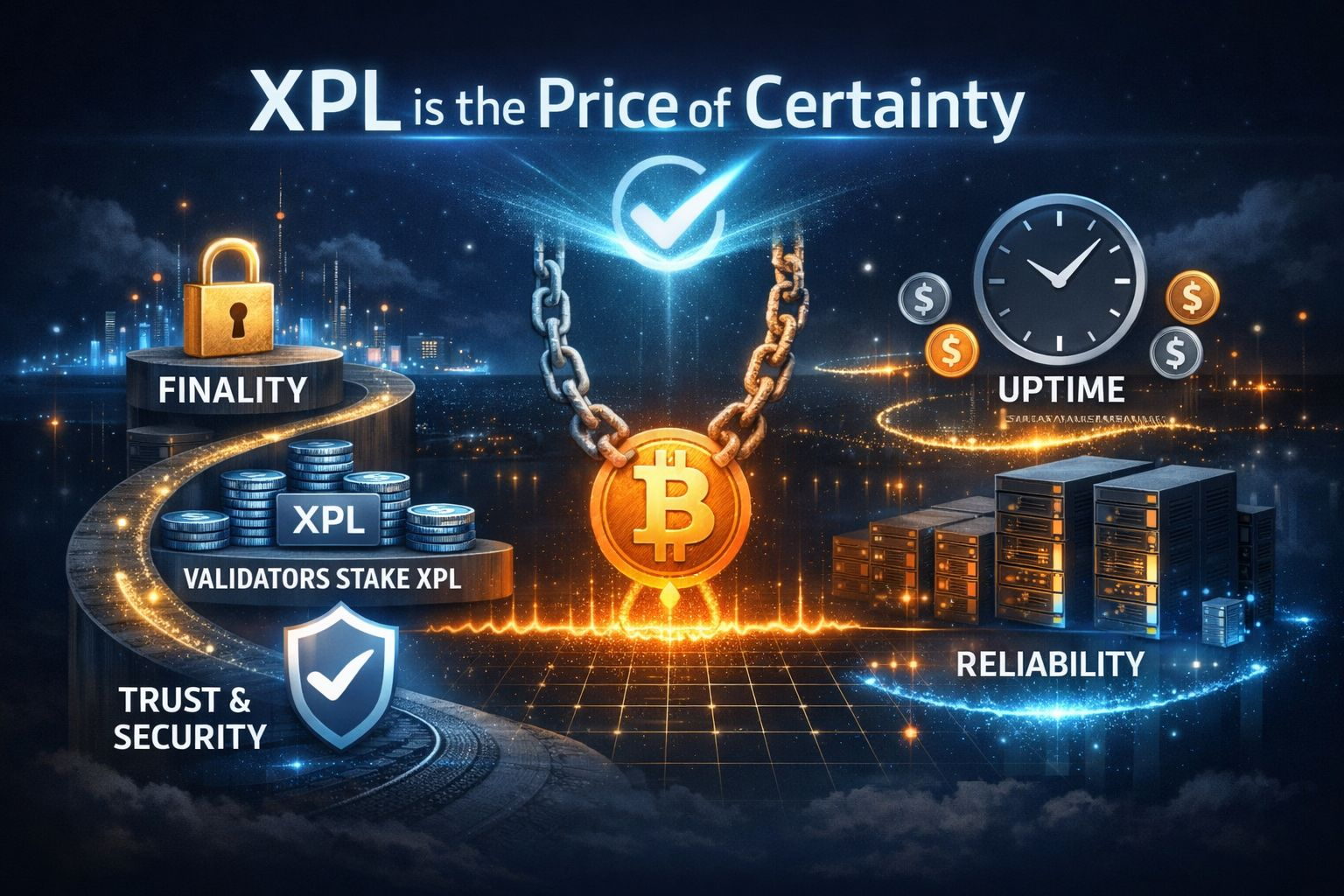
The way Plasma works is that being final is like making a promise. People who help make decisions called validators put up some of their XPL to be a part of this process. This XPL is, like a guarantee that the system will work as promised. If it was easy and cheap to change what has already been decided then saying something is final would not really mean anything it would just mean that something was confirmed quickly. It would not be very strong.
XPL makes reversals hurt the person who does them. The message from the network is that people can try to change what happened before. They will lose more than they can get back. This is what makes it important to have things finalized quickly. It is not just about how fast it happens but, about being believable. XPL is what makes this possible it gives credibility to the network. That is what matters, not just how fast something is done, but that XPL is there to make sure that reversals are self-inflicted damage.
When we talk about censorship resistance it is really the incentives that make a difference not the ideals that people have. Censorship resistance is something that people care about. It is the incentives that drive people to work on censorship resistance. The people who are working on censorship resistance do so because they have a reason, to and that reason is usually an incentive. In the case of censorship resistance incentives are what beat ideals because people are more likely to work on censorship resistance when they have something to gain. Censorship resistance is important. The incentives are what make people want to fight for censorship resistance.
Censorship resistance is not really about saying things like "we're against censorship". It is about making sure that censorship is something that people do not want to do. This is because when people try to censor something it should be an idea for them. Censorship should be a trade, for the people who are trying to do it.
When a stablecoin settlement network becomes important people will try to control what is added and what is not. The main thing to think about is this: what do validators risk losing if they leave out transactions?
When you have XPL at stake being selective does not seem like a policy anymore it seems like a risk. Validators who try to block or delay things or who only let some things happen are putting their position and the money they will make in the future in danger. Being neutral is not something people say they will do it is something that happens because it makes economic sense for the XPL. Validators have to be neutral with the XPL because it is good, for their earnings.
Plasma is connected to Bitcoin. That makes it more neutral. This connection is like a reference point that helps the network stay strong, against people trying to control it or put pressure on it. Plasma does not replace the reasons people use the network.. It makes it harder for people to secretly manipulate the system. Plasma and Bitcoin together make the system stronger.
Uptime: reliability as a financial obligation
Uptime is not about the people who do engineering work. Uptime is really, about being very disciplined.
People do not tolerate problems, with Payments like they do with apps. When it comes to money if Payments only work some of the time users will think of it as a risk not something they can count on. Payments need to work all the time or else users will lose trust in Payments.
XPL is really good at making sure that people who run the system are always available. These people, called Validators get paid when they are online and doing their job all the time. If they go offline they do not get. They might even lose some of their rewards. If they keep failing to do their job they will get in trouble. This is how XPL makes the network very strong and reliable like a bank that people can count on. It teaches the people who run the system that being reliable's the key to their success, with XPL.
The thing, about design is that it can be really subtle. When we make something we want it to be easy for the users to understand and use. So we give the users something.. The people who have to check that everything is working correctly the validators they have to deal with all the complicated stuff. The complexity is what the validators have to carry. This is what happens with the design choice, where users get simplicity and validators carry complexity.
Plasma has a way of thinking that puts stablecoins first. This means they make a separation between things that most other chains do not make as clear. Plasmas stablecoin-first thinking is really about keeping things separate which's different, from what most other chains do.
People should be able to move stablecoins without needing some token that can lose value quickly. If stablecoins are what we are using then using them should be simple and easy to understand. We need to make sure that when people use stablecoins they do not have to pay fees or deal with complicated things, like gas costs. Stablecoins should be easy to use. Not make people take on extra risk just to make a transaction with stablecoins.
That design choice raises a question: if people are not always using XPL then what is XPL actually doing?
The answer is: XPL is not mainly used for spending. It is the thing that supports the network when it is under a lot of pressure. XPL is what validators risk so that people who use stablecoins do not have to risk anything. XPL is like a safety net, for the network.
People want stablecoins to be really stable and something they can count on. They should be like a routine that's always the same so users do not have to worry about them. Stablecoins need to feel boring and dependable like something that is always going to be, for them, which is what users want from stablecoins.
People who check things called Validators get paid with something called XPL. This XPL is, like a reward to help them keep things from getting too exciting so things stay a little boring. The Validators are paid with XPL to keep that boredom intact which means they get XPL for helping to keep things calm and not too interesting.
This is infrastructure logic, not DeFi theater.
To really get what is going on we need an idea of things. XPL is like the price we pay when we trust something or someone. It is the cost of trust that we can actually see.
This cost of trust is something we should think about when we talk about XPL. XPL is the cost of trust that's right out, in the open so we can understand it better.
Most systems do not show the cost of trust. They make the users deal with the cost of trust in the form of uncertainty.. They use branding to make people think the cost of trust is not a problem. The cost of trust is still there, in systems.
Plasma is what makes the cost clear. The XPL is like a guarantee that makes it very expensive for the network to not keep its promises. This is what the XPL stake is, for it makes sure the network does what it says it will do.
The idea of something being final is believable because changing things later can be really painful. Finality is something that people think is okay because rewriting is hard. It hurts.
Neutrality is something that lasts because when you try to control what people can and cannot say it just does not make sense. Neutrality is a thing and it stays that way.
The uptime of the system is consistent because the reliability of the system is what allows validators to keep earning money. The validators need the system to be reliable so they can keep earning money. This is how validators keep earning it is, about the reliability of the system and the uptime of the system.
In a world where stablecoins are used to settle things the thing that really matters is not how quickly things get done. The feeling that you can trust it and walk away without worrying. The stablecoins are what give you this confidence so you can just walk away, with the stablecoins.
So the main thing is not to try and impress you it is to let the music or whatever it's let you forget about everything else the goal of the thing like music or something is to make you forget about all your worries the thing is supposed to make you feel like you are not thinking about anything that is what the goal of the thing, like music is.
The best payment systems are the ones you do not really think about. You just use the payment systems you trust the payment systems. Then you move on with your day. The payment systems are so good that you do not even notice the payment systems are there.
Plasma is trying to meet that standard. If it does work transferring stablecoins will not feel like something you do with crypto anymore. It will feel like a thing to do. You just send the money. You are done. Then you can forget about it. Plasma is really trying to make this happen with stablecoins.
XPL is what makes "forget" a thing, not a reckless one. The thing about XPL is that it is like a price, for being certain. This price is paid ahead of time by the validators.. It is the network that makes sure this price is enforced when it comes to XPL.
If Plasma succeeds the thing that will really show us it is working will not be all the excitement or the popular trends, on charts. Plasma will be the thing that people are talking about when they see that Plasma is actually doing well.
It will be silence—because nobody feels the need to check.