
The financial industry is entering a new chapter — an age when software agents execute trades, rebalance portfolios, manage treasuries, even help coordinate the flows of capital — all without human hands at all. The transition to autonomous finance offers efficiency, scale, and real-time responsiveness. But it also opens up a key challenge: How do we ensure predictability, safety, and trust with machines in control of the money? Vanar was constructed to solve this problem. Vanar offers autonomous finance as a deterministic rail platform, and this is paving the way for the programmable, verifiable, and reliable financial automation that can be implemented globally. This article examines why deterministic infrastructure is important, how Vanar tackles the question, and what this suggests for the world of decentralized financial systems. Automation isn’t new in finance. Algorithms run the show in trading desks, payment routing systems, and risk management platforms. But the vast majority of current products share three key weaknesses: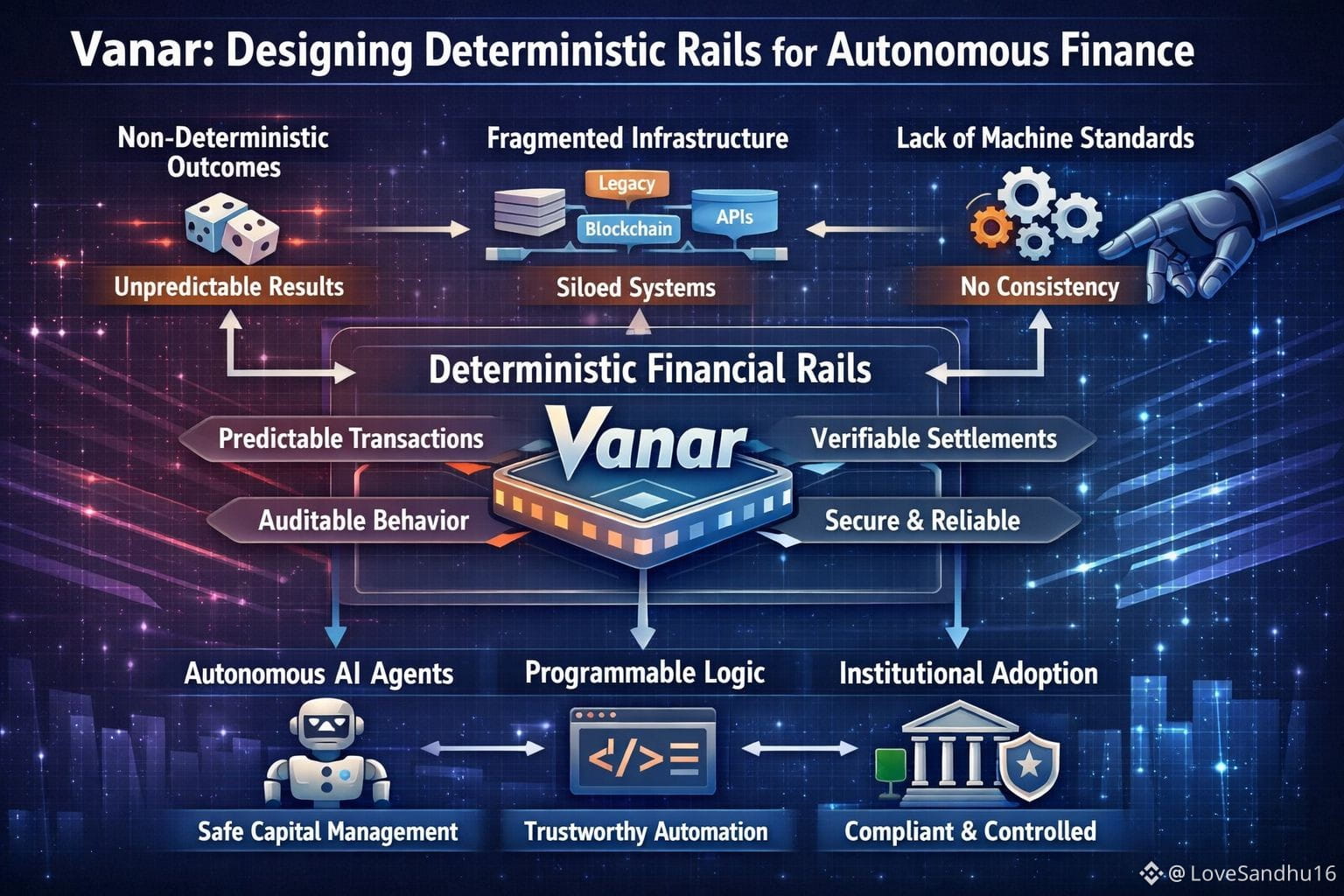
1. Non-Deterministic Outcomes. Most automated systems are run using probabilistic models with off-chain data dependencies or in opaque execution environments. This creates uncertainty:
The same action can yield different outcomes. Trying to debug failures becomes challenging. Auditing behavior is almost impossible at scale. In financial systems unpredictability means risk.
2. Fragmented Infrastructure. The financial stack of today splits around:
Legacy banking rails. Blockchain networks. Middleware services. Custodial platforms. Proprietary APIs. This fragmentation introduces friction, latency, and trust bottlenecks. Unified rails that can operate smoothly across environments are required for autonomous systems.
3. Absence of Machine-Native Standards. The majority of financial protocols were designed for humans. Autonomous agents require:
Machine-readable guarantees. Deterministic execution rules. Verifiable settlement logic. On-chain and off-chain interoperability. Without standardized rails, AI-powered finance is brittle and siloed.
What Are Deterministic Financial Rails? Determinism, at its core, means that given the same inputs, a system will always produce the same outputs. In finance, deterministic rails provide:
Predictable transaction execution. Verifiable settlement outcomes. Auditable system behavior. Decreased attack surface from novel states. Vanar is assembling infrastructure where finance automation isn’t just fast — it is provably reliable.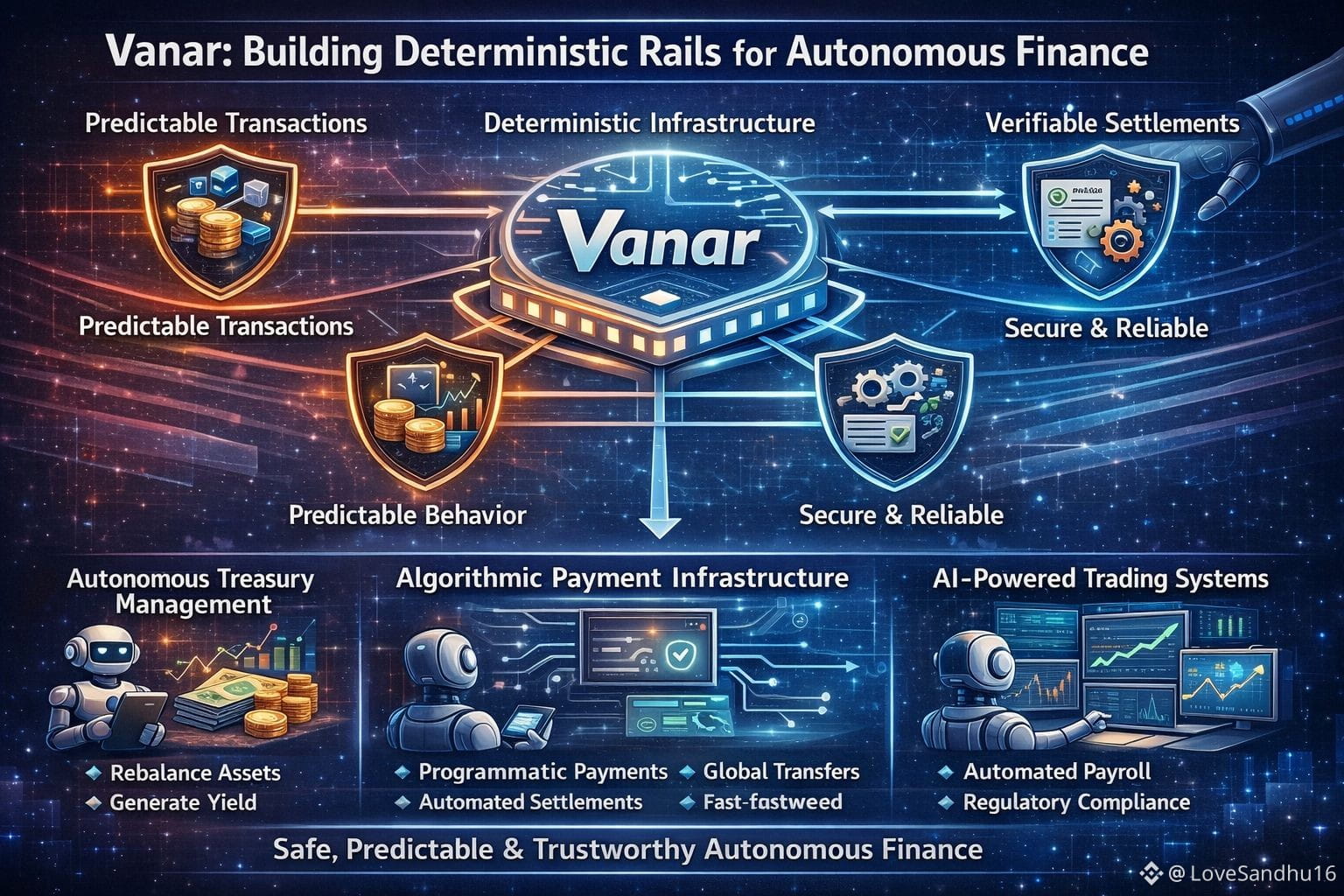
Vanar’s Vision: Automated Finance with Guarantees. Vanar aims to create a programmable financial layer providing mechanisms for:
AI agents to manage capital safely and with trust. Developers to confidently deploy automated financial logic. Institutions to be able to leverage decentralized automation without giving up compliance or control.
