
Vanar Chain started as a promise and is now shaping itself into a clear product direction. The team talks about an L1 that is built for AI workloads, for payments, and for real world assets. That is not marketing fluff. you can see the architecture and product names on the official site, and their public roadmap and event calendar show a deliberate push into developer tooling, hackathons, and ecosystem growth.
The core idea is simple and practical. instead of treating AI as an add-on, Vanar designed primitives that make semantic storage, vector similarity, and onchain indexing part of the chain itself. that changes the conversation from "can we bolt models on top" to "what kinds of apps become easy when the chain already understands and stores meaning." a recent deep dive that lays out a five layer approach explains how they split execution, semantic storage, and reasoning into distinct layers so each can scale and optimize independently. that technical split has direct product consequences for builders who want fast inference, persistent onchain memory, and cheaper semantic queries.
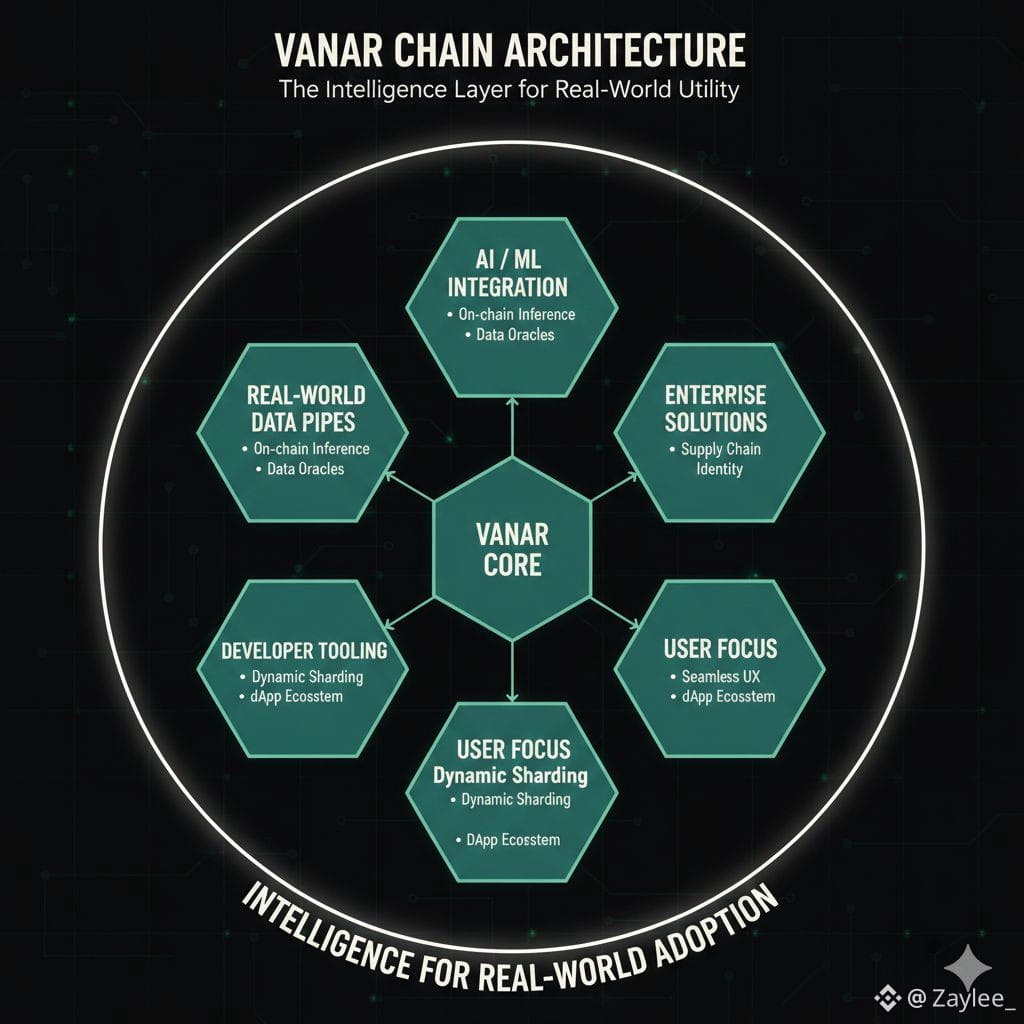
Products are already named and visible. Vanar lists the base chain, a Neutron layer that compresses and makes data queryable as "seeds", and Kayon which is positioned as a decentralized reasoning engine. there are also references to Axon and Flows as upcoming pieces, along with developer tools called Neutron/Kayon that the roadmap aims to expand in 2026. these are not theoretical components. they are in the public product catalog and in recent roadmap posts aimed at enterprise and consumer uptake.
On token and economic plumbing, the ecosystem is transitioning to a single native token, VANRY. Vanar published a clear token swap announcement that explains a one to one migration from an earlier token symbol to VANRY. that matters because it simplifies incentives, gas economics, and governance rollouts. market pages and aggregators are already reflecting VANRY liquidity and trading data, so the token is live in the open market and being priced by exchanges and trackers. if you trade or plan token-based integrations, treat VANRY as the operational token to watch.
Developer momentum is the signal to watch next. public calendars show global hackathon and conference events scheduled for early 2026, with prizes and developer grants aimed at driving real dapp experimentation. when a chain focuses public resources on developer velocity, the early winner is usually the ecosystem that turns small prototypes into tangible user features. Vanar’s documentation, staking products, and dedicated pages for builders lower the barrier to entry for teams that already know EVM tooling. that makes porting or prototyping faster than building from scratch.
Where this becomes strategically interesting is at the intersection of PayFi and real world assets. Vanar positions itself as an AI native chain that can also handle payment rails and tokenized real assets with low predictable gas and optional zero-cost brand integrations. that combination aims at real adoption paths where brands and payment flows matter more than raw transaction throughput. think payments, loyalty systems, and asset tokenization that need semantic search and predictable settlement. these are the use cases that could make Vanar attractive to companies that want blockchain benefits without constant gas surprises.
But the market angle is pragmatic and mixed. crypto media and exchanges report active price discovery, and aggregators call out Vanar’s roadmap as bullish for utility adoption. those writeups often extrapolate product announcements into price forecasts. that is normal. the right way to read it is this: roadmap clarity plus developer incentives produce optionality. optionality becomes value only if builders actually ship, users adopt, and integrations reduce friction. until then, expect volatility tied to announcements, listings, and onchain activity.
Two practical risks matter for anyone building with or investing in Vanar. first, the AI-onchain space is competitive. other chains and middleware projects aim to provide semantic layers or vector search as a service. Vanar’s edge is native integration, but native features also require rigorous audits, performance tuning, and convincing early enterprise users. second, token and economic design migrations always carry execution risk. a token swap needs clean execution, clear timelines, and minimal user confusion to avoid market friction. read the official swap documentation carefully and watch the onchain events.
For builders, here are tactical takeaways. prototype against the Neutron API if you need onchain semantic search. test your gas model with VANRY staking and the explorer tools to see real costs. join the hackathon waves and contribute to starter templates so you avoid reinventing basic adapters. and if your product mixes offchain models with onchain memory, plan for data compression and query budgets early, because those are the operational constraints that decide whether an app scales.
Narrative finally matters. Vanar is selling a move from “transactions only” to “intelligent state and memory.” if they can turn that into developer-first libraries and a small set of early enterprise wins, they can rewrite the value proposition from speculative token play to platform utility play. that is a harder path but the payoff is real. watch for measurable signals: developer retention, meaningful mainnet dapps, enterprise pilots, and onchain semantic queries per day. those will tell you if Vanar is delivering on engineering promises or just packaging ambition.
