


There’s a strange inefficiency baked into digital dollars. You hold USDT, an asset designed to mirror the US dollar. You send it to another wallet to pay, settle, or move funds. The operation is simple: one balance decreases, another increases. Yet on most blockchains, you first need to acquire and hold a volatile cryptocurrency that has nothing to do with the transaction itself.
This isn’t just a UX annoyance. It’s an architectural mismatch. Ethereum’s gas model made sense for a world computer executing arbitrary code. Paying in ETH to consume computation was logical. But when the dominant activity becomes settlement rather than computation, that model starts taxing the very use case stablecoins were supposed to simplify.
The costs hide in layers. There’s the acquisition cost of gas tokens through exchanges, often involving fees and extra steps. There’s volatility risk, where transaction costs drift not because usage changed but because the gas asset’s price did. Then there’s operational overhead. Businesses accepting stablecoins must monitor gas balances, automate top-ups, and reconcile gas expenses separately. Treasury teams don’t want to become part-time gas traders just to move dollar balances.
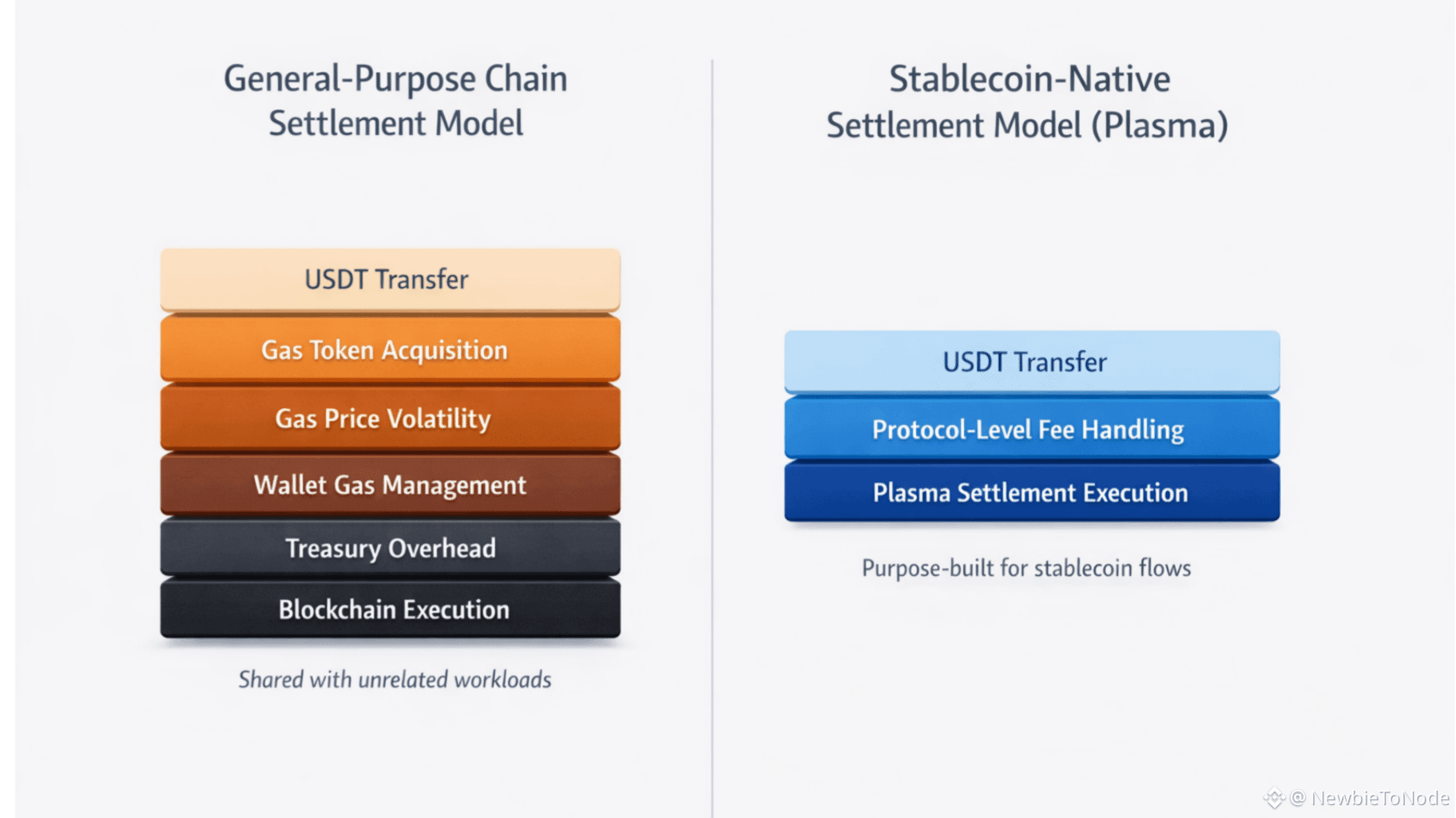
For retail users in emerging markets, the friction hits differently. Someone earning in USDT to escape local currency volatility doesn’t want exposure to ETH price swings. They want stable value. But to actually use those funds, they must estimate gas, track another token, and learn mechanics that have nothing to do with digital dollars. That cognitive load quietly limits who stablecoins really serve.
Plasma’s gasless USDT model removes that entire layer. Transfers execute without users holding XPL for fees. The network still validates and processes transactions, but those mechanics stay at the protocol level. For users, the experience finally matches the promise: you have digital dollars, you send digital dollars, the recipient receives digital dollars.
Settlement infrastructure scales through predictability. Payment processors don’t choose rails based on maximum smart contract flexibility. They ask simpler questions: what will transfers cost, how fast do they finalize, and what dependencies do users inherit? If the answer includes managing volatile gas assets, integration complexity rises immediately.
Legacy payment rails remain dominant partly because their costs are known. Card networks publish merchant fees. Wire transfers have fixed pricing. The fees might be high, but they’re predictable. Blockchain systems that price settlement in volatile assets reintroduce uncertainty at the worst possible layer.
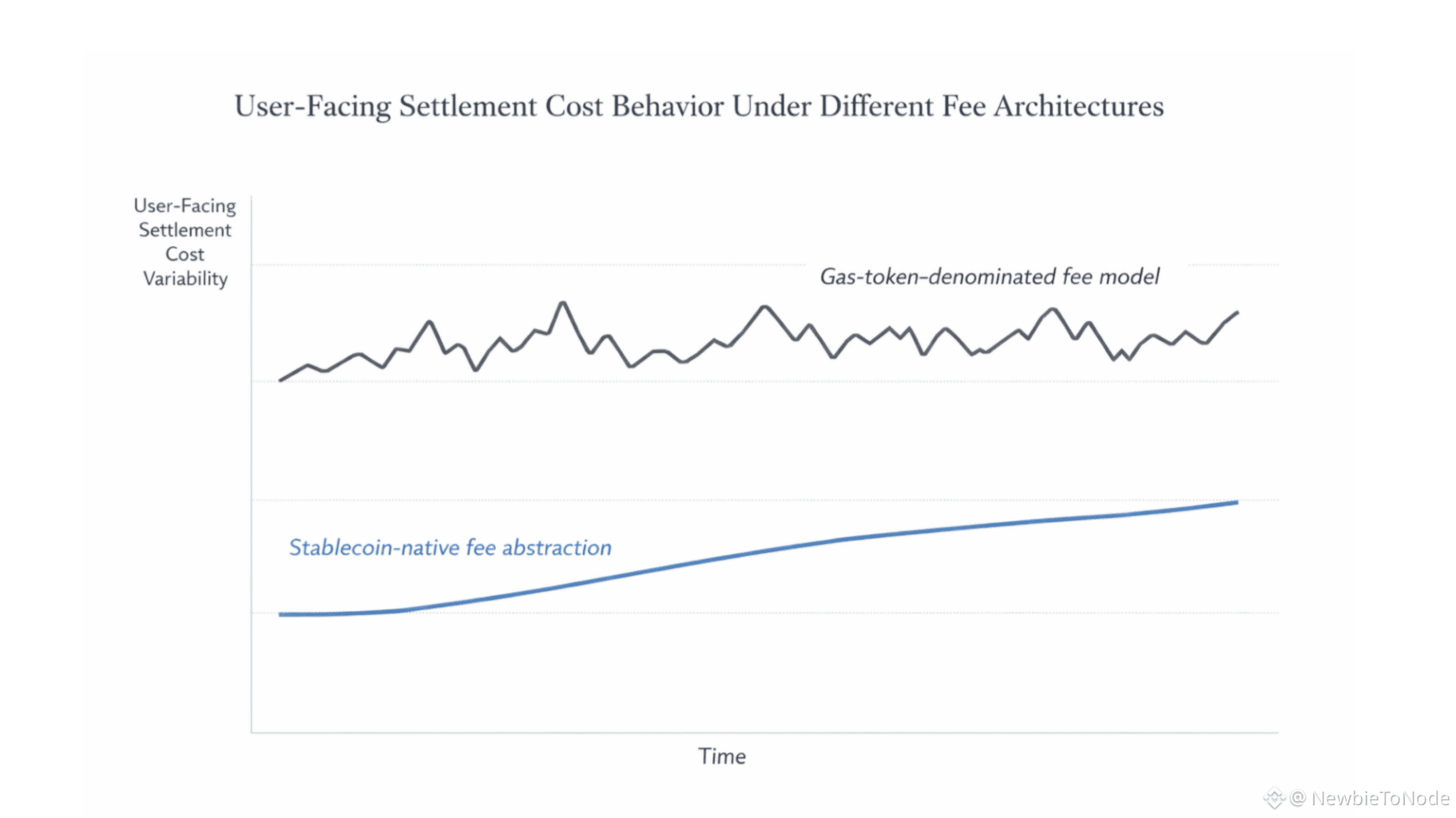
The institutional lens makes this sharper. Corporate treasuries moving stablecoins across wallets, reconciling transactions, and automating payments cannot operate on infrastructure where costs spike due to NFT mints or airdrops. That risk has nothing to do with treasury operations, yet they inherit it by sharing rails with unrelated workloads.
Specialized settlement infrastructure addresses this by separating concerns. Plasma allows USDT transfers to operate with stable economics while heavier computation pays fees in XPL. That distinction reflects how users think. Someone executing a complex DeFi strategy expects to pay for computation. Someone sending money expects a small, predictable cost. Forcing both through the same pricing model is like paying highway tolls in airline miles — technically possible, operationally absurd.
Speed reinforces the model. PlasmaBFT delivers sub-second finality, meaning transfers become irreversible almost immediately. That certainty matters when payments represent exchanged value: goods delivered, salaries paid, invoices closed. Waiting through probabilistic confirmations introduces ambiguity that payment systems try to eliminate.
The deeper issue is the difference between platforms and infrastructure. Platforms maximize optionality. Infrastructure optimizes reliability for a specific function. TCP/IP doesn’t experiment with packet delivery models. DNS doesn’t offer multiple domain resolution methods. They do one job consistently. Stablecoin settlement needs that same design discipline.
The market has already chosen. Stablecoin transfer volumes dominate blockchain activity because users want dollar-denominated digital cash that moves efficiently. The infrastructure should reflect that reality instead of treating settlement as background traffic.
Plasma represents a straightforward thesis: stablecoin settlement deserves purpose-built rails. Gasless user flows for the core use case. Predictable costs. Immediate finality through PlasmaBFT. Bitcoin-anchored security for neutrality. Full EVM compatibility through Reth so adoption doesn’t mean abandoning existing systems. Each decision optimizes for settlement, not for being everything to everyone.
The invisible tax on dollar stability isn’t inevitable. It’s a byproduct of using infrastructure built for other priorities. Purpose-built settlement rails remove that tax, letting digital dollars move with the simplicity they promised, on systems designed for that movement from the start.


