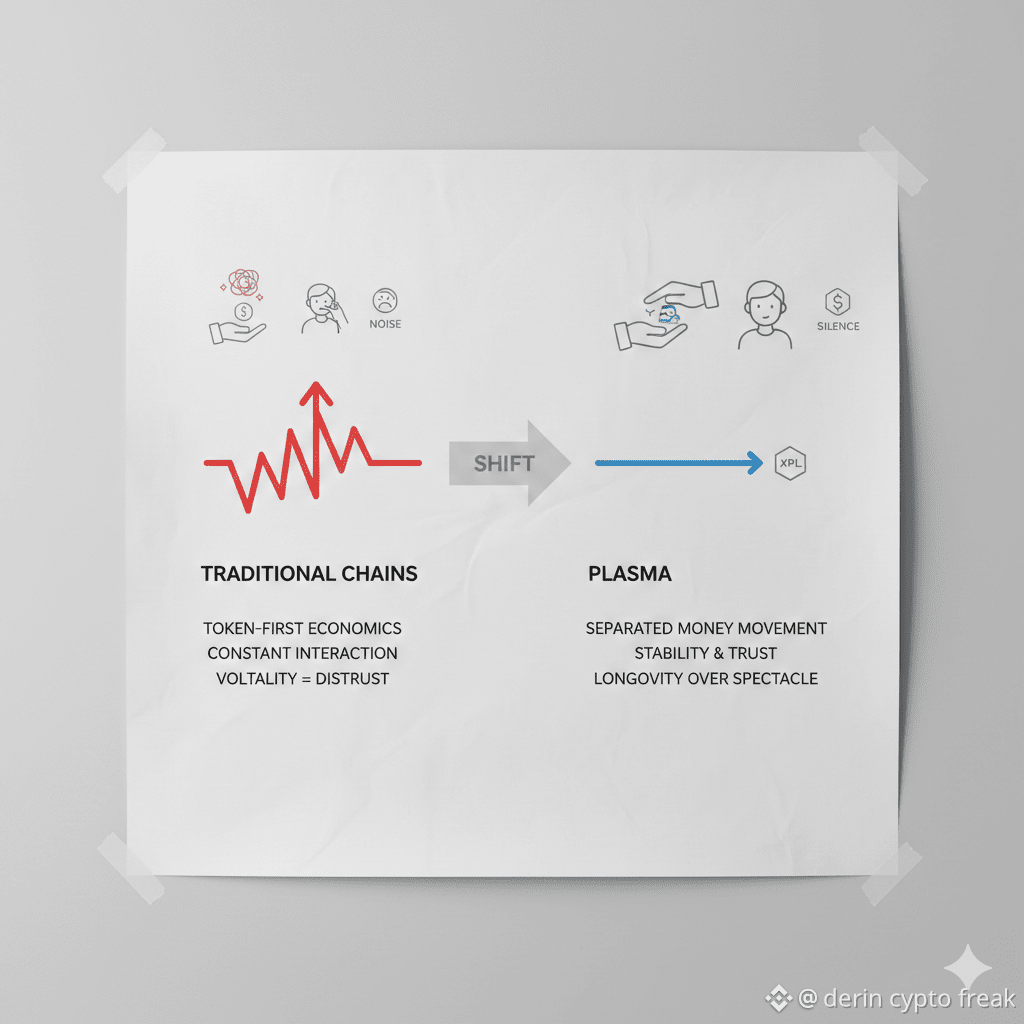
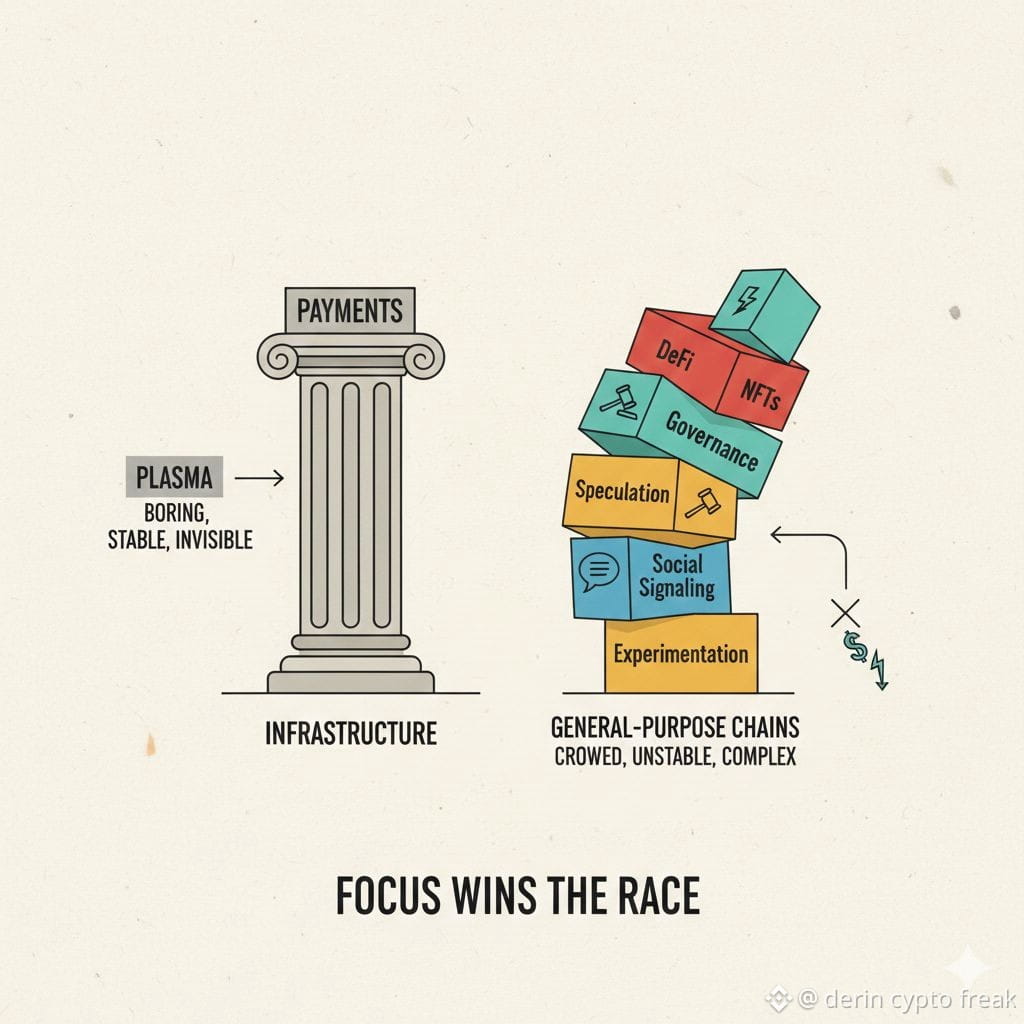
Most blockchains didn’t fail at payments because they were slow. They failed because they tried to be everything at once. When a network attempts to optimize for DeFi, NFTs, speculation, governance experiments, and social signaling simultaneously, payments stop being the core and become just another crowded feature. Attention, incentives, and reliability all get diluted.
Plasma starts from a different premise: payments are not a product vertical, they are infrastructure. And real infrastructure works best when it is boring, stable, and invisible. The less users notice it, the better it’s doing.
That single assumption explains nearly every design decision Plasma makes.
Why General-Purpose Chains Struggle With Money
On most chains today, stablecoins live on top of systems built for experimentation. Fees fluctuate constantly. Execution depends on network sentiment. Ironically, users must often hold volatile assets just to move something meant to be stable.
That setup is excellent for trading and speculation—but terrible for money. Plasma doesn’t attempt to patch this problem with extra layers or clever abstractions. Instead, it narrows the scope and focuses on getting value transfer right at the base level first. This is not a missing feature; it’s a conscious refusal to overextend.
Removing Decisions From the User
One of Plasma’s more subtle innovations is its belief that users shouldn’t need to “decide” how to send money.
On most blockchains, users are forced to think about timing, gas prices, token balances, and execution risk. Plasma treats this as a design failure, not user responsibility. Through predictable settlement, abstracted fees, and stabilized execution, the protocol absorbs complexity instead of exposing it.
This mirrors traditional payment rails. Their success wasn’t purely technical—it was social. They worked because people didn’t have to think.
Why Zero-Fee Transfers Change Behavior
Zero-fee stablecoin transfers aren’t just about being cheaper. They fundamentally alter how money is used.
When users stop mentally accounting for fees, transfers stop feeling like events and start feeling like habits. This matters far more than raw speed claims. Remittances, payroll, treasury movements, and everyday transfers all depend on predictability and psychological ease, not micro-optimizations.
Plasma internalizes this logic. If stablecoins are meant to behave like cash, fee anxiety cannot exist at the user level.
Ethereum Compatibility Without Ethereum’s Tradeoffs
Plasma’s EVM compatibility isn’t about attracting developers through hype. It’s about avoiding isolation. Existing tools and applications can migrate or integrate without friction.
At the same time, Plasma does not inherit Ethereum’s congestion patterns or fee volatility by default. It selectively borrows compatibility while rejecting inefficiency. The result is coexistence without compromise.
A Quiet Token by Design
The handling of XPL reveals Plasma’s priorities clearly. The token exists to secure the network, align validators, and support governance—not to demand constant user interaction.
This is a rejection of token-first economics. Plasma assumes that forcing users to engage with volatility undermines trust in a payment system. By separating money movement from token exposure, the protocol reinforces stability rather than distracting from it.
Why Plasma Won’t Chase Attention
Plasma is unlikely to dominate headlines or social feeds. Its success shows up as consistency, low friction, and routine usage—not viral metrics.
That means growth will look slow from the outside. But payment infrastructure that scales too fast often collapses under its own incentive structures. Plasma intentionally sacrifices spectacle for longevity.
The Risk It Chooses to Take
Focus is Plasma’s strength—and its risk. By centering stablecoins and payments, it narrows its exposure. Regulatory pressure or shifts in market priorities could force adaptation.
Plasma doesn’t deny this risk. It accepts it deliberately, instead of hedging with every possible narrative.
It isn’t trying to win the attention race.It’s trying to finish the race.
Payments, in Plasma’s view, are not entertainment. They are neutral systems meant to be trusted. And trust is built not through noise—but through absence of it.