

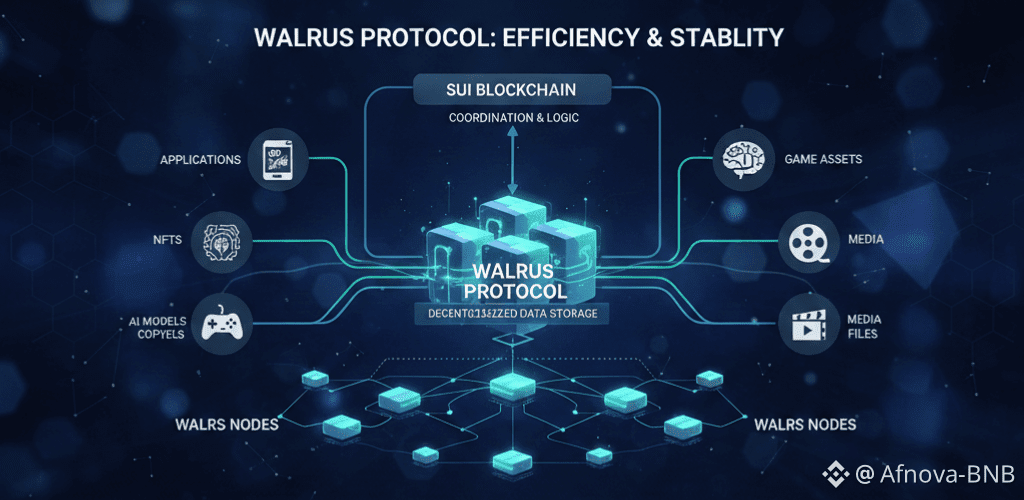
Hello My Square Family Afnova Here to explain about the @Walrus 🦭/acc Network. When we look around the crypto space today, we see faster blockchains, cheaper transactions, and more complex apps, but we rarely talk about where all the data actually lives. NFTs, AI models, game assets, and media files are getting bigger every year. In my knowledge, storing all this directly on blockchains is unrealistic and extremely expensive. Walrus starts exactly from this reality. They accept that blockchains should coordinate and verify, not store massive files themselves.
As I kept researching, I realized Walrus is not trying to replace blockchains. They work alongside them, especially with Sui. This design choice says a lot. Instead of building another heavy chain, Walrus lets Sui handle coordination and logic, while Walrus nodes focus purely on storing data. In my view, this separation is smart because each system does what it is best at. Sui moves fast and manages state, Walrus quietly holds the data safely.
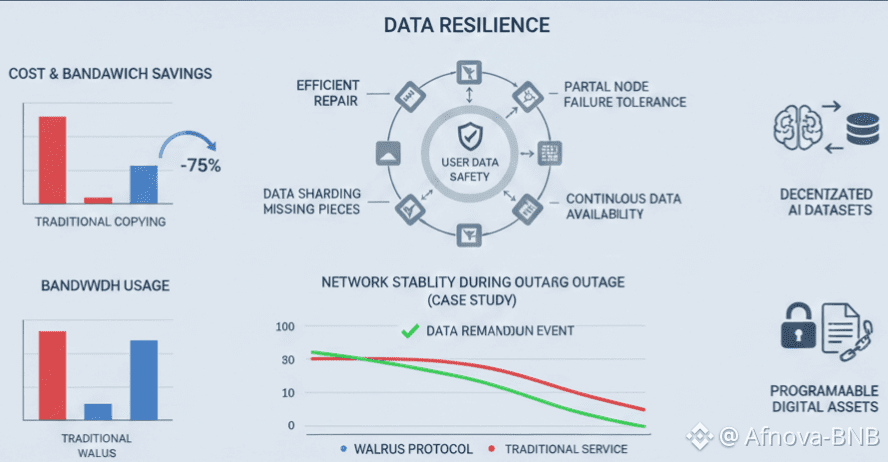
What really caught my attention is how Walrus stores data differently. We read about many storage networks that simply copy files again and again across nodes. That works, but it wastes a huge amount of space and money. From what I understand, Walrus uses a very advanced method where data is split and spread in a way that allows recovery even if many nodes disappear. I tell you honestly, this is one of those designs that looks boring on the surface but is very powerful underneath.
In my research, I learned that Walrus does not need to fully rebuild a file when a small part is lost. Instead, it only repairs the missing piece. This saves bandwidth, time, and cost. Over a long period, this kind of efficiency is what keeps a network alive. This is also why, in my opinion, Walrus can scale without becoming too expensive for users.
We also saw a real-world test of this system recently. When a popular storage service built on top of Walrus shut down, many people expected data loss or chaos. But what we saw instead was stability. User data remained safe and could be moved elsewhere. In my knowledge, this is the true test of decentralization. When one company fails and the system keeps running, the design has done its job.
Another thing I appreciate is how Walrus fits into the future of AI. We read everywhere that decentralized AI needs access to large datasets. Models cannot train or operate without reliable storage. From my understanding, Walrus is slowly becoming the place where this data can live without relying on centralized servers. That makes it more than just storage. It becomes a foundation for autonomous systems.
I also want to mention how Walrus feels very developer-friendly. Because it works closely with Sui, data can be owned, transferred, and even traded like digital assets. In my view, this opens doors for entirely new business models. Files are no longer just files. They become programmable objects that can be rented, sold, or shared in controlled ways.
When I step back and look at Walrus as a whole, I do not see a loud project. I see a quiet backbone forming. In my experience, the most important infrastructure rarely gets attention early. It becomes visible only when everyone depends on it. Walrus feels like it is moving in that direction.
So I tell you this honestly. Walrus is not about hype, quick gains, or flashy promises. It is about durability, efficiency, and long-term thinking. If decentralized apps, AI, and digital ownership continue to grow, then storage becomes non-negotiable. And in my opinion, Walrus is positioning itself to be one of the systems people rely on without even thinking about it.

